Canada Warbler (Plate 103)
Audubon's “Canada Warbler”, The Birds of America, plate CIII
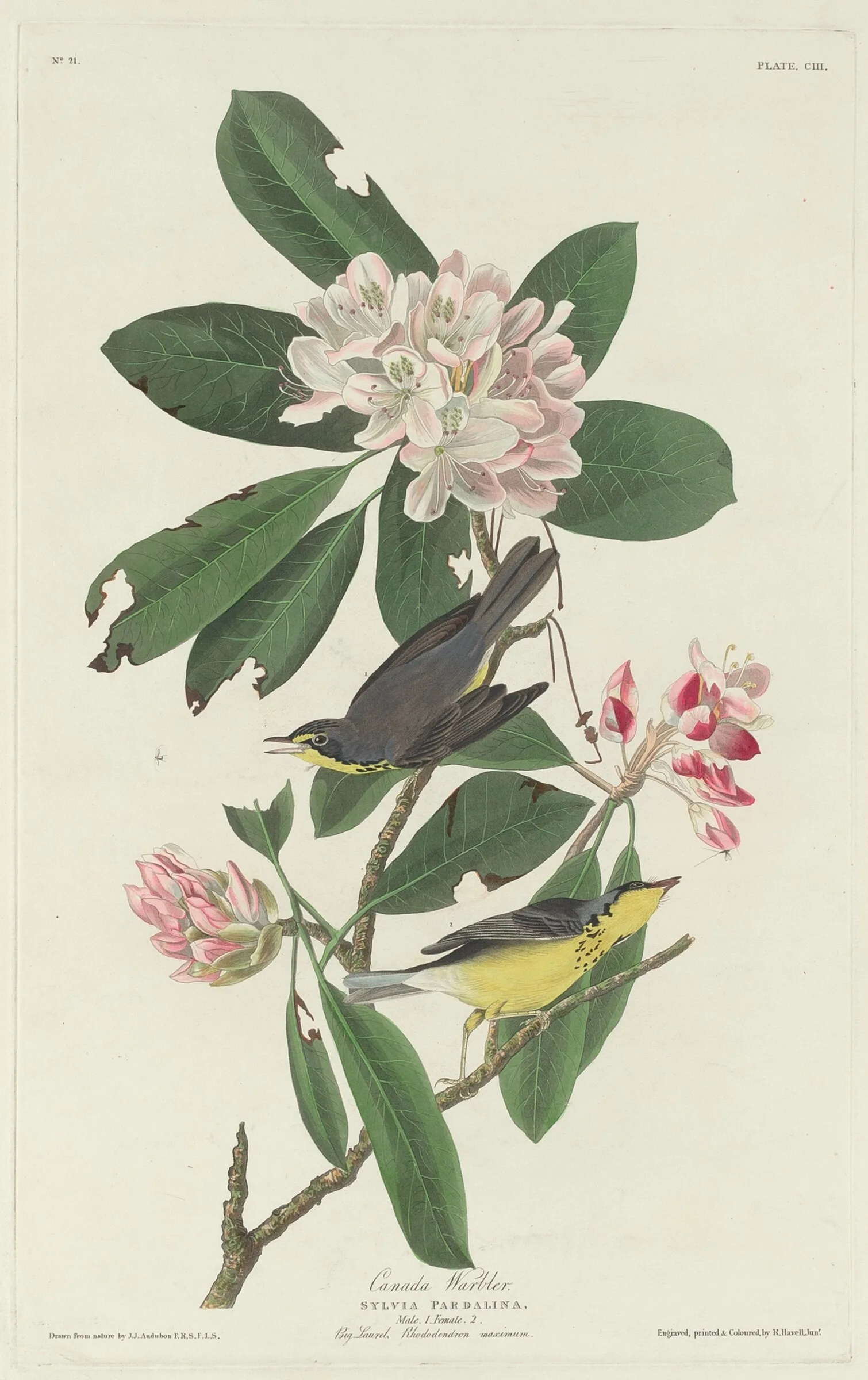
Click or press Enter to enlarge
Open the full-resolution image (2398 px, National Gallery of Art)
| Plate | 103 (CIII) |
|---|---|
| Audubon's name | Canada Warbler |
| Modern name | Canada Warbler |
| Scientific name | Cardellina canadensis |
| Status | Least Concern |
| Engraved by | Robert Havell, after Audubon's watercolor |
| Date | 1831 |
| Medium | Hand-colored engraving and aquatint on Whatman wove paper |
| Plants and setting | Great laurel, or rosebay rhododendron (Rhododendron maximum) |
| Collections | Songbirds |
| This impression | National Gallery of Art, Washington, 1945.8.103; Gift of Mrs. Walter B. James |
About this plate
Plate 103 shows a male and female Canada Warbler among the pink and white flowers of great laurel, or rosebay rhododendron. The male is grey above and yellow below, with a necklace of black streaks across the breast and a bold eye ring; the female is plainer. Audubon opened the chapter with a reverie on laurel thickets along mountain streams, with trout below and warblers moving through the leaves.
In the text Audubon called the bird the Canada Flycatcher, following Wilson, and placed it among the flycatchers because of the bristles at the base of its bill. He said a comparison with his plate of the Bonaparte Flycatcher, plate 5, would prove the two were distinct. It does not: the Bonaparte Flycatcher is now identified as a Canada Warbler too, painted in a different plumage.
The Canada Warbler breeds in moist, shrubby forest across Canada, the northeastern United States and south along the Appalachians, often in rhododendron thickets like the one in the plate. It forages actively, often catching insects in flight. It winters in the Andes of northern South America and is one of the last warblers to arrive in spring. Its population has declined substantially since the 1960s, although it is still listed as Least Concern.
In Audubon's words
Methinks I see the timid trout eyeing my movements from beneath his rocky covert, while the warblers and other sylvan choristers, equally fond of their wild retreats, are skipping in all the freedom of nature around me. Delightful moments have been to me those when, seated in such a place, with senses all intent, I gazed on the rosy tints of the flowers that seemed to acquire additional colouring from the golden rays of the sun, as he rode proudly over the towering mountains, drawing aside as it were the sable curtain that till now hung over the landscape, and drying up, with the gentleness of a parent towards his cherished offspring, the dewy tears that glittered on each drooping plant. Would that I could describe to you the thoughts that on such a morning have filled my whole soul; but alas, I have not words wherewith to express the feelings of gratitude, love, and wonder that thrilled and glowed in my bosom!
John James Audubon, Ornithological Biography, vol. 2 (1834), “The Canada Flycatcher”. Read the full chapter.



