Chipping Sparrow (Plate 104)
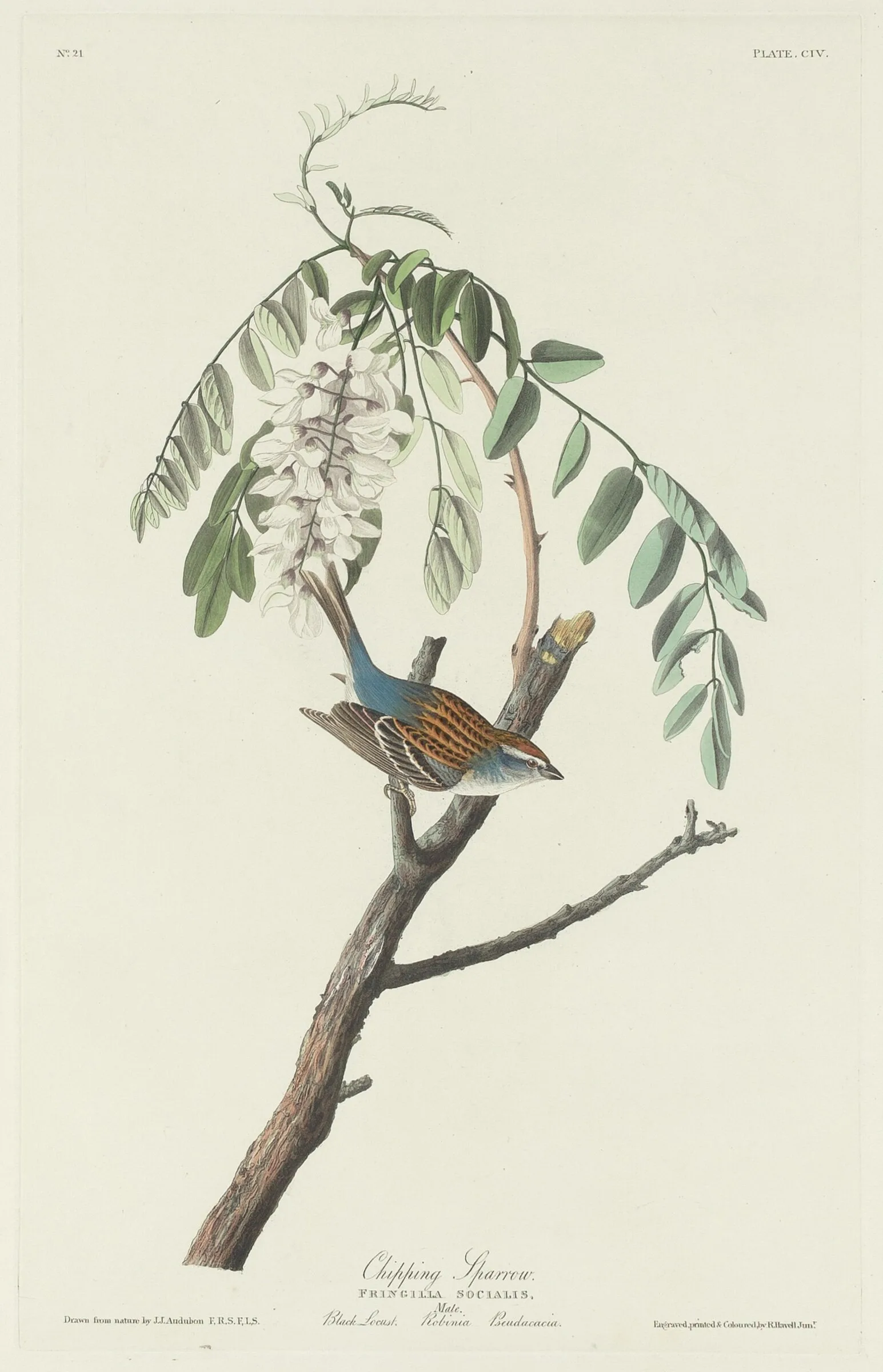
Audubon's “Chipping Sparrow”, The Birds of America, plate CIV
Click or press Enter to enlarge
Open the full-resolution image (2366 px, National Gallery of Art)
| Plate | 104 (CIV) |
|---|---|
| Audubon's name | Chipping Sparrow |
| Modern name | Chipping Sparrow |
| Scientific name | Spizella passerina |
| Status | Least Concern |
| Engraved by | Robert Havell, after Audubon's watercolor |
| Date | 1831 |
| Medium | Hand-colored engraving and aquatint on Whatman wove paper |
| Plants and setting | Black locust (Robinia pseudoacacia) |
| Collections | Songbirds |
| This impression | National Gallery of Art, Washington, 1945.8.104; Gift of Mrs. Walter B. James |
About this plate
Plate 104 shows Chipping Sparrows on a branch of black locust with hanging clusters of white flowers. Audubon noted that the tree grows wild in the mountains from Canada to Carolina, that its tough, lasting wood was used for gates and fence stakes, and that it was planted around farms and along village streets.
He called the Chipping Sparrow one of the commonest birds in the United States, living in towns, orchards, gardens and field edges. He described its social habits in winter, when it joins Song, White-throated, Savannah and Field Sparrows in mixed flocks, and its visits to sunny sandy roads to pick seeds from dung. By early May it builds a small, slender nest in an orchard tree, bush or cedar, never on the ground, and it often raises two broods south of Pennsylvania.
The Chipping Sparrow breeds from Canada to Central America, in open woods, parks, suburbs and farmyards, and is one of the most familiar birds of lawns and gardens. Breeding adults have a bright rusty cap and black eye line, and the song is a dry, rapid trill. The nest was traditionally lined with horsehair, which gave it the old name hair-bird. It is listed as Least Concern.
In Audubon's words
Early in May the Chipping Sparrow has already formed its nest, which it has placed indifferently in the apple or peach tree of the orchard or garden, in any evergreen bush or cedar, high or low, as it may best suit, but never on the ground. It is small and comparatively slender, being formed of a scanty collection of fine dried grass, and lined with horse or cow hair. The eggs are four or five, of a bright greenish-blue colour, slightly marked with dark and light-brown spots, chiefly distributed towards the larger end. They are more pointed at the small end than is common in this genus. Although timorous, these birds express great anxiety when their nest is disturbed, especially the female. They generally raise two broods in the season, south of Pennsylvania, and not unfrequently in Virginia and Maryland.
John James Audubon, Ornithological Biography, vol. 2 (1834), “The Chipping Sparrow”. Read the full chapter.



