Red-breasted Nuthatch (Plate 105)
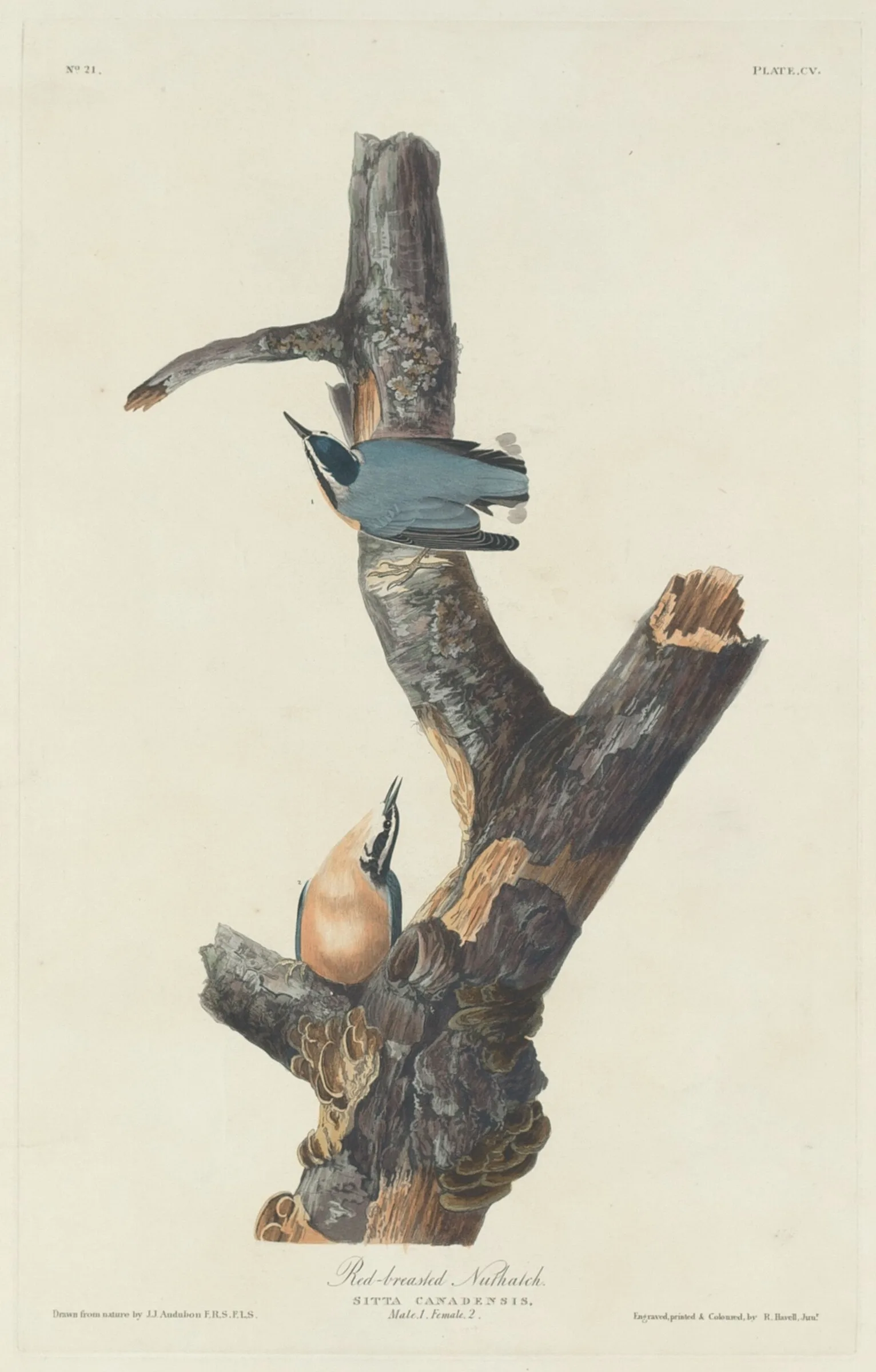
Audubon's “Red-breasted Nuthatch”, The Birds of America, plate CV
Click or press Enter to enlarge
Open the full-resolution image (2227 px, National Gallery of Art)
| Plate | 105 (CV) |
|---|---|
| Audubon's name | Red-breasted Nuthatch |
| Modern name | Red-breasted Nuthatch |
| Scientific name | Sitta canadensis |
| Status | Least Concern |
| Engraved by | Robert Havell, after Audubon's watercolor |
| Date | 1831 |
| Medium | Hand-colored engraving and aquatint on Whatman wove paper |
| Collections | Songbirds |
| This impression | National Gallery of Art, Washington, 1945.8.105; Gift of Mrs. Walter B. James |
About this plate
Plate 105 shows a male and female Red-breasted Nuthatch, small blue-grey climbers with a black cap, white eyebrow and black eye line, and rusty underparts that are paler in the female. Audubon called the species the Red-bellied Nuthatch in the text.
Audubon wrote that it divides the country with the Brown-headed Nuthatch, which lives in the South, and is most common from Pennsylvania's mountains north to Maine and Nova Scotia. He saw none in Newfoundland and only one in Labrador. Near Eastport, Maine, on 19 May, he found a pair digging a nest hole in a low dead stump, about fourteen inches deep, taking turns at the work. He described its quick movement up and down branches, rapping the bark and pulling off flakes for insects, and sleeping head downward.
The Red-breasted Nuthatch breeds in coniferous and mixed forest across Canada, the northeastern states and the western mountains. It smears sticky conifer resin around its nest entrance, which may deter predators and competitors. In years when cone crops fail in the north, large numbers move south in irruptions and appear at feeders far beyond the usual winter range. Its nasal call has been compared to a toy tin horn. It is listed as Least Concern.
In Audubon's words
The activity and industry of this little creature are admirable. With the quickness of thought it moves up and down the branches of trees, assuming various positions, examining every hole or cranny in the bark, frequently rapping against it with its bill, and detaching now and then small fragments, in order to get at the insects or larvæ concealed beneath. It searches for its food among the leaves of the tallest pines, along the fences, and on the fallen logs, ever busy, petulant, and noisy, probably never resting except during the night, when, like other species of the tribe, it attaches itself by the feet to the bark, and sleeps head downwards. Like other birds of this genus also, it is careless of man, although it never suffers him to form too close an acquaintance.
John James Audubon, Ornithological Biography, vol. 2 (1834), “The Red-bellied Nuthatch”. Read the full chapter.



