Black Vulture (Plate 106)
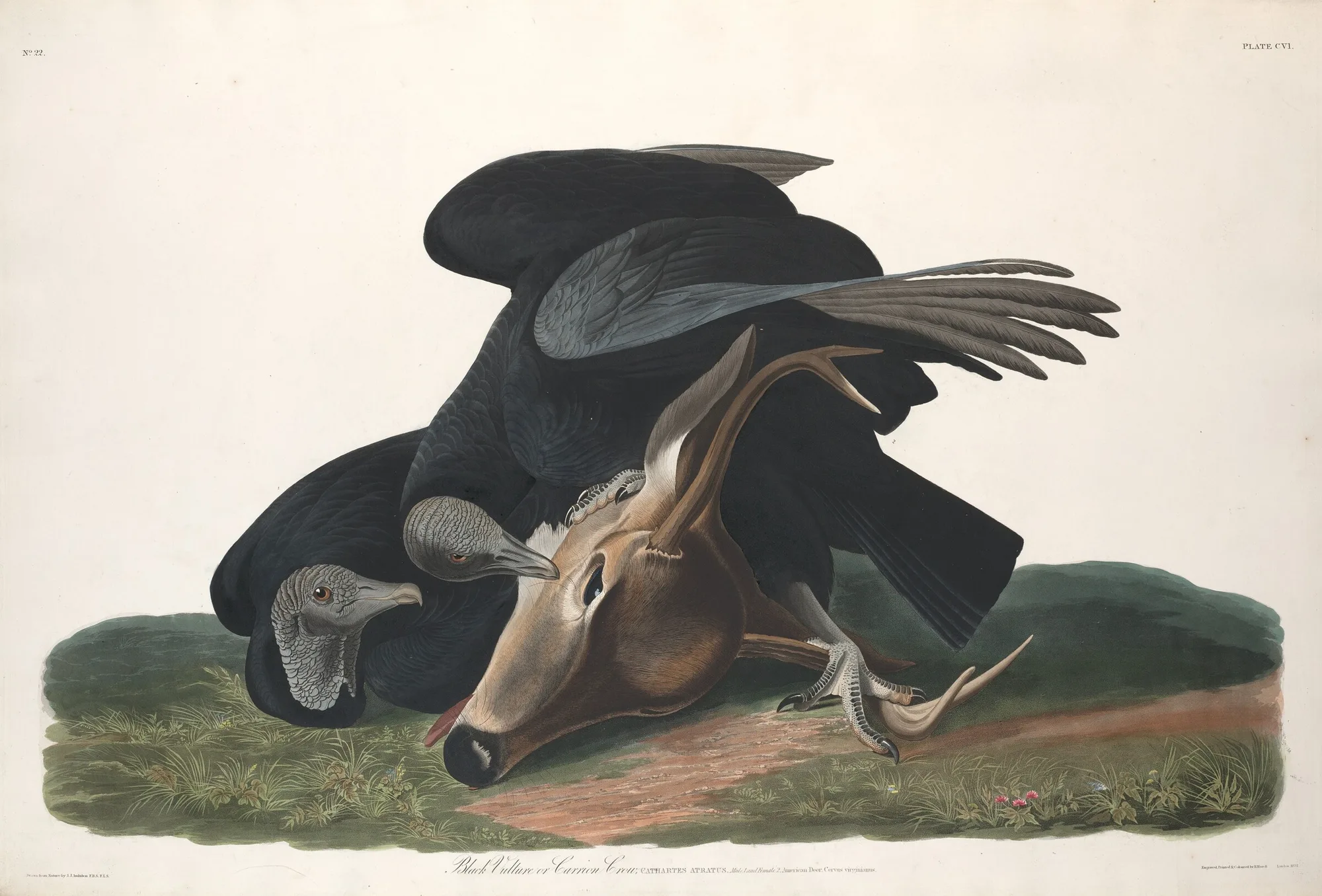
Audubon's “Black Vulture”, The Birds of America, plate CVI
Click or press Enter to enlarge
Open the full-resolution image (4492 px, National Gallery of Art)
| Plate | 106 (CVI) |
|---|---|
| Audubon's name | Black Vulture |
| Modern name | Black Vulture |
| Scientific name | Coragyps atratus |
| Status | Least Concern |
| Engraved by | Robert Havell, after Audubon's watercolor |
| Date | 1831 |
| Medium | Hand-colored engraving and aquatint on Whatman wove paper |
| Collections | Hawks, Eagles and Falcons |
| This impression | National Gallery of Art, Washington, 1945.8.106; Gift of Mrs. Walter B. James |
About this plate
Plate 106 shows a pair of Black Vultures, black with bare grey heads and white patches near the wing tips, feeding at the head of a deer. Audubon's heading gives the old southern name, Carrion Crow.
Most of the chapter reprints a paper Audubon had read to the Wernerian Natural History Society in Edinburgh, arguing that vultures find food by sight, not smell. He described experiments in which he stuffed a deer skin with dry grass and laid it in an open field. A vulture landed, attacked the painted clay eyes and tore open the seams, then flew off, but soon spotted a small garter snake at a distance and swallowed it. In a second test he hid a dead hog under cane in a ravine in July; vultures passed over it for two days without finding it, though dogs fed on it.
Audubon wrote the chapter about the Turkey Vulture as well as the Black Vulture, and his conclusion was only half right. The Turkey Vulture has a keen sense of smell and can find carcasses hidden under forest canopy. The Black Vulture has a much weaker sense of smell and often finds food by watching Turkey Vultures. Black Vultures range from the eastern United States to South America and have spread north in recent decades. The species is listed as Least Concern.
In Audubon's words
I then retired about a hundred yards, and in the lapse of some minutes, a Vulture, coursing round the field tolerably high, espied the skin, sailed directly towards it, and alighted within a few yards of it. I ran immediately, covered by a large tree, until within about forty yards, and from that place could spy the bird with ease. He approached the skin, looked at it with apparent suspicion, jumped on it, raised his tail, and voided freely (as you well know all birds of prey in a wild state generally do before feeding),—then approaching the eyes, that were here solid globes of hard, dried, and painted clay, attacked first one and then the other, with, however, no farther advantage than that of disarranging them.
John James Audubon, Ornithological Biography, vol. 2 (1834), “The Black Vulture or Carrion Crow”. Read the full chapter.