Northern Harrier (Plate 356)
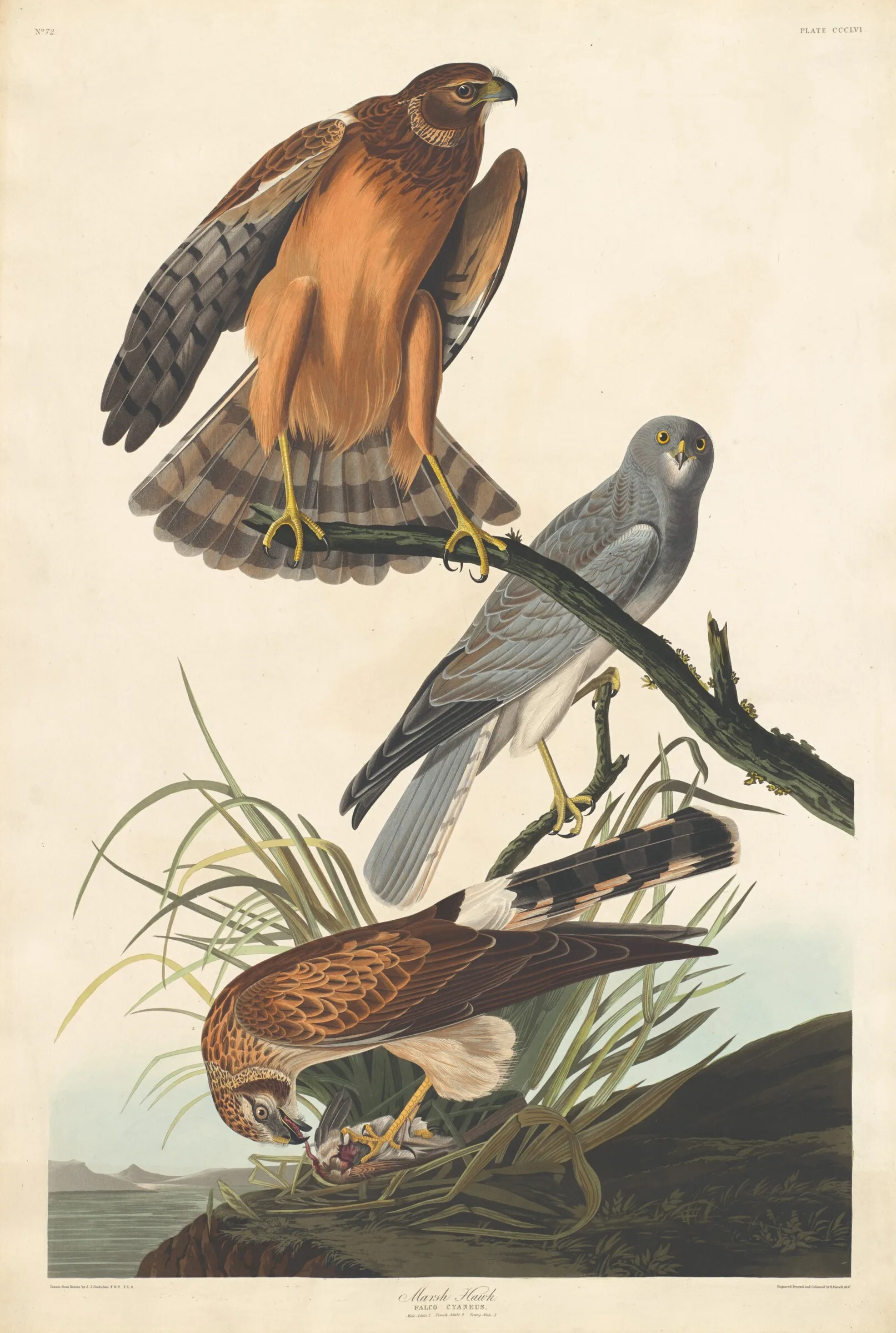
Audubon's “Marsh Hawk”, The Birds of America, plate CCCLVI
Click or press Enter to enlarge
Open the full-resolution image (5478 px, National Gallery of Art)
| Plate | 356 (CCCLVI) |
|---|---|
| Audubon's name | Marsh Hawk |
| Modern name | Northern Harrier |
| Scientific name | Circus hudsonius |
| Status | Least Concern |
| Engraved by | Robert Havell, after Audubon's watercolor |
| Date | 1837 |
| Medium | Hand-colored engraving and aquatint on Whatman wove paper |
| Collections | Hawks, Eagles and Falcons |
| This impression | National Gallery of Art, Washington, 1945.8.356; Gift of Mrs. Walter B. James |
About this plate
Plate 356 shows the Northern Harrier, which Audubon called the Marsh Hawk. Adult males are pale grey above and white below, with black wingtips. Females are brown above and streaked below. Both sexes have a white rump patch and an owl-like facial disc.
Audubon called it Falco cyaneus, the name then used for the European Hen Harrier. He discussed at length whether the American and European birds were the same and agreed with Swainson that wing shape varied too much with age and sex to separate them. In 2017 the American Ornithological Society did split them. The American bird is now Circus hudsonius, the Northern Harrier.
Northern Harriers breed in marshes, grasslands and tundra across Canada and the northern United States and winter south to Central America. They hunt by flying low over the ground and use their hearing, much like owls, to find voles and other small animals. The species is listed as Least Concern.
Audubon said he had met the bird in Newfoundland and Labrador, in Texas, and everywhere between. He compared its methodical quartering of the prairie to a well-trained pointer.
In Audubon's words
With ease and elegance of flight, guided by an uncommon acuteness of what I would call short-sightedness, the Marsh Hawk, like an experienced gleaner, ranges over the wide extent of the prairie. The pure white of the hind part of the female’s back, and the pale blue of the male, attract your eye so long as the pair remain within sight. The diligence and industry which they exhibit remind you of the search of a well-trained pointer. This species visits the greater part of the United States. Dr Richardson procured some specimens in latitude 65° north, and Dr Townsend found it on the plains of the Columbia River, as well as on the extensive prairies bordering on the Missouri. I have met with it in Newfoundland and Labrador on the one hand, in Texas on the other, and in every intermediate portion of the country.
John James Audubon, Ornithological Biography, vol. 4 (1838), “Marsh Hawk”. Read the full chapter.