Canada Jay (Plate 107)
Audubon's “Canada Jay”, The Birds of America, plate CVII
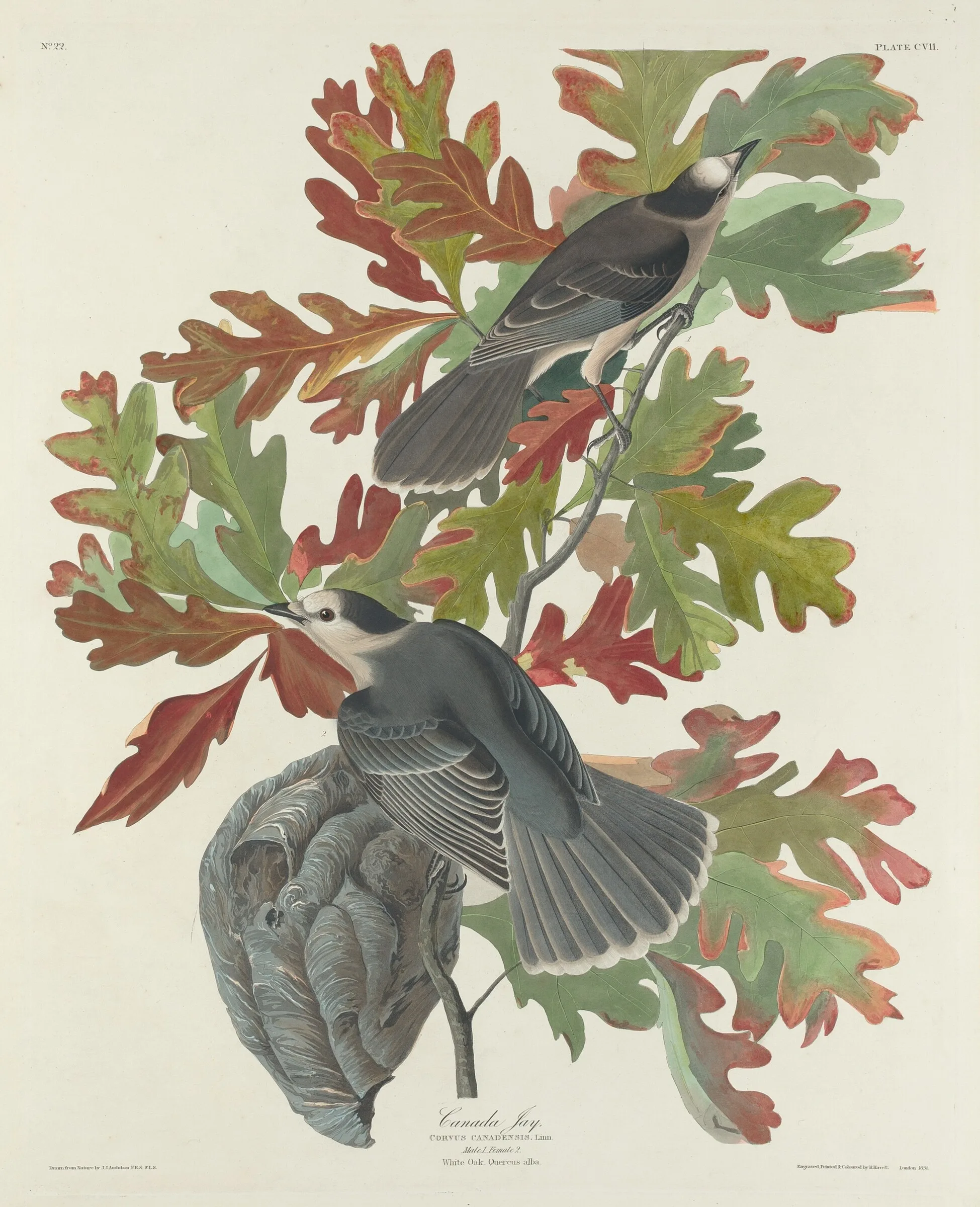
Click or press Enter to enlarge
Open the full-resolution image (3283 px, National Gallery of Art)
| Plate | 107 (CVII) |
|---|---|
| Audubon's name | Canada Jay |
| Modern name | Canada Jay |
| Scientific name | Perisoreus canadensis |
| Status | Least Concern |
| Engraved by | Robert Havell, after Audubon's watercolor |
| Date | 1831 |
| Medium | Hand-colored engraving and aquatint on Whatman wove paper |
| Plants and setting | Oak branch in autumn colour, with a hornet's nest |
| Collections | Songbirds |
| This impression | National Gallery of Art, Washington, 1945.8.107; Gift of Mrs. Walter B. James |
About this plate
Plate 107 shows a pair of Canada Jays on an oak branch in autumn colour, with a hornet's nest hanging from it. Audubon wrote that he added the nest because he had seen the bird in Maine pursuing hornets.
He found it breeding in Maine, where people called it the Carrion Bird for its taste for meat. His friend Edward Harris told him that while fishing from a birch canoe in the Maine lakes in 1833, jays landed at one end of the canoe and took his bait. Lumbermen amused themselves by baiting a pole balanced on the sill of their hut and striking the inside end when jays landed, flinging the birds into the air. John Bachman reported one caught in a snare set for Bobwhites.
The Canada Jay lives in boreal and subalpine conifer forests from Alaska to Newfoundland and south in the Rockies and northern New England. It stores thousands of food items in summer and autumn, gluing them into bark crevices with sticky saliva, and lives on these caches through winter. It nests in late winter, often with snow on the ground. The American Ornithological Society renamed it Gray Jay in 1957 and restored the name Canada Jay in 2018. It is listed as Least Concern.
In Audubon's words
My generous friend, Edward Harris, Esq. of New York, told me that while fishing in a birch canoe on the lakes in the interior of the State of Maine, in the latter part of the summer of 1833, the Jays were so fearless as to alight in one end of his bark, while he sat in the other, and help themselves to his bait, taking very little notice of him. The lumberers or wood-cutters of this State frequently amuse themselves in their camp during their eating hours, with what they call "transporting the carrion bird." This is done by cutting a pole eight or ten feet in length, and balancing it on the sill of their hut, the end outside the entrance being baited with a piece of flesh of any kind.
John James Audubon, Ornithological Biography, vol. 2 (1834), “The Canada Jay”. Read the full chapter.



