Fox Sparrow (Plate 108)
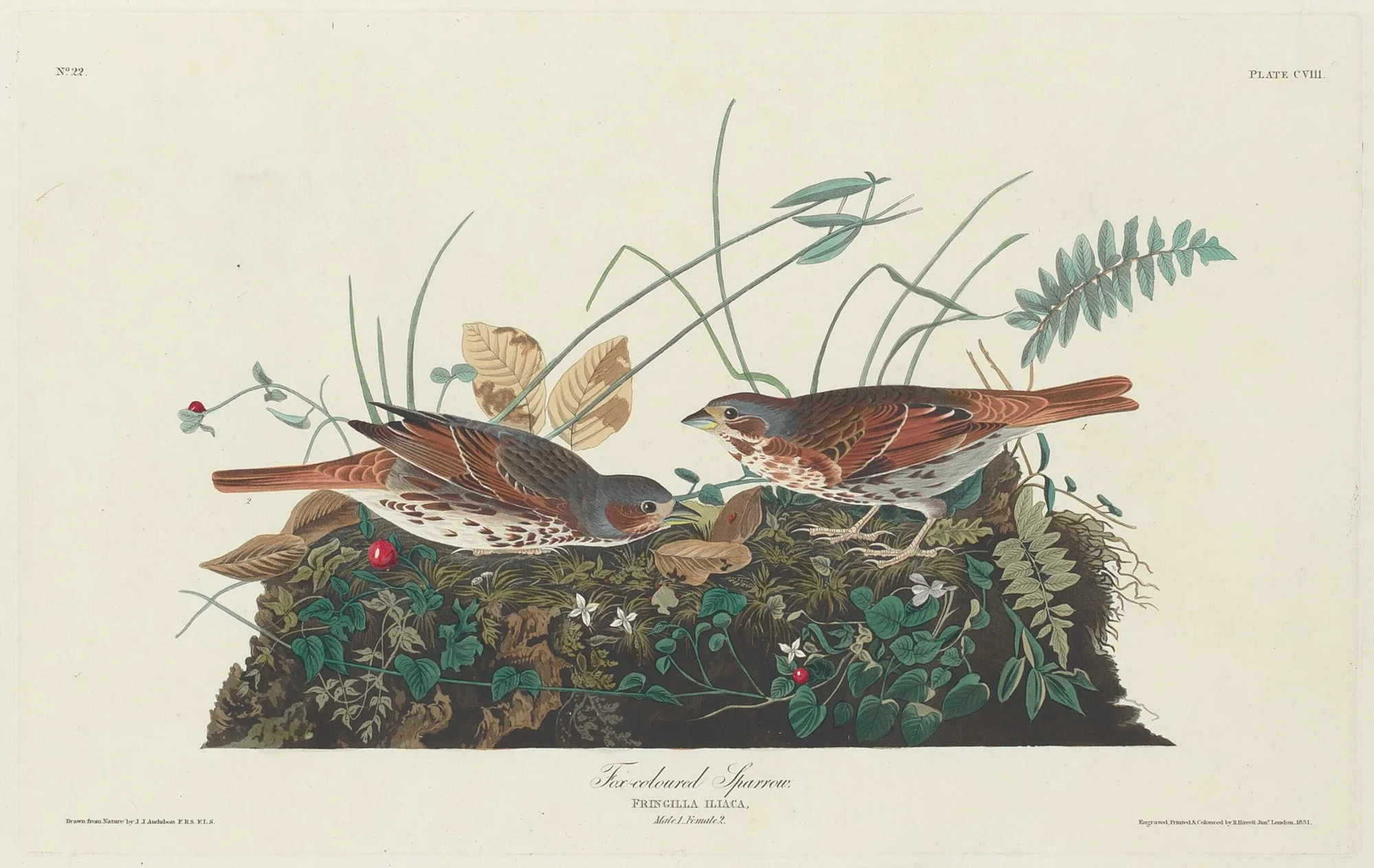
Audubon's “Two-colored Sparrow”, The Birds of America, plate CVIII
Click or press Enter to enlarge
Open the full-resolution image (2377 px, National Gallery of Art)
| Plate | 108 (CVIII) |
|---|---|
| Audubon's name | Two-colored Sparrow |
| Modern name | Fox Sparrow |
| Scientific name | Passerella iliaca |
| Status | Least Concern |
| Engraved by | Robert Havell, after Audubon's watercolor |
| Date | 1831 |
| Medium | Hand-colored engraving and aquatint on Whatman wove paper |
| Collections | Songbirds |
| This impression | National Gallery of Art, Washington, 1945.8.108; Gift of Mrs. Walter B. James |
About this plate
Plate 108 shows a male and female Fox Sparrow, large sparrows with foxy red wings and tail and heavy red-brown spots on a white breast. The National Gallery of Art title for this plate reads Two-colored Sparrow, but Audubon's text and the plate lists use Fox-coloured Sparrow.
Audubon described it as a winter visitor to every state south of Massachusetts, down to Louisiana. Small family flocks hold a thicket beside a stream all winter, scratching among fallen leaves. He thought its song surpassed that of the Eastern Towhee. In Labrador and Newfoundland, where it breeds, he saw it feeding on tiny shellfish along the shore. He noted that in Charleston it was caught in figure-four traps and sold in the market for ten or twelve cents, and that his friends Dr Samuel Wilson and John Bachman kept it in their aviaries.
The Fox Sparrow breeds in northern and mountain thickets across Canada, Alaska and the western United States. Its four main groups, red, sooty, slate-coloured and thick-billed, differ so much that some authorities treat them as separate species. Audubon's birds belong to the red group of the boreal forest. It feeds by jumping forward and kicking back with both feet to clear leaf litter. It is listed as Least Concern.
In Audubon's words
While in the United States, it lives retired, and separates itself from most other species. Little flocks, consisting of a family or two, take possession of some low well-covered thicket, by the side of some clear streamlet, where they spend the winter unmolested, searching for food among the fallen and withered leaves, or among the roots and dead branches of trees. Should a warm morning dawn on their retreat, the male birds directly ascend to the middle branches of the brambles, and in a soft under tone cheer the females with their melodies. At all other times they remain comparatively silent, merely emitting a note to call each other, or to assure their little family that all is safe around them.
John James Audubon, Ornithological Biography, vol. 2 (1834), “The Fox-coloured Sparrow”. Read the full chapter.



