Savannah Sparrow (Plate 109)
Audubon's “Savannah Finch”, The Birds of America, plate CIX
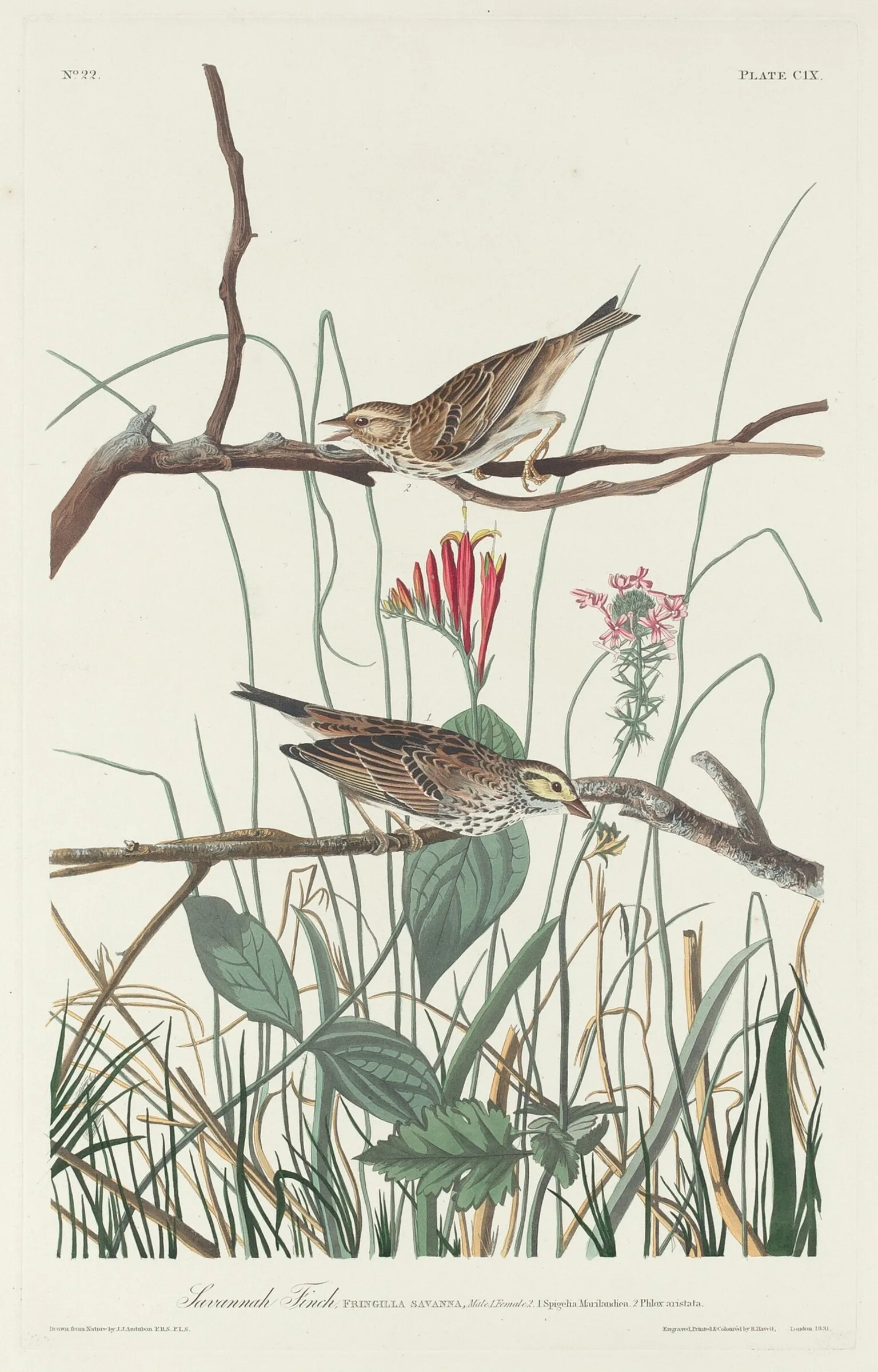
Click or press Enter to enlarge
Open the full-resolution image (2412 px, National Gallery of Art)
| Plate | 109 (CIX) |
|---|---|
| Audubon's name | Savannah Finch |
| Modern name | Savannah Sparrow |
| Scientific name | Passerculus sandwichensis |
| Status | Least Concern |
| Engraved by | Robert Havell, after Audubon's watercolor |
| Date | 1831 |
| Medium | Hand-colored engraving and aquatint on Whatman wove paper |
| Plants and setting | Indian pink-root (Spigelia marilandica) and Phlox aristata |
| Collections | Songbirds |
| This impression | National Gallery of Art, Washington, 1945.8.109; Gift of Mrs. Walter B. James |
About this plate
Plate 109 shows a male and female Savannah Sparrow with two flowering plants. Audubon identified them as Indian pink-root, or worm-grass, with rich carmine flowers, figure 1 of the plate, and a phlox, Phlox aristata, figure 2. He noted that the pink-root grows in damp meadows and woods in Kentucky and along the Alleghenies.
Audubon called it one of the most abundant and hardy American finches, wintering in the Middle States, ranging north to Labrador, and crowding the old fields of the South from October to April. He described it running fast on the ground with its body low, hiding like a mouse rather than flying, and preferring dry, slightly raised ground near the coast. He noted that it migrates by day and is hunted by Northern Harriers, Merlins and Sharp-shinned Hawks.
Alexander Wilson named the bird after Savannah, Georgia, where he collected it. The Savannah Sparrow breeds across Canada, Alaska and the northern and western United States in grassland, hayfields, tundra and salt marsh, and winters south to Central America. It varies greatly across its range. The pale Ipswich Sparrow, which breeds almost only on Sable Island off Nova Scotia, is one of its subspecies. It is listed as Least Concern.
In Audubon's words
It confines itself principally to the ground, where it runs with extreme agility, lowering its body as if to evade your view, and when in danger hiding as closely as a mouse, nay, seldom taking to wing, unless much alarmed or suddenly surprised. It is fondest of dry, rather elevated situations, not very distant from the sea shore, and although it travels much, I have never found one in deep woods. During winter it associates with the Field Sparrow and Bay-winged Sparrow, and with these it is often seen in open plains of great extent, scantily covered with tall grasses or low clumps of trees and briars. Regardless of man, it approaches the house, frequents the garden, and alights on low buildings with as little concern as if in the most retired places.
John James Audubon, Ornithological Biography, vol. 2 (1834), “The Savannah Finch”. Read the full chapter.



