Hooded Warbler (Plate 110)
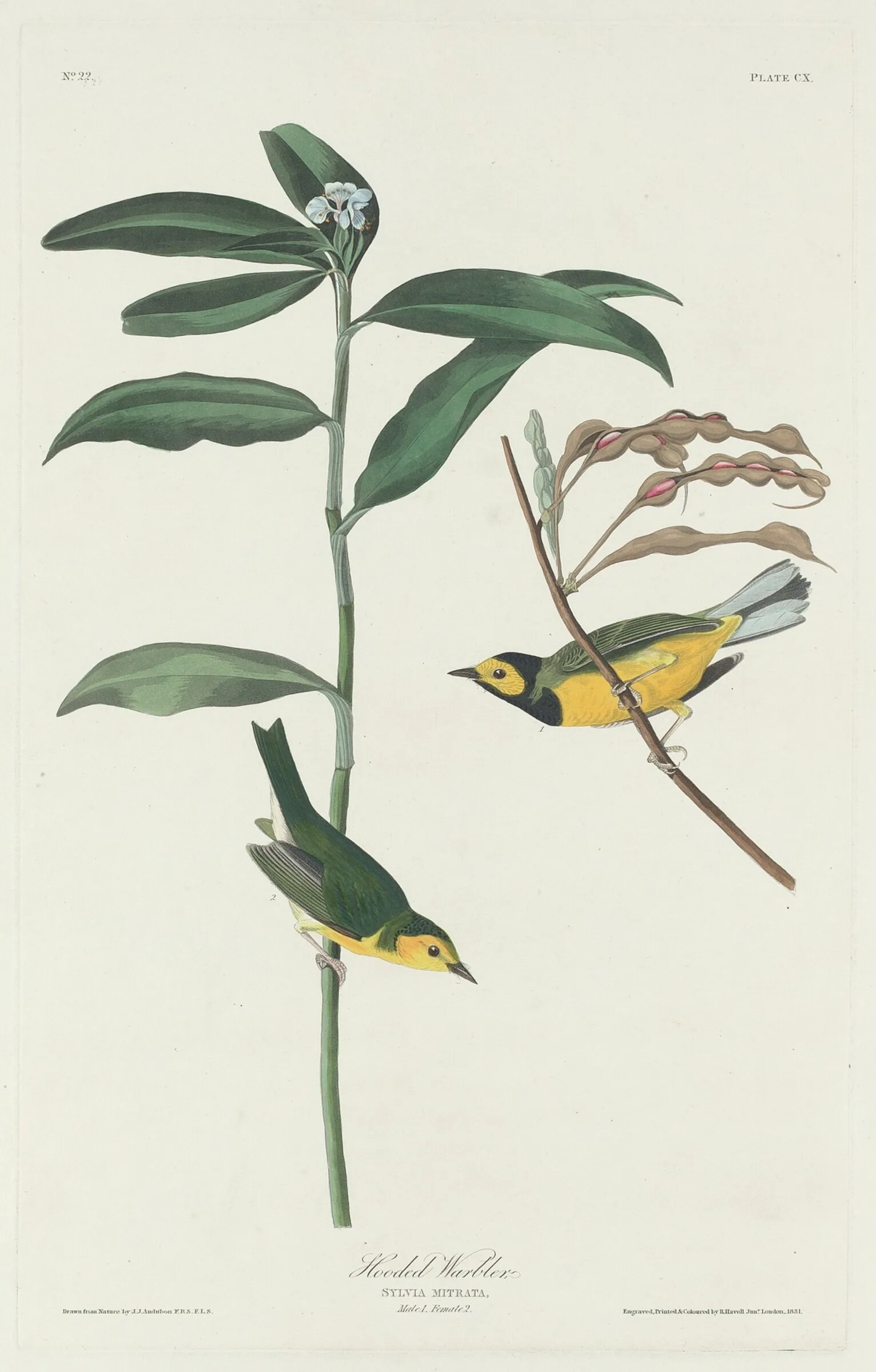
Audubon's “Hooded Warbler”, The Birds of America, plate CX
Click or press Enter to enlarge
Open the full-resolution image (2407 px, National Gallery of Art)
| Plate | 110 (CX) |
|---|---|
| Audubon's name | Hooded Warbler |
| Modern name | Hooded Warbler |
| Scientific name | Setophaga citrina |
| Status | Least Concern |
| Engraved by | Robert Havell, after Audubon's watercolor |
| Date | 1831 |
| Medium | Hand-colored engraving and aquatint on Whatman wove paper |
| Collections | Songbirds |
| This impression | National Gallery of Art, Washington, 1945.8.110; Gift of Mrs. Walter B. James |
About this plate
Plate 110 shows a male and female Hooded Warbler on a flowering plant that Audubon said is common where the birds live and has no scent. The male has a yellow face framed by a black hood and throat; the female has a yellow forehead and face with at most a trace of the hood.
Audubon opened with a scene of the bird's habitat: tall trees hung with vines and grapes, flowering undergrowth, and a clear stream. He found the species abundant in Louisiana, along the Mississippi and up the Ohio nearly to Cincinnati, and in the northern parts of Florida, Georgia and the Carolinas. He wrote that its habits were closer to a flycatcher's than a warbler's and compared it with his Selby's Flycatcher, plate 9. That bird is now known to be a female Hooded Warbler.
The Hooded Warbler breeds in the understory of mature deciduous forest across the southeastern United States and north into southern Ontario, often in tree-fall gaps and shrubby patches. It flicks its tail open to flash white spots, which may startle insects. Males and females winter in different habitats in Mexico and Central America, males in mature forest and females in scrub. The chapter is followed by the episode The Lost One, about a live-oaker lost in the woods of East Florida. It is listed as Least Concern.
In Audubon's words
In many parts of our woods, the traveller, as he proceeds, cannot help stopping to admire the peaceful repose that spreads its pleasing charm on all around. The tall trees are garlanded with climbing plants, which have entwined their slender stems around them, creeping up the crevices of the deeply furrowed bark, and vying with each other in throwing forth the most graceful festoons, to break the straight lines of the trunks which support them; while here and there from the taller branches, numberless grape-vines hang in waving clusters, or stretch across from tree to tree. The underwood shoots out its branches, as if jealous of the noble growth of the larger stems, and each flowering shrub or plant displays its blossoms, to tempt the stranger to rest a while, and enjoy the beauty of their tints, or refresh his nerves with their rich odours.
John James Audubon, Ornithological Biography, vol. 2 (1834), “The Hooded Warbler”. Read the full chapter.



