Bird of Washington (Bald Eagle) (Plate 11)
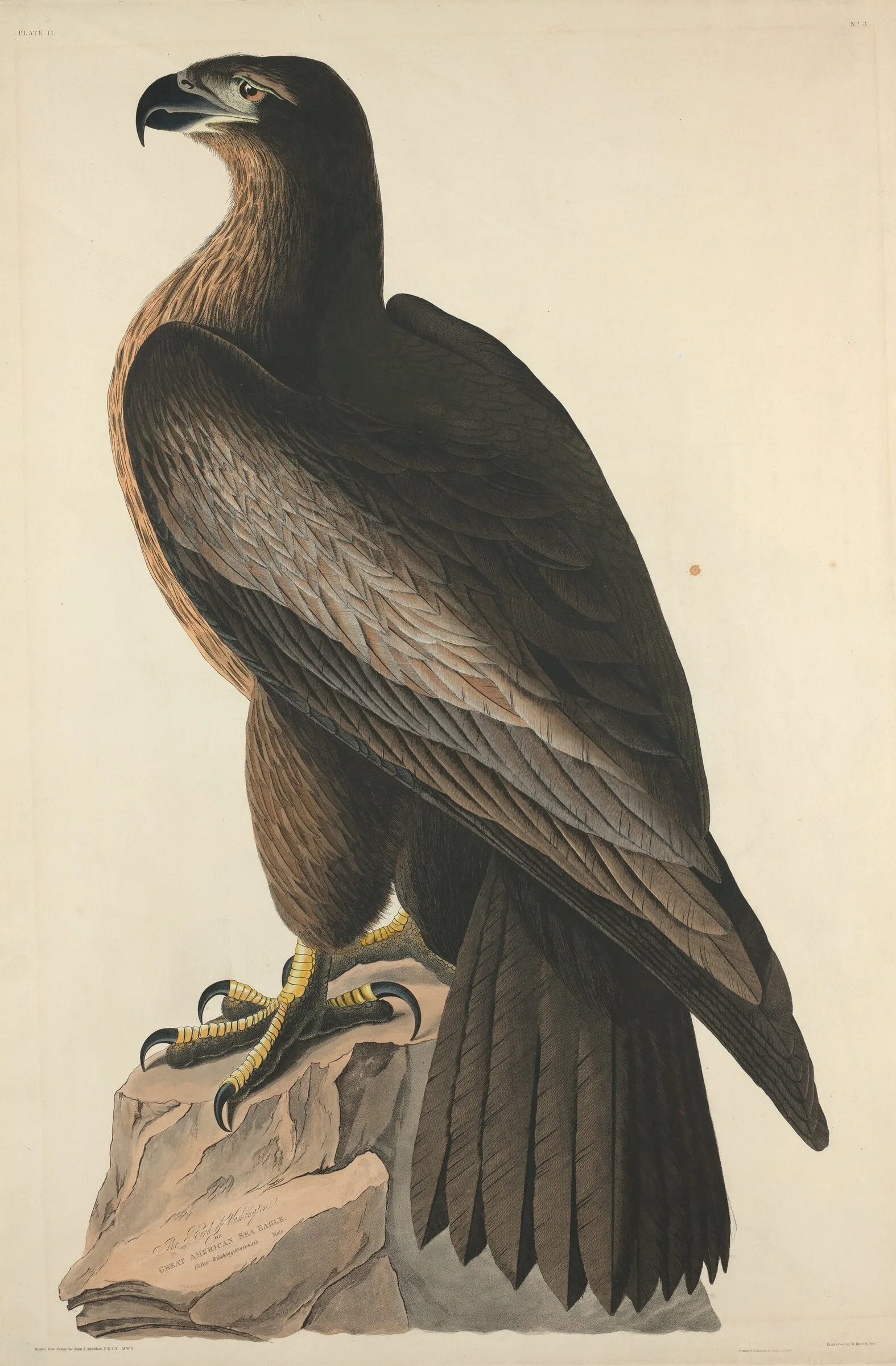
Audubon's “The Bird of Washington or Great American Sea Eagle”, The Birds of America, plate XI
Click or press Enter to enlarge
Open the full-resolution image (4893 px, National Gallery of Art)
| Plate | 11 (XI) |
|---|---|
| Audubon's name | The Bird of Washington or Great American Sea Eagle |
| Modern name | Bald Eagle (immature) |
| Scientific name | Haliaeetus leucocephalus |
| Status | Least Concern |
| Engraved by | Robert Havell, after Audubon's watercolor |
| Date | 1827 |
| Medium | Hand-colored engraving and aquatint on Whatman wove paper |
| Collections | Hawks, Eagles and Falcons |
| This impression | National Gallery of Art, Washington, 1945.8.11; Gift of Mrs. Walter B. James |
About this plate
Plate 11 shows a very large dark brown eagle perched on a rock above water. Audubon believed it was a new species, larger than the Bald Eagle, and named it in honor of George Washington. It was the first plate engraved by Robert Havell after the work moved from Edinburgh to London in 1827.
The Ornithological Biography tells the story at length. Audubon first saw the bird in February 1814 on a trading voyage up the Upper Mississippi, when his Canadian boatman pointed it out as the Great Eagle. He later watched a pair nesting on cliffs and spent two years trying to collect one. He finally shot a male near Henderson, Kentucky, as it fed at a spot where his friend Dr Rankin had slaughtered hogs. He then drew it and recorded its measurements.
No such species exists. The Bird of Washington is generally explained as a young Bald Eagle, Haliaeetus leucocephalus, which takes four to five years to gain the white head and tail. Immature Bald Eagles can be larger than adults in wing and tail measurements. Some writers have argued that Audubon drew on an earlier published eagle image for the figure.
The Bald Eagle breeds across North America near lakes, rivers and coasts. DDT and persecution reduced it to a few hundred pairs in the lower 48 states by the 1960s. After protection and the DDT ban it recovered and was removed from the Endangered Species list in 2007. It is listed as Least Concern.
In Audubon's words
I prepared my double-barrelled piece, which I constantly carry, and went slowly and cautiously towards him. Quite fearlessly he awaited my approach, looking upon me with undaunted eye. I fired and he fell. Before I reached him he was dead. With what delight did I survey the magnificent bird! Had the finest salmon ever pleased him as he did me?—Never. I ran and presented him to my friend, with a pride which they alone can feel, who, like me, have devoted themselves from their earliest childhood to such pursuits, and who have derived from them their first pleasures.
John James Audubon, Ornithological Biography, vol. 1 (1831), “The Bird of Washington”. Read the full chapter.