Hooded Warbler (Plate 9)
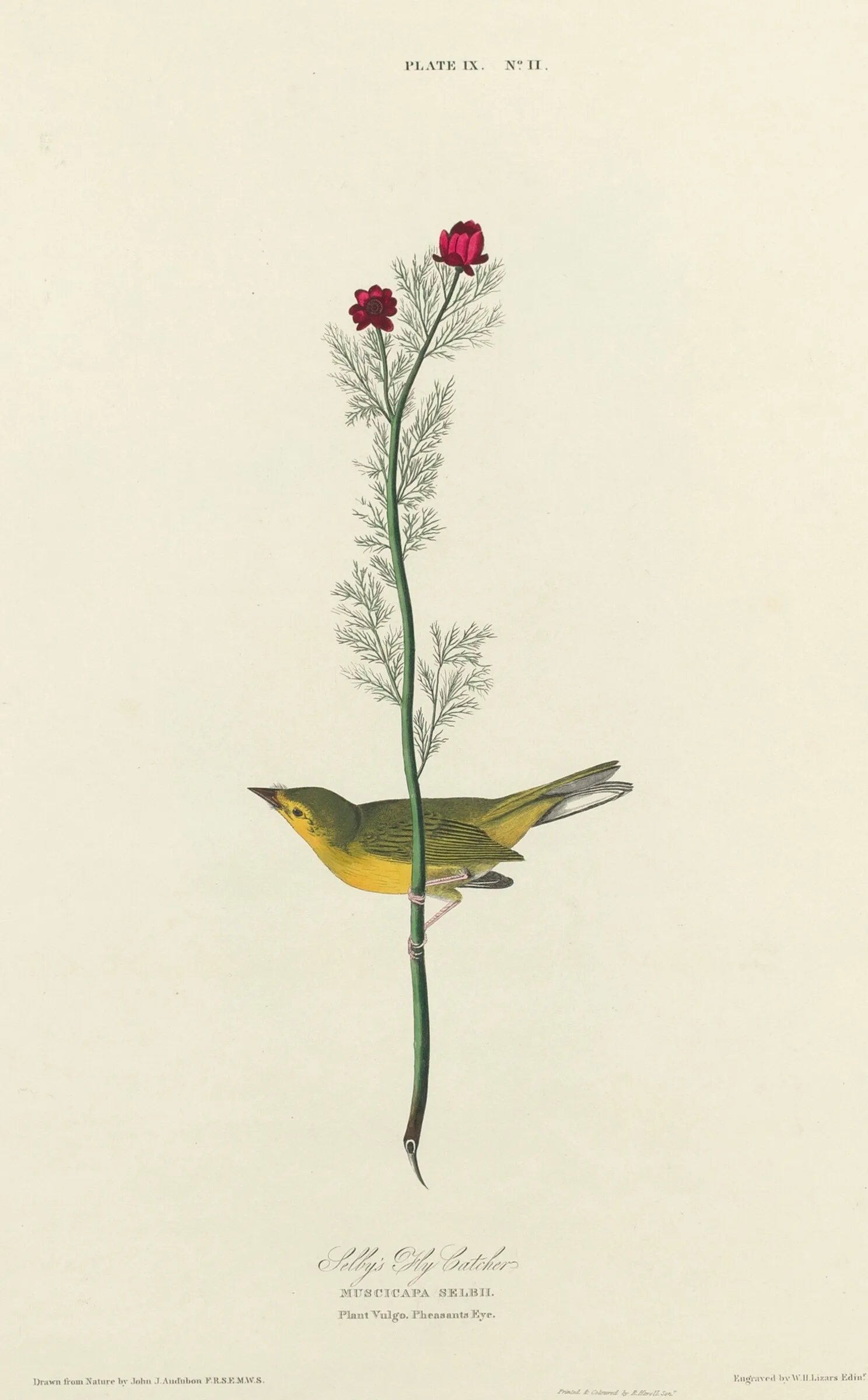
Audubon's “Selby's Flycatcher”, The Birds of America, plate IX
Click or press Enter to enlarge
Open the full-resolution image (2486 px, National Gallery of Art)
| Plate | 9 (IX) |
|---|---|
| Audubon's name | Selby's Flycatcher |
| Modern name | Hooded Warbler |
| Scientific name | Setophaga citrina |
| Status | Least Concern |
| Engraved by | William Home Lizars, after Audubon's watercolor |
| Date | 1827 |
| Medium | Etching and engraving with hand coloring on Whatman paper |
| Plants and setting | A crimson-flowered plant Audubon found growing wild in damp ground in Louisiana, said to be introduced from Europe |
| Collections | Songbirds |
| This impression | National Gallery of Art, Washington, 1945.8.9; Gift of Mrs. Walter B. James |
About this plate
Plate 9 shows a single male with a black hood around a yellow face, perched on a flowering plant with crimson blossoms. Audubon wrote that he found the flower growing wild near the spot where he shot the bird, and chose it to contrast with the bird's colors. He had been told it came originally from Europe and saw it only in damp places in Louisiana. The plate was engraved by William Home Lizars in 1827.
Audubon named the bird after Prideaux John Selby, the English ornithologist and bird painter, who had helped him in Edinburgh. He thought it was a new and very rare species, writing that he had shot only three in nine years. His journal places the first on 1 July 1821 in Louisiana, with his young assistant Joseph Mason present. He shot a female on 4 July and a second male on 27 September.
Selby's Flycatcher is the adult male Hooded Warbler, Setophaga citrina. Wilson had already described that species, and Audubon himself figured it again under its proper name in a later plate. The confusion did not last long.
The Hooded Warbler breeds in moist deciduous forest with dense understory across the southeastern and central United States, and winters from Mexico to Panama. It is listed as Least Concern. It was formerly placed in the genus Wilsonia.
In Audubon's words
As this bird, to the day on which my engraving of it appeared, had not been described, or, in as far as I know, obtained by any other person than myself, notwithstanding the great number of individuals who have of late years been searching our States for new and rare species, it must be considered as of very unfrequent occurrence, and probably as seldom going farther north or east than the place where I discovered it. Moreover, it is so scarce even there, that in all my walks I only shot three individuals, in the course of nine years. In no instance have I been able to cultivate its society longer than a few minutes, as, before it might escape from me, I was obliged to shoot it, in order to satisfy myself that it was indeed a different bird from any figured or described in books.
John James Audubon, Ornithological Biography, vol. 1 (1831), “Selby's Fly-catcher”. Read the full chapter.



