Baltimore Oriole (Plate 12)
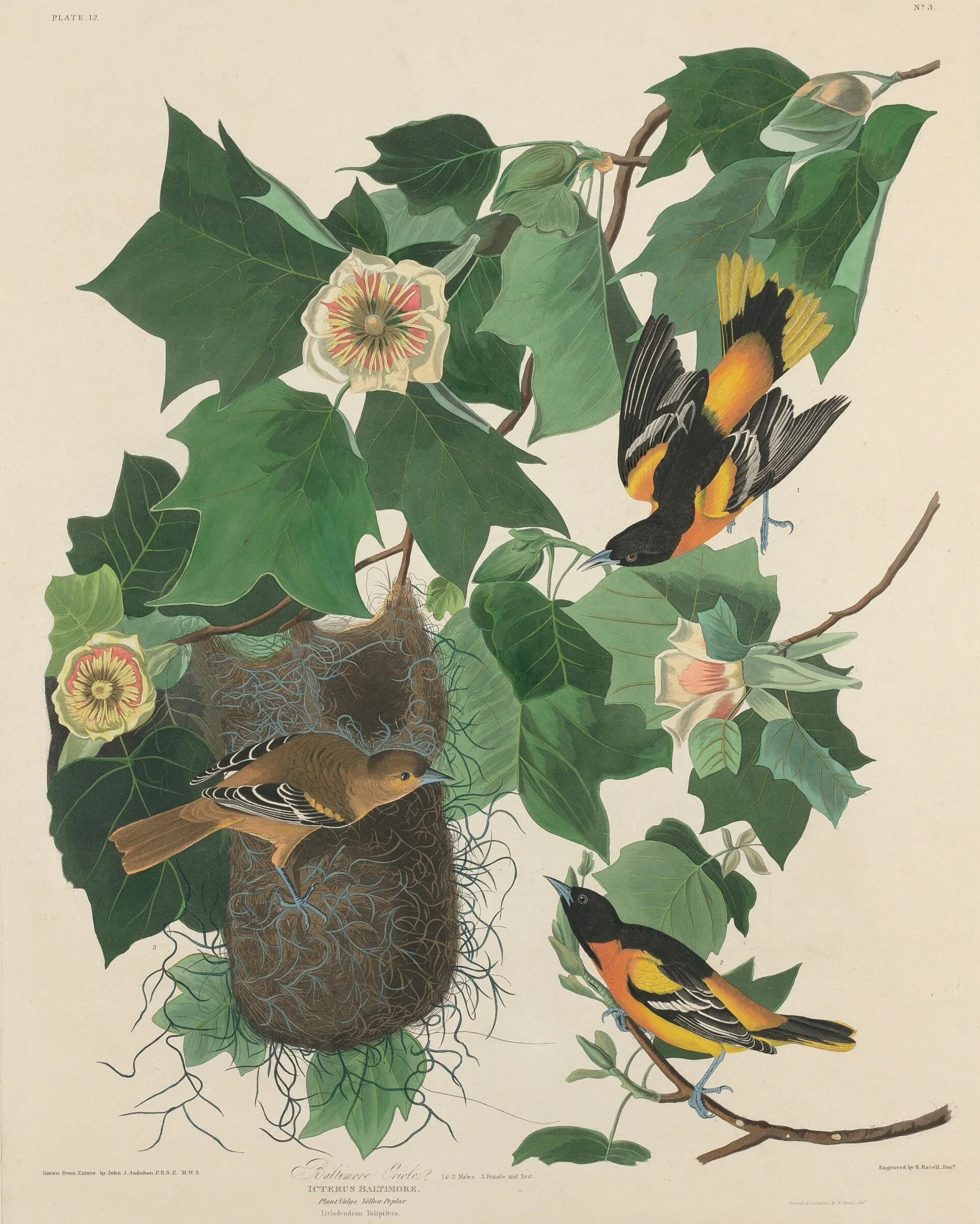
Audubon's “Baltimore Oriole”, The Birds of America, plate XII
Click or press Enter to enlarge
Open the full-resolution image (3109 px, National Gallery of Art)
| Plate | 12 (XII) |
|---|---|
| Audubon's name | Baltimore Oriole |
| Modern name | Baltimore Oriole |
| Scientific name | Icterus galbula |
| Status | Least Concern |
| Engraved by | Robert Havell, after Audubon's watercolor |
| Date | 1827 |
| Medium | Hand-colored engraving and aquatint on Whatman wove paper |
| Size | plate: 65.9 x 52.6 cm (25 15/16 x 20 11/16 in.) sheet: 99.9 x 67 cm (39 5/16 x 26 3/8 in.) |
| Plants and setting | Tulip-tree (Liriodendron tulipifera) in flower, with a nest of Spanish moss |
| Collections | Songbirds |
| This impression | National Gallery of Art, Washington, 1945.8.12; Gift of Mrs. Walter B. James |
About this plate
Plate 12 shows Baltimore Orioles in different stages of plumage around a woven nest that hangs from a pendulous branch of Tulip-tree in flower. Audubon wrote that the branch was the kind of twig orioles favour on the Ohio, but that he actually cut it in Louisiana. The nest in the plate is made of Spanish moss. The plate was engraved by Robert Havell in 1827.
The chapter opens with a long description of an autumn voyage up the Mississippi and Ohio, with the oriole as a constant companion. Audubon then describes nest building in detail. The male fastens strands of Spanish moss between two twigs like a swing, and the female weaves new strands across them into a network. He noted that nests in Louisiana were open and airy, while those farther north were lined more warmly and placed to face the sun.
The name is unchanged in English: Baltimore Oriole, now Icterus galbula. From 1973 to 1995 it was merged with Bullock's Oriole of the West as the Northern Oriole, then split again. The name comes from the orange and black colors of the arms of Lord Baltimore, the colonial proprietor of Maryland. Audubon called the bird Icterus baltimore.
The species breeds in open woodland, river edges and shade trees across eastern and central North America and winters from Mexico to northern South America. Audubon wrote that it reared two broods a season in Louisiana. It is listed as Least Concern.
In Audubon's words
No sooner does he reach the branches, than with bill and claws, aided by an astonishing sagacity, he fastens one end of the moss to a twig, with as much art as a sailor might do, and takes up the other end, which he secures also, but to another twig a few inches off, leaving the thread floating in the air like a swing, the curve of which is perhaps seven or eight inches from the twigs. The female comes to his assistance with another filament of moss, or perhaps some cotton thread, or other fibrous substance, inspects the work which her mate has done, and immediately commences her operations, placing each thread in a contrary direction to those arranged by her lordly mate, and making the whole cross and recross, so as to form an irregular network. Their love increases daily as they see the graceful fabric approaching perfection, until their conjugal affection and faith become as complete as in any species of birds with which I am acquainted.
John James Audubon, Ornithological Biography, vol. 1 (1831), “The Baltimore Oriole”. Read the full chapter.



