Pileated Woodpecker (Plate 111)
Audubon's “Pileated Woodpecker”, The Birds of America, plate CXI
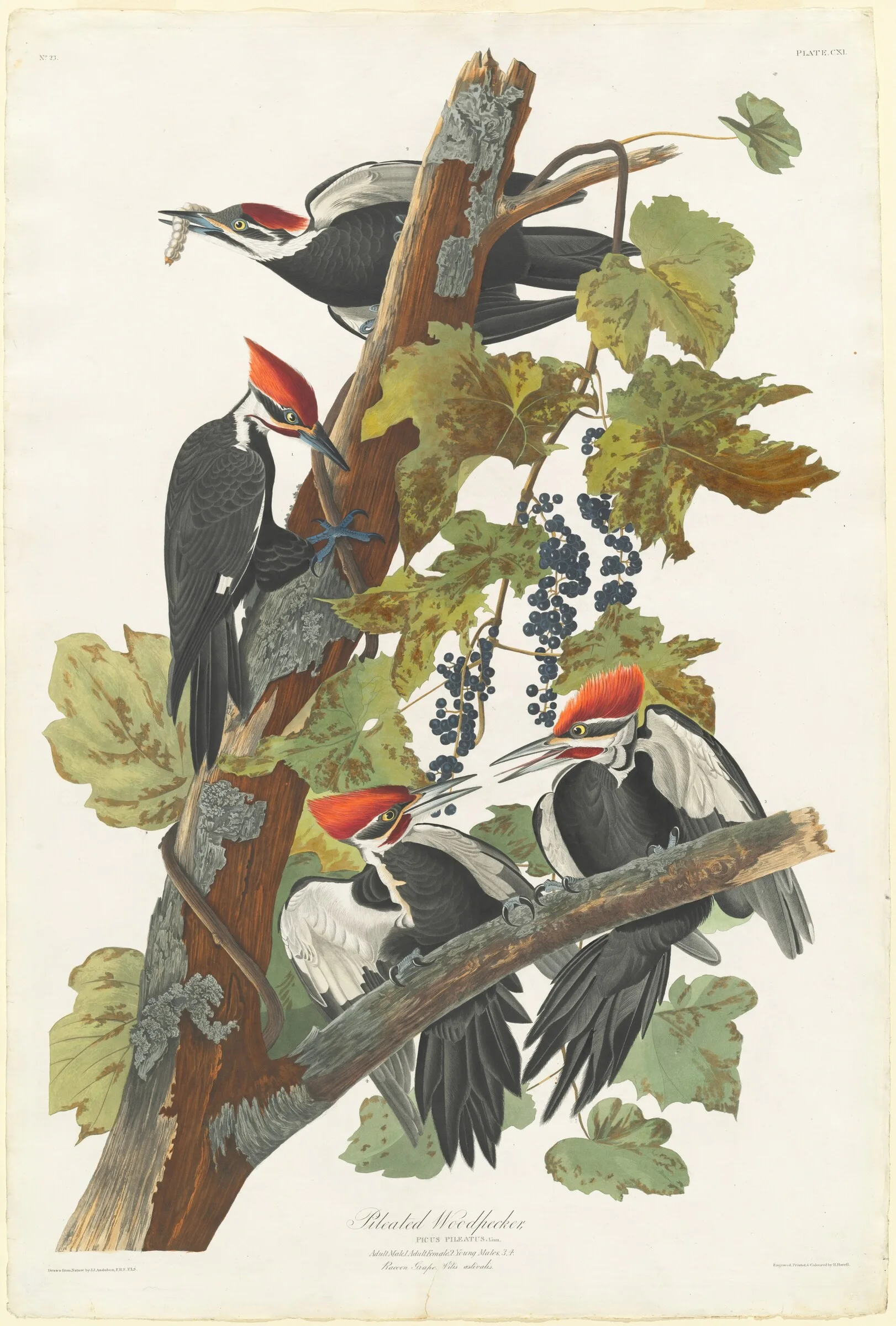
Click or press Enter to enlarge
Open the full-resolution image (7741 px, National Gallery of Art)
| Plate | 111 (CXI) |
|---|---|
| Audubon's name | Pileated Woodpecker |
| Modern name | Pileated Woodpecker |
| Scientific name | Dryocopus pileatus |
| Status | Least Concern |
| Engraved by | Robert Havell, after Audubon's watercolor |
| Date | 1831 |
| Medium | Hand-colored engraving and aquatint on Whatman wove paper |
| Size | plate: 98.4 x 64.8 cm (38 3/4 x 25 1/2 in.) sheet: 101 x 67.9 cm (39 3/4 x 26 3/4 in.) |
| Plants and setting | A vine, probably wild grape, on which the birds climb |
| Collections | Woodpeckers |
| This impression | National Gallery of Art, Washington, 1945.8.111; Gift of Mrs. Walter B. James |
About this plate
Plate 111 shows four Pileated Woodpeckers: an adult male, a female and two young males. Audubon's figures line in the Ornithological Biography lists them as 'male, female and young males'. The birds climb and cling about a vine, giving views of the red crest, the black body and the white neck stripes from several angles.
Audubon knew the bird as Picus pileatus. It is now Dryocopus pileatus, the largest woodpecker in the United States and Canada now that the Ivory-billed Woodpecker is gone. Audubon compared the two directly and judged the Pileated the wilder of the pair. Males have a red stripe from the bill, which females lack.
The species lives in mature forest across the eastern United States, the boreal belt of Canada and the Pacific Northwest. It digs large rectangular holes in dead wood to reach carpenter ants. Logging cut its numbers in the 1800s, but it recovered as eastern forests grew back and it is now listed as Least Concern.
Audubon wrote that he had met the bird in nearly every part of the country. He chased it for miles among cabbage palms in East Florida and spent several days in the Great Pine Forest of Pennsylvania trying to shoot one, to prove that birds in both places were the same species. The chapter also quotes his friend John Bachman of Charleston on a pair that carried off the young of Eastern Bluebirds nesting in their old hole.
In Audubon's words
Even in the wildest parts of Eastern Florida, where I have at times followed it, to assure myself that the birds I saw were of the same species as that found in our distant Atlantic States, its vigilance was not in the least abated. For miles have I chased it from one cabbage-tree to another, without ever getting within shooting distance, until at last I was forced to resort to stratagem, and seeming to abandon the chase, took a circuitous route, concealed myself in its course, and waited until it came up, when, it being now on the side of the tree next to me, I had no difficulty in bringing it down. I shall never forget, that, while in the Great Pine Forest of Pennsylvania, I spent several days in the woods endeavouring to procure one, for the same purpose of proving its identity with others elsewhere seen.
John James Audubon, Ornithological Biography, vol. 2 (1834), “The Pileated Woodpecker”. Read the full chapter.