Downy Woodpecker (Plate 112)
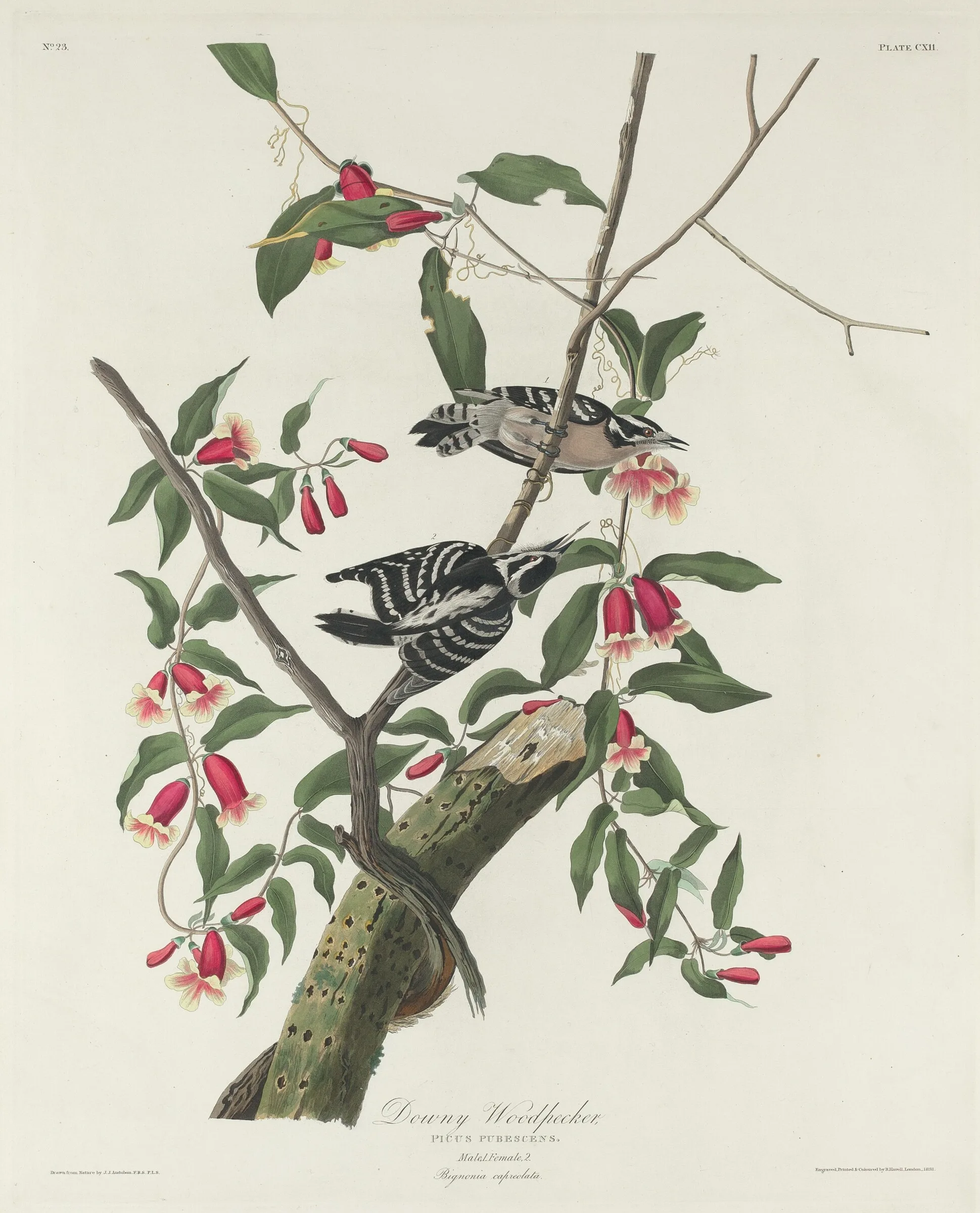
Audubon's “Downy Woodpecker”, The Birds of America, plate CXII
Click or press Enter to enlarge
Open the full-resolution image (3154 px, National Gallery of Art)
| Plate | 112 (CXII) |
|---|---|
| Audubon's name | Downy Woodpecker |
| Modern name | Downy Woodpecker |
| Scientific name | Dryobates pubescens |
| Status | Least Concern |
| Engraved by | Robert Havell, after Audubon's watercolor |
| Date | 1831 |
| Medium | Hand-colored engraving and aquatint on Whatman wove paper |
| Plants and setting | Crossvine (Bignonia capreolata), which Audubon called the Ramping Trumpet-flower |
| Collections | Woodpeckers |
| This impression | National Gallery of Art, Washington, 1945.8.112; Gift of Mrs. Walter B. James |
About this plate
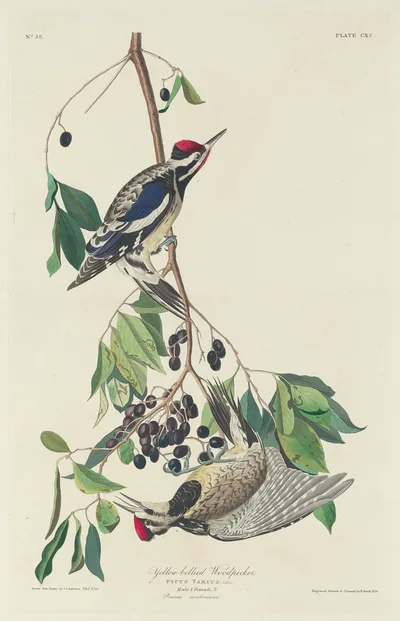
Plate 112 shows a male and a female Downy Woodpecker on a flowering vine that Audubon called the Ramping Trumpet-flower, Bignonia capreolata, known today as crossvine. The male carries the small red patch on the back of the head. Audubon noted that the vine grows only in the Southern states and that hummingbirds feed at its scentless orange flowers.
Audubon used Linnaeus's name Picus pubescens. The species has since been moved to the genus Dryobates. It is the smallest woodpecker in North America and looks much like a small Hairy Woodpecker, from which it differs in its short bill and the dark bars on its white outer tail feathers.
Audubon wrote that the bird was best known in his day as the Sap-sucker, a name now reserved for the genus Sphyrapicus. He argued, against most farmers, that its rows of small holes did fruit trees good rather than harm. He found it from Louisiana to Labrador. The Downy lives in woods, orchards and suburbs over most of the United States and Canada, takes suet at feeders and is listed as Least Concern.
The chapter records that pairs dig a nest hole a foot or more deep, that the six white eggs lie on bare wood and that two broods are raised in the South. Audubon also noticed that wintering birds in Florida, Georgia and the Carolinas had their underparts blackened by soot from burned grassland.
In Audubon's words
About the middle of April it begins to form its nest, shewing little care as to the kind of tree it selects for the purpose, although it generally chooses a sound one, sometimes, however, taking one that is partially decayed. The pair work together for several days before the hole is completed, sometimes perhaps a whole week, as they dig it to the depth of a foot or sixteen inches. The direction is sometimes perpendicularly downwards from the commencement, sometimes transverse to the tree for four or five inches, and then longitudinal. The hole is rendered smooth and conveniently large throughout, the entrance being perfectly round, and just large enough to admit one bird at a time. The eggs, commonly six in number, pure white, and translucent, are deposited on the bare wood. In the Southern and Middle States, two broods are raised in the season; farther north seldom more than one. The young follow their parents through the woods, in company with Nuthatches and Creepers, and seem at all times lively and happy.
John James Audubon, Ornithological Biography, vol. 2 (1834), “The Downy Woodpecker”. Read the full chapter.