Eastern Bluebird (Plate 113)
Audubon's “Blue-Bird”, The Birds of America, plate CXIII
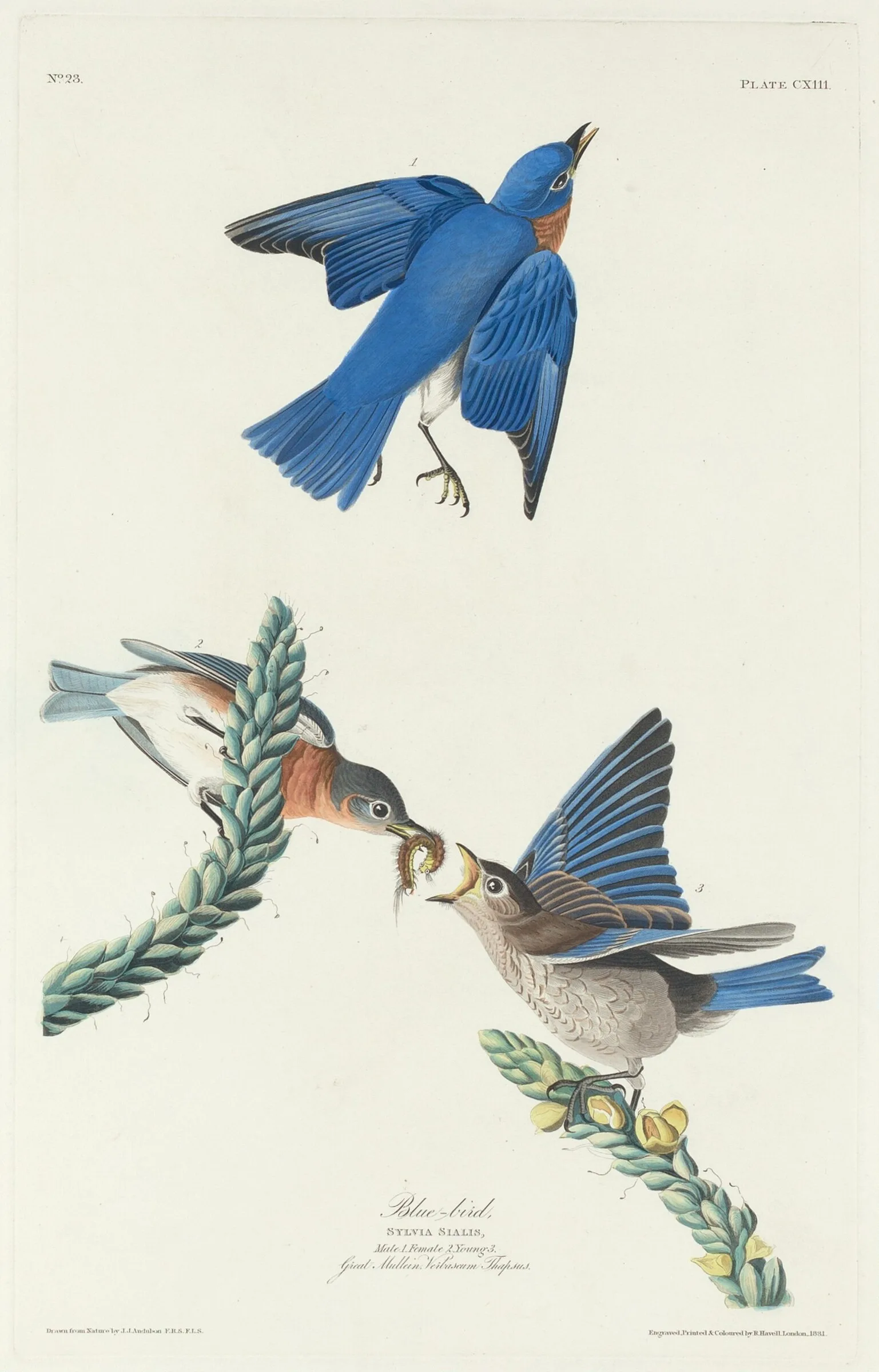
Click or press Enter to enlarge
Open the full-resolution image (2380 px, National Gallery of Art)
| Plate | 113 (CXIII) |
|---|---|
| Audubon's name | Blue-Bird |
| Modern name | Eastern Bluebird |
| Scientific name | Sialia sialis |
| Status | Least Concern |
| Engraved by | Robert Havell, after Audubon's watercolor |
| Date | 1831 |
| Medium | Hand-colored engraving and aquatint on Whatman wove paper |
| Plants and setting | A flowering stalk, apparently great mullein (Verbascum thapsus) |
| Collections | Songbirds |
| This impression | National Gallery of Art, Washington, 1945.8.113; Gift of Mrs. Walter B. James |
About this plate
Plate 113 shows a family of Eastern Bluebirds: a blue and rusty male, a duller female and a speckled young bird. They perch on a tall flowering stalk. Audubon's text mentions that bluebirds in autumn pounce on grasshoppers from the tops of the great mullein in old fields, and the plant in the plate appears to be that mullein.
Audubon placed the bird in the warbler genus Sylvia as Sylvia sialis. It is now Sialia sialis, a member of the thrush family. The spotted breast of the young bird, which Audubon drew, is one of the signs of that relationship.
The Eastern Bluebird lives in open country with scattered trees from southern Canada to the Gulf states and south into Mexico and Central America. It nests in old woodpecker holes and in boxes. Numbers fell in the 20th century as House Sparrows and European Starlings took over nest holes, then recovered with the spread of nest-box trails. It is listed as Least Concern.
Audubon wrote that the bird breeds in Florida as early as January, pairs at Charleston in that month, in Pennsylvania in mid-April and in Maine in June. He described nest boxes put up for it on roofs and barns, two or three broods a year, and its soft warble with quivering wings. He found hundreds wintering on the plantations of Florida.
In Audubon's words
When March returns, the male commences his courtship, manifesting as much tenderness and affection towards his chosen one, as the dove itself. Martins and House-wrens! be prepared to encounter his anger, or keep at a respectful distance. Even the wily cat he will torment with querulous chirpings, whenever he sees her in the path from which he wishes to pick up an insect for his mate. The Blue Bird breeds in the Floridas as early as January, and pairs at Charleston in that month, in Pennsylvania about the middle of April, and in the State of Maine in June. It forms its nest in the box made expressly for the purpose, or in any convenient hole or cavity it can find, often taking possession of those abandoned by the Woodpecker. The eggs are from four to six, of a pale blue colour. Two and often three broods are raised in the year.
John James Audubon, Ornithological Biography, vol. 2 (1834), “The Blue Bird”. Read the full chapter.



