White-crowned Sparrow (Plate 114)
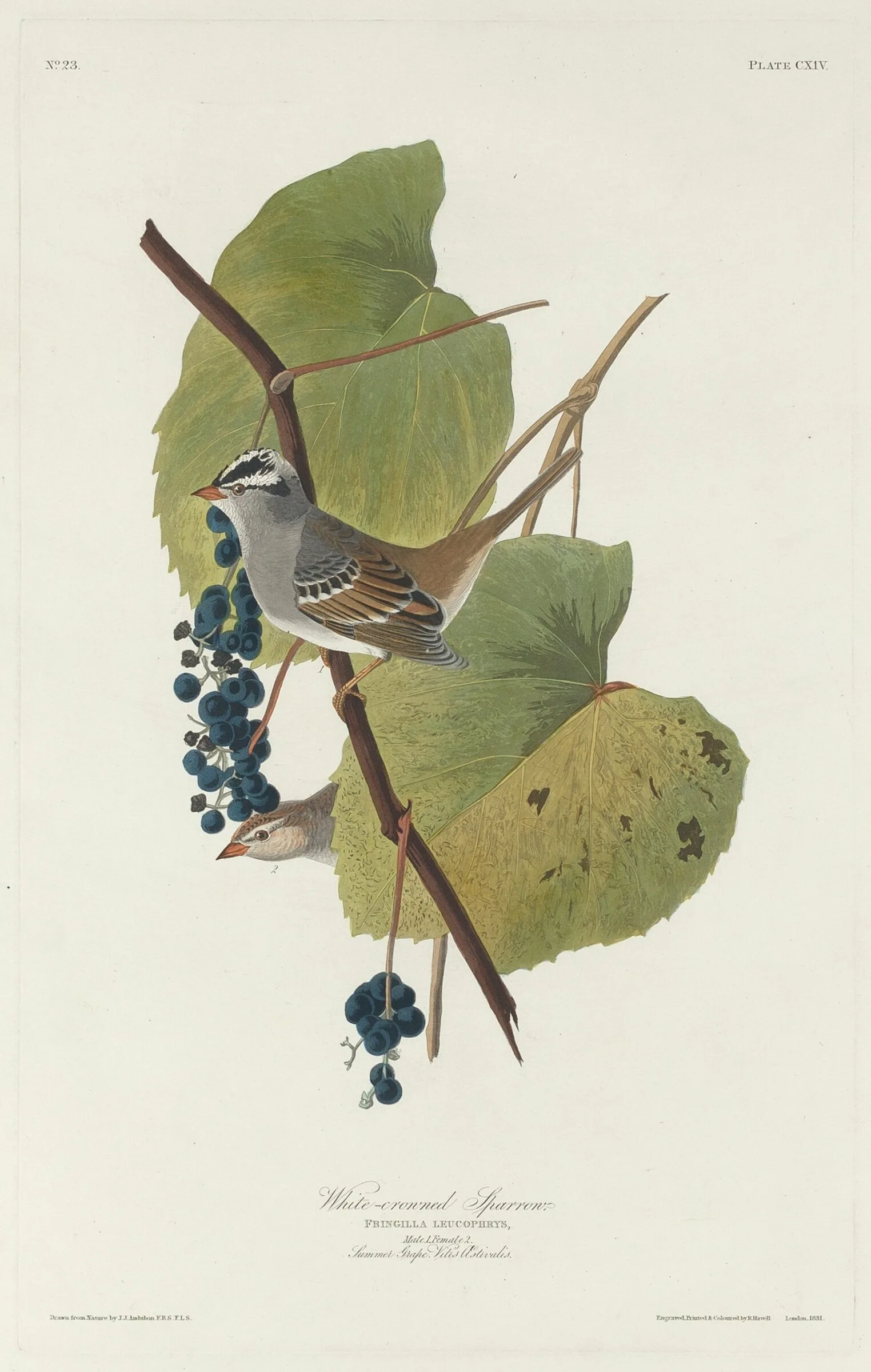
Audubon's “White-crowned Sparrow”, The Birds of America, plate CXIV
Click or press Enter to enlarge
Open the full-resolution image (2417 px, National Gallery of Art)
| Plate | 114 (CXIV) |
|---|---|
| Audubon's name | White-crowned Sparrow |
| Modern name | White-crowned Sparrow |
| Scientific name | Zonotrichia leucophrys |
| Status | Least Concern |
| Engraved by | Robert Havell, after Audubon's watercolor |
| Date | 1831 |
| Medium | Hand-colored engraving and aquatint on Whatman wove paper |
| Size | plate: 49.9 x 31.4 cm (19 5/8 x 12 3/8 in.) sheet: 100.3 x 68 cm (39 1/2 x 26 3/4 in.) |
| Collections | Songbirds |
| This impression | National Gallery of Art, Washington, 1945.8.114; Gift of Mrs. Walter B. James |
About this plate
Plate 114 shows a male and a female White-crowned Sparrow in breeding plumage, with the bold black and white stripes on the crown. Audubon wrote that in spring and summer the sexes are equally handsome, the male being only a little larger.
Audubon followed Bonaparte in calling it Fringilla leucophrys. It is now Zonotrichia leucophrys, a close relative of the White-throated and Harris's sparrows. Audubon correctly worked out that birds lose much of the bright head pattern in winter and that young birds have brown rather than black and white stripes, which explains why winter birds were sometimes taken for another species.
The White-crowned Sparrow breeds across the Arctic and subarctic of Canada and Alaska and in the mountains and Pacific coast of the West. It winters across much of the United States and into Mexico. Its song has been studied for decades as a model of regional bird dialects. It is listed as Least Concern.
Audubon first met the species at Henderson, Kentucky, in the autumn of 1817, when he collected five birds. He came to know it well in Labrador in 1833, where he heard its song soon after landing and wrote one of the most emotional passages in the Ornithological Biography about it. In Labrador his party also searched long for its nest under dwarf pines and mosses, finally clearing the ground with hatchets.
In Audubon's words
Thus it was with me, when, some time after I had been landed on the dreary coast of Labrador, I for the first time heard the song of the White-crowned Sparrow. I could not refrain from indulging in the thought that, notwithstanding the many difficulties attending my attempts—my mission I must call it—to study God's works in this wild region, I was highly favoured. At every step, new objects presented themselves, and whenever I rested, I enjoyed a delight never before experienced. Humbly and fervently did I pray for a continuation of those blessings, through which I now hoped to see my undertaking completed, and again to join my ever-dear family.
John James Audubon, Ornithological Biography, vol. 2 (1834), “The White-crowned Sparrow”. Read the full chapter.



