Eastern Wood-Pewee (Plate 115)
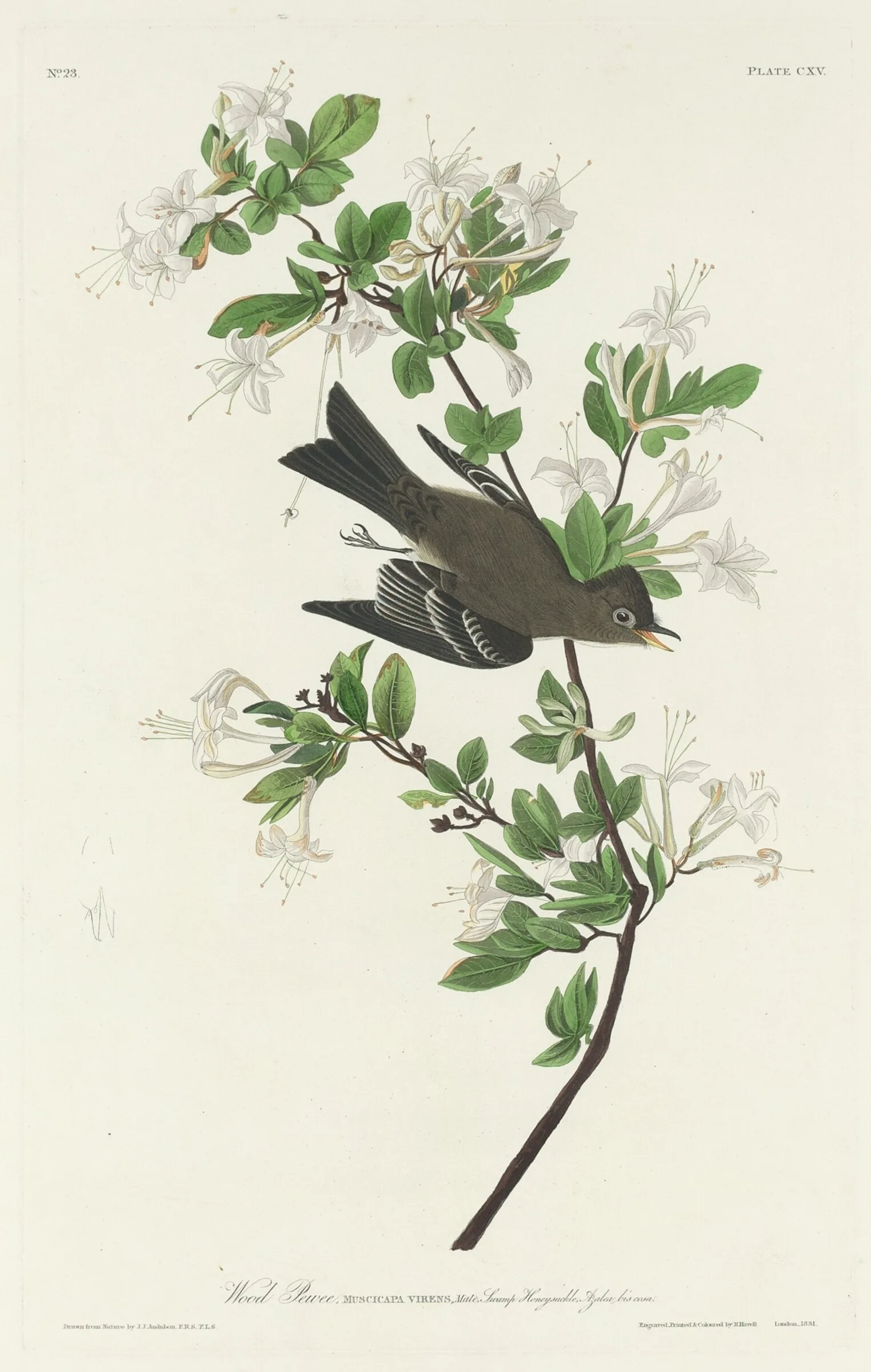
Audubon's “Wood Pewee”, The Birds of America, plate CXV
Click or press Enter to enlarge
Open the full-resolution image (2438 px, National Gallery of Art)
| Plate | 115 (CXV) |
|---|---|
| Audubon's name | Wood Pewee |
| Modern name | Eastern Wood-Pewee |
| Scientific name | Contopus virens |
| Status | Least Concern |
| Engraved by | Robert Havell, after Audubon's watercolor |
| Date | 1831 |
| Medium | Hand-colored engraving and aquatint on Whatman wove paper |
| Collections | Songbirds |
| This impression | National Gallery of Art, Washington, 1945.8.115; Gift of Mrs. Walter B. James |
About this plate
Plate 115 shows a single male Wood Pewee, a plain olive-grey flycatcher with two pale wing bars, perched on a branch in the pose of a bird waiting to sally out after insects.
Audubon used Linnaeus's name Muscicapa virens. The bird is now the Eastern Wood-Pewee, Contopus virens, in the tyrant flycatcher family. The chapter opens with Audubon's complaint about how hard it is to tell the Wood Pewee from Traill's Flycatcher, the Acadian Flycatcher and other small dull flycatchers. That difficulty is still real: several of these species are safely told apart only by voice.
The Eastern Wood-Pewee breeds in deciduous and mixed woods across eastern North America and winters in northern South America. It is named for its slow, plaintive song, a whistled pee-a-wee. Breeding Bird Survey data show a long decline, as with many aerial insect eaters, but the species is still common and is listed as Least Concern.
Audubon wrote that the bird lives in the darkest and most gloomy parts of the forest, lingers in overgrown orchards, and in autumn skims over slimy pools to take insects from the surface of the water. He also noted its habit of chasing other birds away from its favourite perch and its nest.
In Audubon's words
It is in the darkest and most gloomy retreats of the forest that the Wood Pewee is generally to be found, during the season which it spends with us. You may find it, however, lurking for a while in the shade of an overgrown orchard; or, as autumn advances, you may see it gleaning the benumbed insects over the slimy pools, or gliding on the outskirts of the woods, when, for the last time, the piping notes of the Bullfrog are heard mingling with its own plaintive notes. In all these places, it exhibits the simplicity and freedom of its natural habits, dashing after the insects on which it principally feeds, with a remarkable degree of inattention to surrounding objects. Its sallies have also the appearance of being careless, although at times protracted, when it seems to seize several insects in succession, the more so perhaps that it has no rival to contend with in such situations.
John James Audubon, Ornithological Biography, vol. 2 (1834), “The Wood Pewee”. Read the full chapter.



