Brown Thrasher (Plate 116)
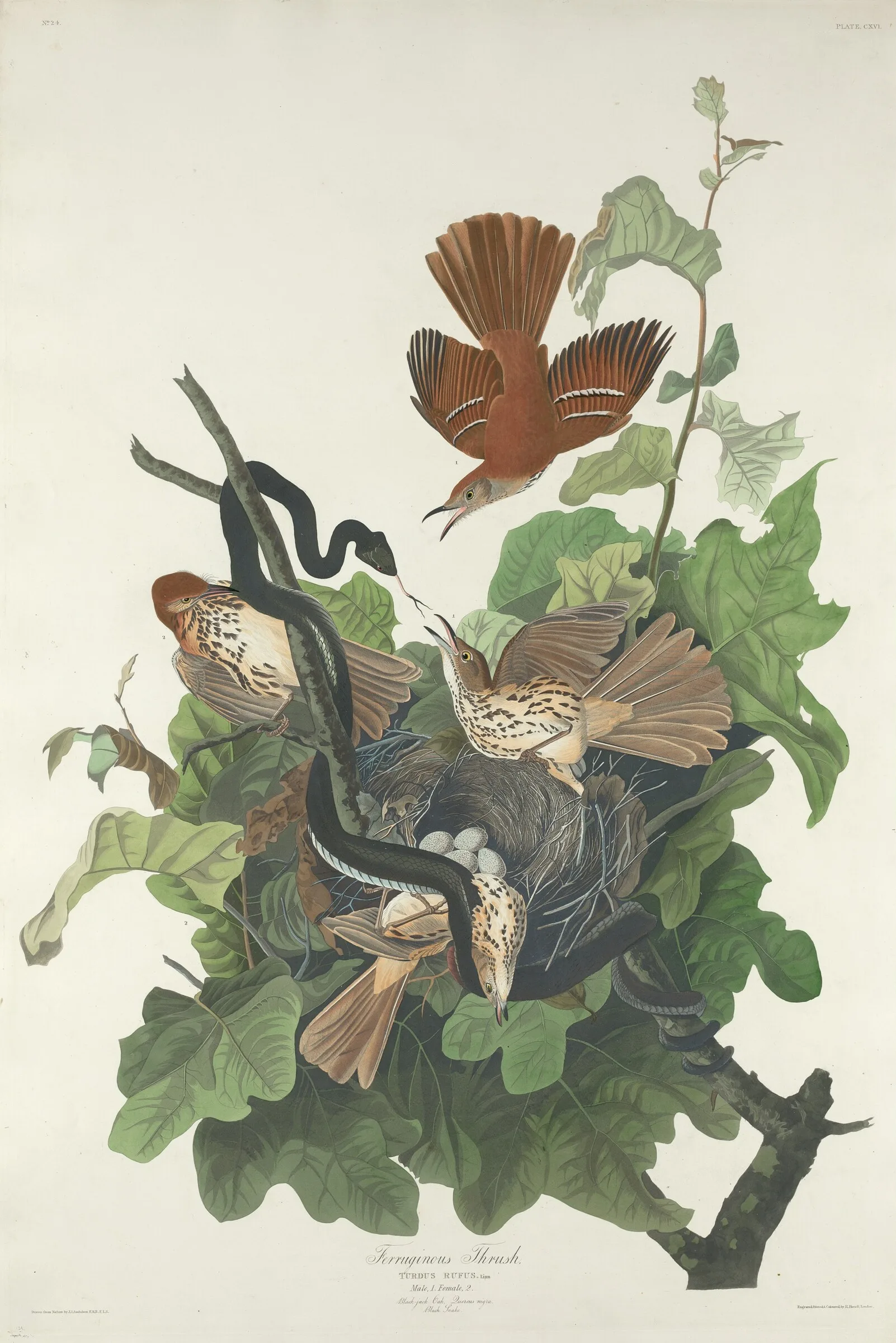
Audubon's “Ferruginous Thrush”, The Birds of America, plate CXVI
Click or press Enter to enlarge
Open the full-resolution image (4572 px, National Gallery of Art)
| Plate | 116 (CXVI) |
|---|---|
| Audubon's name | Ferruginous Thrush |
| Modern name | Brown Thrasher |
| Scientific name | Toxostoma rufum |
| Status | Least Concern |
| Engraved by | Robert Havell, after Audubon's watercolor |
| Date | 1831 |
| Medium | Hand-colored engraving and aquatint on Whatman wove paper |
| Collections | Songbirds |
| This impression | National Gallery of Art, Washington, 1945.8.116; Gift of Mrs. Walter B. James |
About this plate
Plate 116 is one of Audubon's most dramatic compositions. A snake has upset a Brown Thrasher nest and coiled around the female. Her mate defends her, a second male dives in with open bill and a third grips the snake. Audubon opens the chapter by asking the reader to look at the plate, and says the snake was in the end beaten and the female, nearly dead, recovered after he held her for a few minutes.
Audubon called it the Ferruginous Thrush, Turdus rufus, and noted that most people called it the Brown Thrush or Thrasher. It is now Toxostoma rufum. It is not a true thrush but a member of the mockingbird family, and it has one of the largest song repertoires of any North American bird.
The Brown Thrasher breeds in thickets and hedgerows across the eastern and central United States and southern Canada and winters in the Southeast. It is the state bird of Georgia. Its numbers have fallen over recent decades, but it is listed as Least Concern.
Audubon wrote that the species was found all year in Louisiana, Florida, Georgia and the Carolinas, and that he saw none north of Nova Scotia. He described it as the most numerous thrush in the Union after the robin, migrating by day, alone and close to the ground.
In Audubon's words
With open bill he is already prepared to strike a vengeful blow at the reptile, his bright eye glancing hatred at his foe. See a third grappling with the snake, and with all its might tearing the skin from its body! Should this alliance of noble spirits prove victorious, will it not remind you that innocence, although beset with difficulties, may, with the aid of friendship, extricate herself with honour? The birds in the case represented were greatly the sufferers: their nest was upset, their eggs lost, and the life of the female in imminent danger. But the snake was finally conquered, and a jubilee held over its carcass by a crowd of thrushes and other birds, until the woods resounded with their notes of exultation. I was happy in contributing my share to the general joy, for, on taking the almost expiring bird into my hand for a few minutes, she recovered in some degree, and I restored her to her anxious mate.
John James Audubon, Ornithological Biography, vol. 2 (1834), “The Ferruginous Thrush”. Read the full chapter.



