Mississippi Kite (Plate 117)
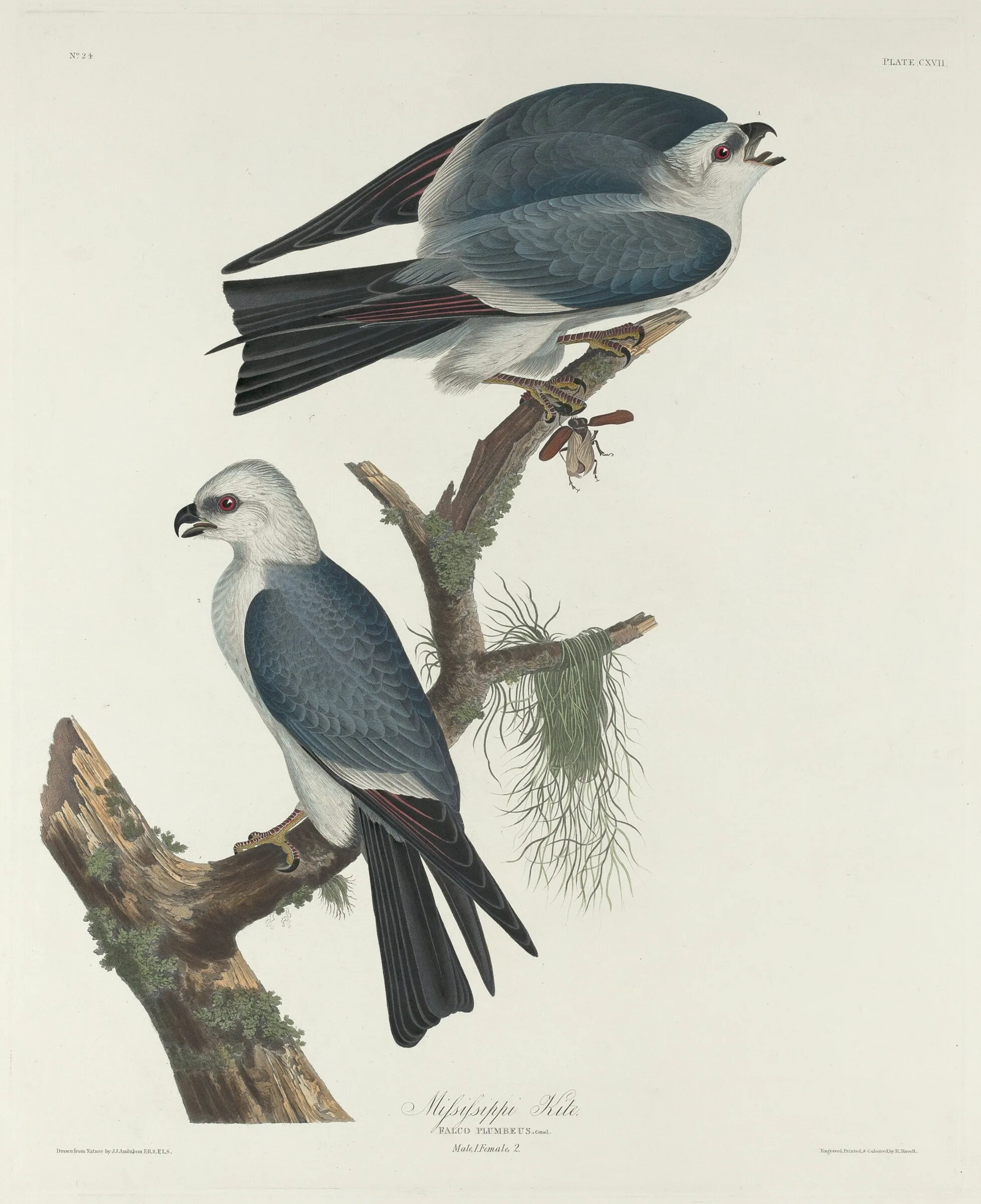
Audubon's “Mississippi Kite”, The Birds of America, plate CXVII
Click or press Enter to enlarge
Open the full-resolution image (3160 px, National Gallery of Art)
| Plate | 117 (CXVII) |
|---|---|
| Audubon's name | Mississippi Kite |
| Modern name | Mississippi Kite |
| Scientific name | Ictinia mississippiensis |
| Status | Least Concern |
| Engraved by | Robert Havell, after Audubon's watercolor |
| Date | 1831 |
| Medium | Hand-colored engraving and aquatint on Whatman wove paper |
| Collections | Hawks, Eagles and Falcons |
| This impression | National Gallery of Art, Washington, 1945.8.117; Gift of Mrs. Walter B. James |
About this plate
Plate 117 shows a male and a female Mississippi Kite, slim grey hawks with dark tails and long pointed wings. Audubon described the bird hunting on the wing, taking large insects and lizards and eating them in the air.
Audubon called it Falco plumbeus, a name that properly belongs to the related Plumbeous Kite of the American tropics. The species is now Ictinia mississippiensis. Alexander Wilson had named it the Mississippi Kite after collecting one near Natchez, and that English name has lasted.
Mississippi Kites breed in the southern United States, from the Carolinas to the southern Great Plains, and migrate to central South America for the winter. In the 20th century they spread into towns, golf courses and shelterbelts on the Plains and they now nest in city trees in places like Kansas and Texas. The species is listed as Least Concern.
Audubon wrote that the kite reached Lower Louisiana in mid-April in small parties and nested in the tops of Magnolia grandiflora. The chapter tells a story he admitted was to his discredit. He found a young kite on a branch, and when he fired at it the mother lifted her chick and carried it to another tree. He then shot both and left them under a log to draw later, but an animal ate them before he returned. He wrote that his punishment was merited.
In Audubon's words
At the report of the gun, the old bird came, holding food in her claws. She perceived me, but alighted, and fed her young with great kindness. I shot at both, and again missed, or at least did not succeed, which might have happened from my having only small shot in my gun. The mother flew in silence, sailed over head just long enough to afford me time to reload, returned, and to my great surprise gently lifted her young, and sailing with it to another tree, about thirty yards distant, deposited it there. My feelings at that moment I cannot express. I wished I had not discovered the poor bird; for who could have witnessed, without emotion, so striking an example of that affection which none but a mother can feel; so daring an act, performed in the midst of smoke, in the presence of a dreaded and dangerous enemy. I followed, however, and brought both to the ground at one shot, so keen is the desire of possession!
John James Audubon, Ornithological Biography, vol. 2 (1834), “The Mississippi Kite”. Read the full chapter.