Warbling Vireo (Plate 118)
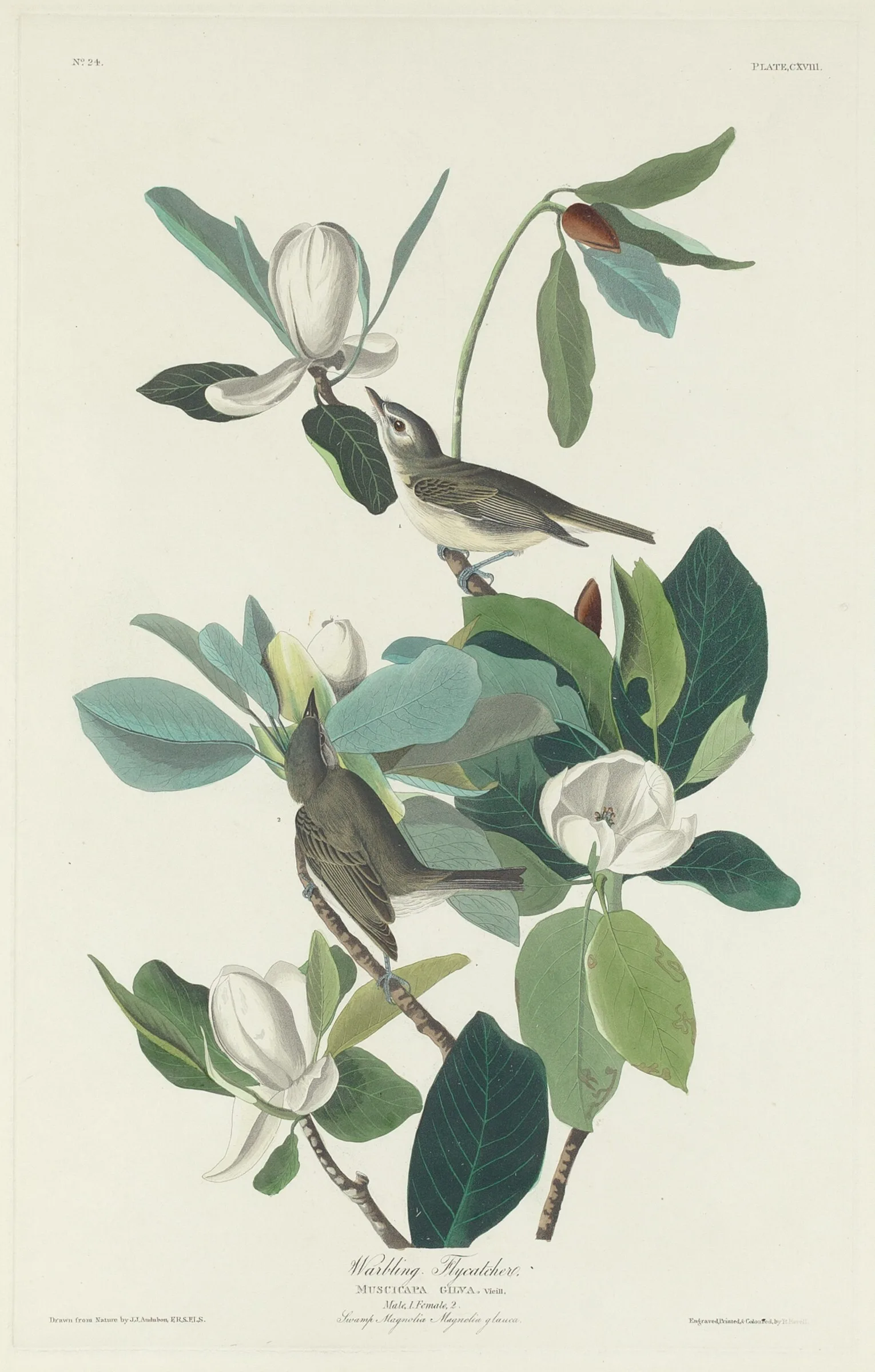
Audubon's “Warbling Flycatcher”, The Birds of America, plate CXVIII
Click or press Enter to enlarge
Open the full-resolution image (2400 px, National Gallery of Art)
| Plate | 118 (CXVIII) |
|---|---|
| Audubon's name | Warbling Flycatcher |
| Modern name | Warbling Vireo |
| Scientific name | Vireo gilvus |
| Status | Least Concern |
| Engraved by | Robert Havell, after Audubon's watercolor |
| Date | 1831 |
| Medium | Hand-colored engraving and aquatint on Whatman wove paper |
| Collections | Songbirds |
| This impression | National Gallery of Art, Washington, 1945.8.118; Gift of Mrs. Walter B. James |
About this plate
Plate 118 shows a male and a female Warbling Vireo, small plain grey-olive birds with a pale eyebrow. Audubon's chapter is built around a nest, and the plate is generally described as showing the pair with their hanging cup nest.
Audubon headed the chapter 'The Warbling Flycatcher or Vireo' and used Bonaparte's name Vireo gilvus, which is still in use. Vireos were then often lumped with the flycatchers. They are now known to form their own family, Vireonidae, more closely related to shrikes and crows.
The Warbling Vireo breeds across much of North America in tall deciduous trees, especially cottonwoods, willows and poplars near water, and winters in Mexico and Central America. Its song is a long, run-on warble. It is listed as Least Concern.
Audubon describes watching a pair build their nest in a Lombardy poplar that almost touched his lodging window at Camden, New Jersey, where he had gone in May to watch migrating warblers. The birds worked for eight days, attaching grass to knots on the branch and bark of the trunk and adding bits of hornet nest and corn husk. He followed them out of the village to an old haystack where they gathered fine grasses.
In Audubon's words
One morning I observed both of them at work; they had already attached some slender blades of grass to the knots on the branch and the bark of the trunk, and had given them a circular disposition. They continued working downwards and outwards, until the structure exhibited the form of their delicate tenement. Before the end of the second day, bits of hornets' nests and particles of corn-husks had been attached to it by pushing them between the rows of grass, and fixing them with silky substances. On the third day, the birds were absent, nor could I hear them anywhere in the neighbourhood, and thinking that a cat might have caught them from the edge of the roof, I despaired of seeing them again.
John James Audubon, Ornithological Biography, vol. 2 (1834), “The Warbling Flycatcher or Vireo”. Read the full chapter.



