Yellow-throated Vireo (Plate 119)
Audubon's “Yellow-throated Vireo”, The Birds of America, plate CXIX
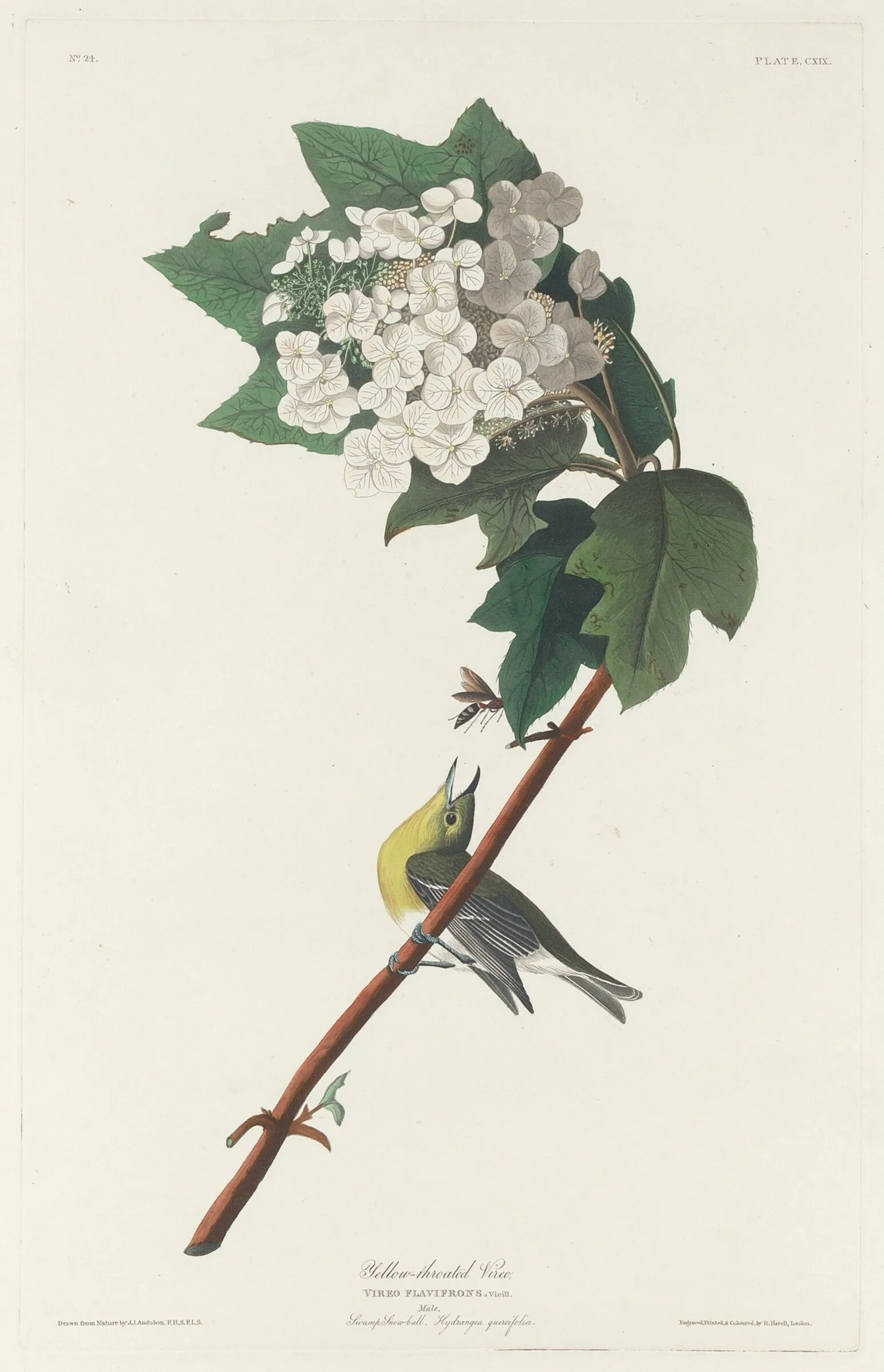
Click or press Enter to enlarge
Open the full-resolution image (2416 px, National Gallery of Art)
| Plate | 119 (CXIX) |
|---|---|
| Audubon's name | Yellow-throated Vireo |
| Modern name | Yellow-throated Vireo |
| Scientific name | Vireo flavifrons |
| Status | Least Concern |
| Engraved by | Robert Havell, after Audubon's watercolor |
| Date | 1831 |
| Medium | Hand-colored engraving and aquatint on Whatman wove paper |
| Size | plate: 49.8 x 31.4 cm (19 5/8 x 12 3/8 in.) sheet: 100.5 x 67.9 cm (39 9/16 x 26 3/4 in.) |
| Plants and setting | Oakleaf hydrangea (Hydrangea quercifolia), which Audubon called the Swamp Snowball |
| Collections | Songbirds |
| This impression | National Gallery of Art, Washington, 1945.8.119; Gift of Mrs. Walter B. James |
About this plate
Plate 119 shows a single male Yellow-throated Vireo on a stem of oakleaf hydrangea in flower. Audubon called the plant the Swamp Snowball, Hydrangea quercifolia, and wrote that it grew on the sandy banks of small streams in the uplands of Louisiana, with white flower clusters that dry on the stalk and last into winter.
Audubon used Vieillot's name Vireo flavifrons, which is still current. Its bright yellow throat and breast, white wing bars and yellow spectacles make it the most colourful vireo of the eastern forest.
The species breeds in tall deciduous and mixed woods across the eastern United States and southern Canada and winters from southern Mexico to northern South America. It forages slowly through the canopy, as Audubon described, and builds a deep cup nest hung from a fork near the end of a branch. It is listed as Least Concern.
Audubon wrote that the bird was rare in Louisiana, where he saw it only in early spring and late autumn, and that it was common only from Pennsylvania eastward. He described its song as slow, plaintive syllables like pree-a, rising and falling, and compared its careful habits with those of the Red-eyed Vireo.
In Audubon's words
It is more silent than either of the species above mentioned, although its notes have a strong resemblance to those of the Red-eyed. These notes are more measured and plaintive than those of any of its tribe, sometimes consisting of sounds resembling the syllables prēe-ā, preē-ā, rising and falling in sweet modulation. One might imagine them the notes of a bird lost in the woods, and they make a strong impression on the mind of the listener. Now and then the sight of his mate seems to animate the male, when he repeats the same syllables eight or ten times in succession.
John James Audubon, Ornithological Biography, vol. 2 (1834), “The Yellow-throated Flycatcher, or Vireo”. Read the full chapter.



