Eastern Phoebe (Plate 120)
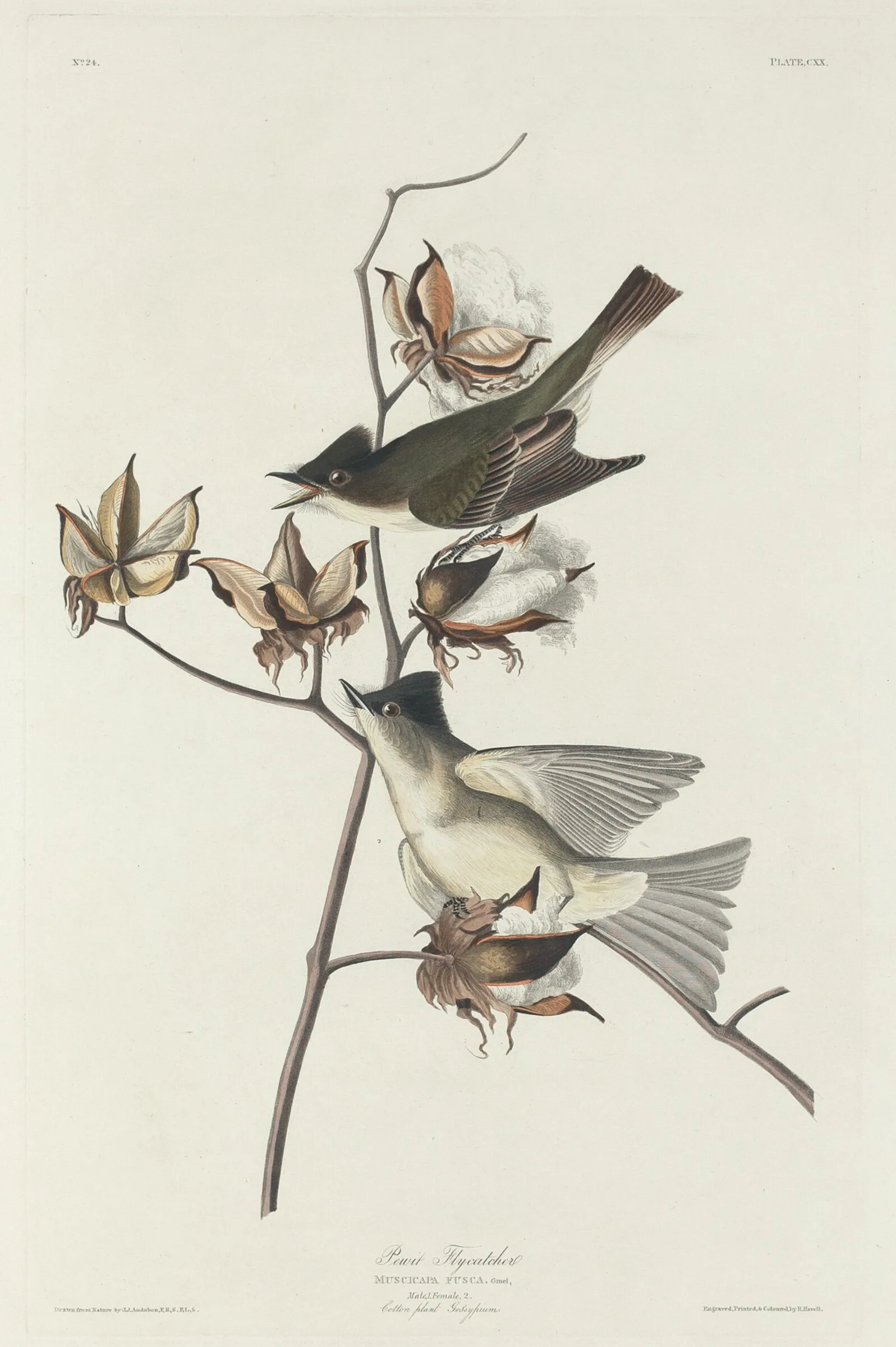
Audubon's “Pewit Flycatcher”, The Birds of America, plate CXX
Click or press Enter to enlarge
Open the full-resolution image (2431 px, National Gallery of Art)
| Plate | 120 (CXX) |
|---|---|
| Audubon's name | Pewit Flycatcher |
| Modern name | Eastern Phoebe |
| Scientific name | Sayornis phoebe |
| Status | Least Concern |
| Engraved by | Robert Havell, after Audubon's watercolor |
| Date | 1831 |
| Medium | Hand-colored engraving and aquatint on Whatman wove paper |
| Collections | Songbirds |
| This impression | National Gallery of Art, Washington, 1945.8.120; Gift of Mrs. Walter B. James |
About this plate
Plate 120 shows a male and a female Eastern Phoebe, plain grey-brown flycatchers that wag their tails. The chapter is one of the most personal in the Ornithological Biography, and the plate is closely tied to Audubon's early years in Pennsylvania.
Audubon called it the Pewee Flycatcher, Muscicapa fusca; the plate is lettered Pewit Flycatcher. It is now the Eastern Phoebe, Sayornis phoebe, named for its burry fee-bee song. It is one of the earliest flycatchers to return north in spring because it can eat berries in cold weather.
The species breeds across eastern North America and winters in the southern United States and Mexico. It often nests under bridges, eaves and rock ledges, placing a mud and moss cup on a vertical surface. It is common and listed as Least Concern.
Audubon describes a pair that nested over the entrance of a small cave on the banks of Perkiomen Creek, near his father's farm at Mill Grove. He spent days in the cave until the birds accepted him and watched the female lay her first egg. It was with the young of these phoebes that he tied light silver threads to their legs and found two marked birds nesting nearby the next year. This is usually cited as the first bird-banding experiment in North America.
In Audubon's words
Several days in succession I went to the spot, and saw with pleasure that as my visits increased in frequency, the birds became more familiarized to me, and, before a week had elapsed, the Pewees and myself were quite on terms of intimacy. It was now the 10th of April; the spring was forward that season, no more snow was to be seen, Redwings and Grakles were to be found here and there. The Pewees, I observed, began working at their old nest. Desirous of judging for myself, and anxious to enjoy the company of this friendly pair, I determined to spend the greater part of each day in the cave. My presence no longer alarmed either of them. They brought a few fresh materials, lined the nest anew, and rendered it warm by adding a few large soft feathers of the common goose, which they found strewn along the edge of the water in the creek.
John James Audubon, Ornithological Biography, vol. 2 (1834), “The Pewee Flycatcher”. Read the full chapter.



