Dark-eyed Junco (Plate 13)
Audubon's “Snow-Bird”, The Birds of America, plate XIII
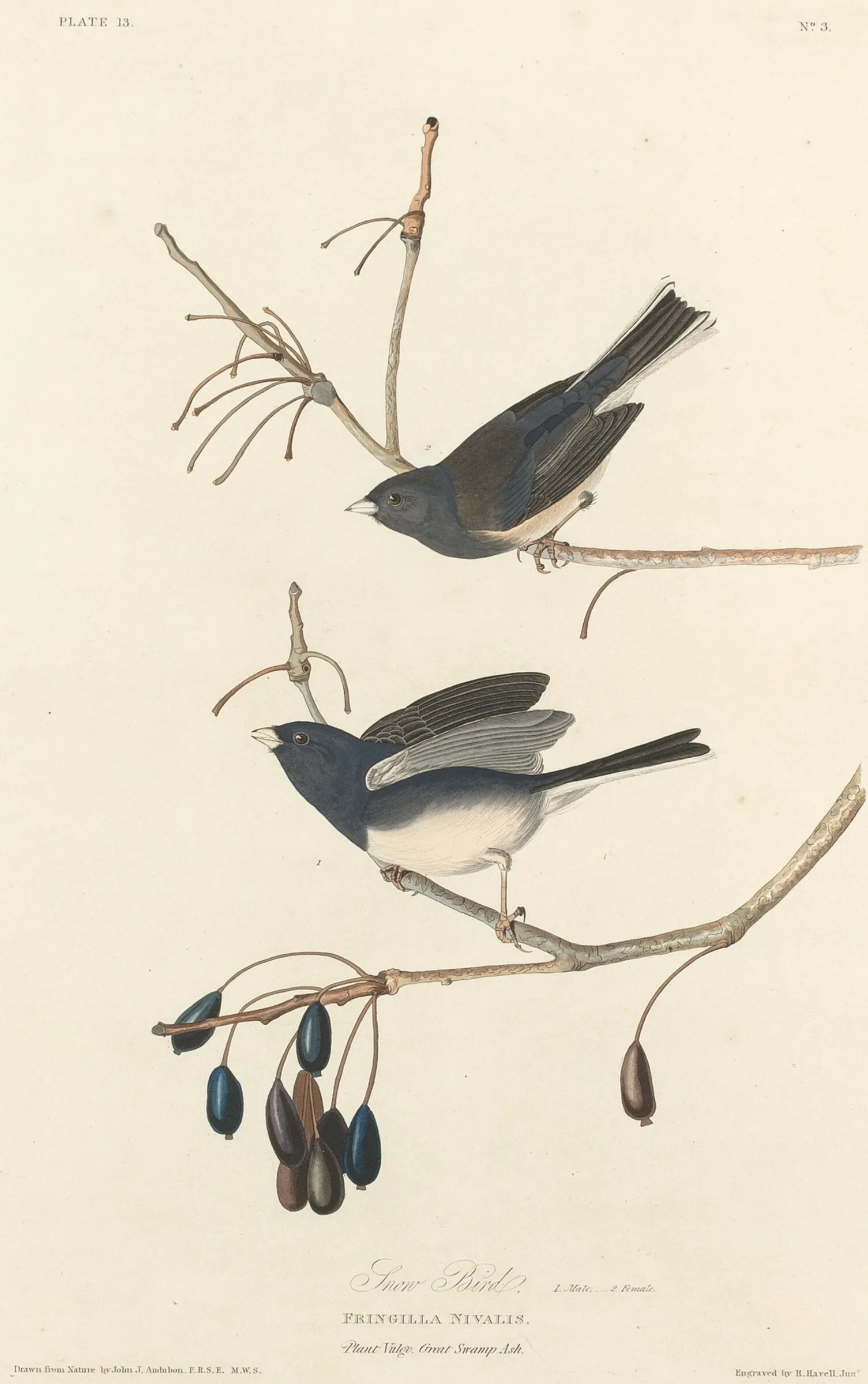
Click or press Enter to enlarge
Open the full-resolution image (2240 px, National Gallery of Art)
| Plate | 13 (XIII) |
|---|---|
| Audubon's name | Snow-Bird |
| Modern name | Dark-eyed Junco |
| Scientific name | Junco hyemalis |
| Status | Least Concern |
| Engraved by | Robert Havell, after Audubon's watercolor |
| Date | 1827 |
| Medium | Hand-colored engraving and aquatint on Whatman wove paper |
| Plants and setting | Tupelo (Nyssa) twig with fruit |
| Collections | Songbirds |
| This impression | National Gallery of Art, Washington, 1945.8.13; Gift of Mrs. Walter B. James |
About this plate
Plate 13 shows a male and female Dark-eyed Junco on a twig of Tupelo with its dark purple fruit. Audubon wrote that he shot the pair on one of these trees in the low grounds of Louisiana. The male is dark slate grey above with a white belly. The female is browner. The plate was engraved by Robert Havell in 1827.
Audubon described the bird as a winter visitor to Louisiana from early November until spring. He wrote that it grew so tame in hard weather that it became a companion to every child, and that Americans cherished it as Europeans did the Robin. He saw it far up the Arkansas River, in Maine and on the Upper Lakes. He also noted strings of them for sale as food in the New Orleans market.
The bird is the Dark-eyed Junco, Junco hyemalis. The eastern form shown by Audubon is the Slate-colored Junco. In 1973 the American Ornithologists' Union merged it with several western forms, such as the Oregon Junco, into one species. Snowbird is still a common folk name in the eastern United States.
Dark-eyed Juncos breed in coniferous and mixed forest across Canada, the northern United States and the western mountains, and in the Appalachians south to Georgia. In winter they spread across almost all of the United States. The species is one of the most numerous birds in North America and is listed as Least Concern.
In Audubon's words
So gentle and tame does it become on the least approach of hard weather, that it forms, as it were, a companion to every child. Indeed, there is not an individual in the Union who does not know the little Snow Bird, which, in America, is cherished as the Robin is in Europe. I have seen it fed by persons from the "Old Country," and have always been pleased by such a sight. During fine weather, however, it becomes more timorous, and keeps aloof, resorting to the briar patches and the edges of the fences; but even then it is easily approached, and will suffer a person on horseback to pass within a few feet of the place where it may be searching for food on the road, or the rails of the fences on which it is perched.
John James Audubon, Ornithological Biography, vol. 1 (1831), “The Snow Bird”. Read the full chapter.



