Snowy Owl (Plate 121)
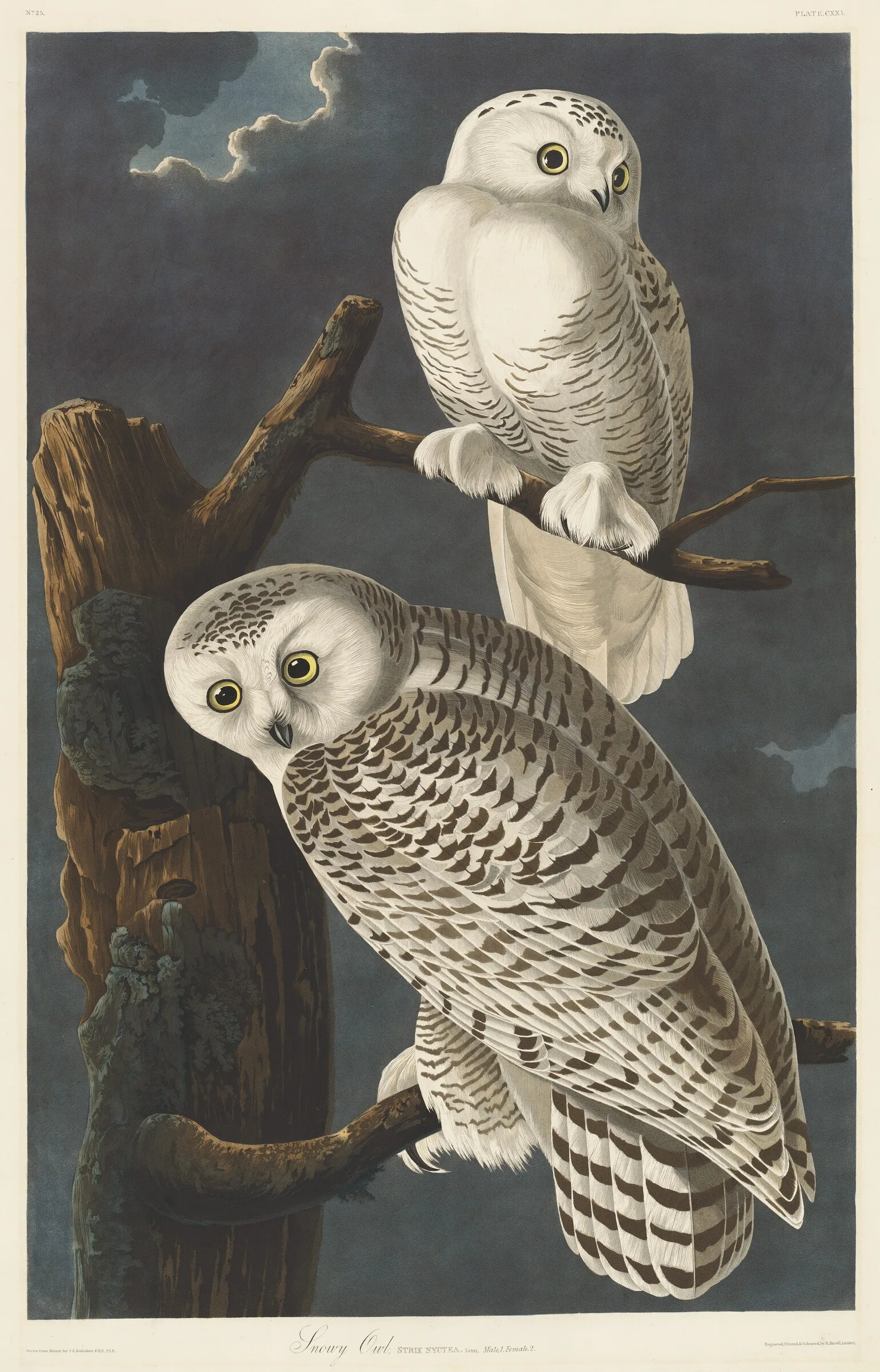
Audubon's “Snowy Owl”, The Birds of America, plate CXXI
Click or press Enter to enlarge
Open the full-resolution image (5211 px, National Gallery of Art)
| Plate | 121 (CXXI) |
|---|---|
| Audubon's name | Snowy Owl |
| Modern name | Snowy Owl |
| Scientific name | Bubo scandiacus |
| Status | Vulnerable |
| Engraved by | Robert Havell, after Audubon's watercolor |
| Date | 1831 |
| Medium | Hand-colored engraving and aquatint on Whatman wove paper |
| Size | plate: 89.5 x 65.4 cm (35 1/4 x 25 3/4 in.) sheet: 100.7 x 68 cm (39 5/8 x 26 3/4 in.) |
| Plants and setting | Dead tree; night sky |
| Collections | Owls |
| This impression | National Gallery of Art, Washington, 1945.8.121; Gift of Mrs. Walter B. James |
About this plate
Plate 121 shows a male and a female Snowy Owl perched on a dead tree against a dark night sky. The male is almost pure white; the larger female is heavily barred with dark brown. The night setting is unusual in the series and suits Audubon's note that the owl hunts both by day and at dusk.
Audubon called it Strix nyctea. For much of the 20th century it was placed in its own genus as Nyctea scandiaca. DNA studies showed it belongs with the horned owls, and it is now Bubo scandiacus, a close relative of the Great Horned Owl.
Snowy Owls breed on the Arctic tundra around the world, where they feed largely on lemmings, and move south in winter. In some years large numbers reach the northern United States. In 2017 the IUCN moved the species to Vulnerable after new estimates put the world population far lower than once thought.
Audubon wrote that the owl was a winter visitor from November to early February, most common in Massachusetts and Maine, and that he had seen it in Kentucky and Ohio. He described it catching fish at rapids in the manner of a wild cat, robbing muskrat traps and striking ducks and pigeons in flight. He also listed birds taken near Charleston and at Columbia, South Carolina.
In Audubon's words
The Snowy Owl hunts during the day, as well as in the dusk. Its flight is firm and protracted, although smooth and noiseless. It passes swiftly over its hunting ground, seizes its prey by instantaneously falling on it, and generally devours it on the spot. When the objects of its pursuit are on wing, such as ducks, grouse, or pigeons, it gains upon them by urging its speed, and strikes them somewhat in the manner of the Peregrine Falcon. It is fond of the neighbourhood of rivers and small streams, having in their course cataracts or shallow rapids, on the borders of which it seizes on fishes, in the manner of our wild cat.
John James Audubon, Ornithological Biography, vol. 2 (1834), “The Snowy Owl”. Read the full chapter.
Snowy Owl (Plate 121): the story behind one of the most famous plates in the collection →