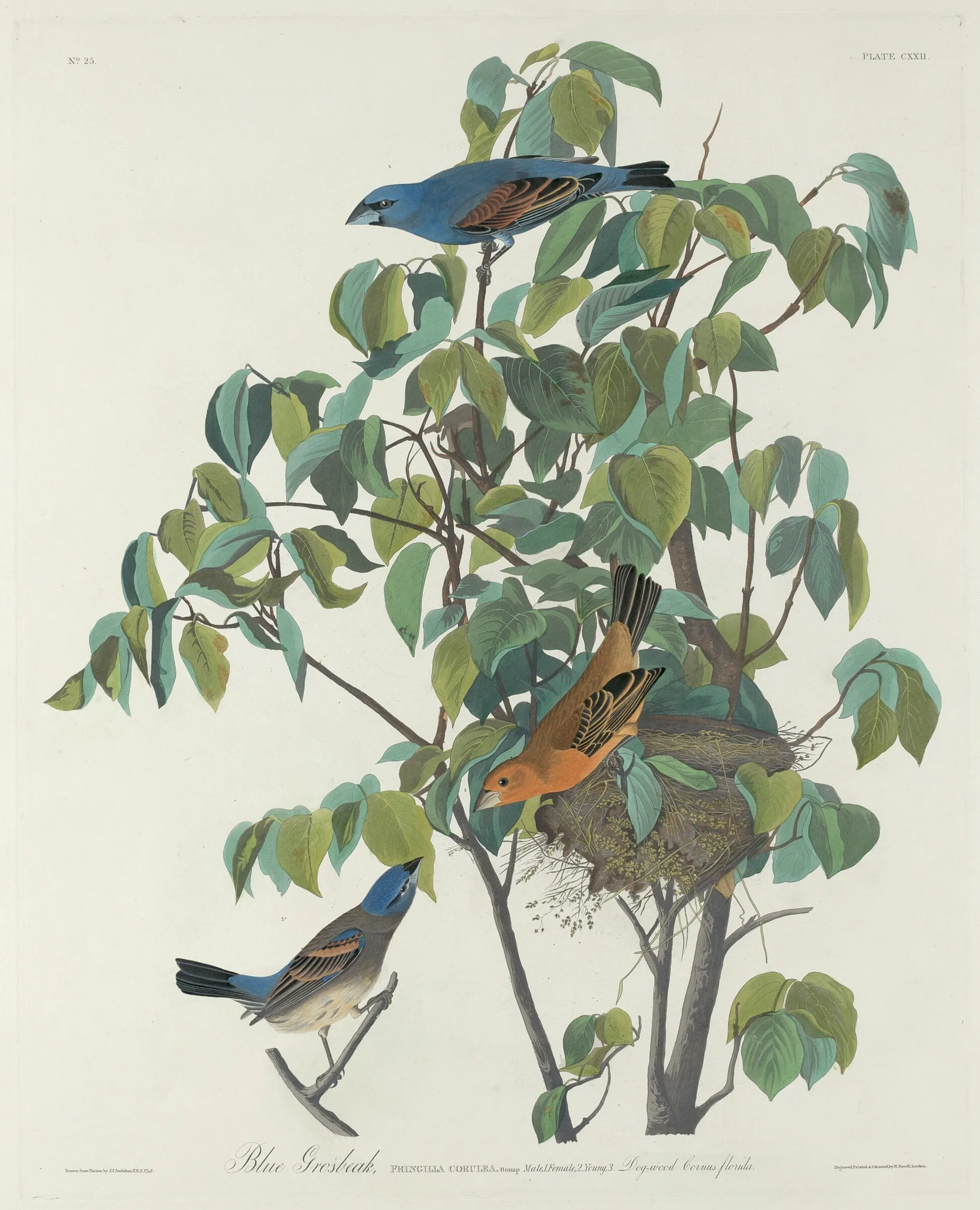
Blue Grosbeak (Plate 122)
Audubon's “Blue Grosbeak”, The Birds of America, plate CXXII
Click or press Enter to enlarge
Open the full-resolution image (3177 px, National Gallery of Art)
| Plate | 122 (CXXII) |
|---|---|
| Audubon's name | Blue Grosbeak |
| Modern name | Blue Grosbeak |
| Scientific name | Passerina caerulea |
| Status | Least Concern |
| Engraved by | Robert Havell, after Audubon's watercolor |
| Date | 1831 |
| Medium | Hand-colored engraving and aquatint on Whatman wove paper |
| Size | plate: 65.4 x 52.1 cm (25 3/4 x 20 1/2 in.) sheet: 99.7 x 67.3 cm (39 1/4 x 26 1/2 in.) |
| Plants and setting | Dogwood twig with the nest, cut by Audubon after the young had flown |
| Collections | Songbirds |
| This impression | National Gallery of Art, Washington, 1945.8.122; Gift of Mrs. Walter B. James |
About this plate
Plate 122 shows a male, a female and young Blue Grosbeaks around a nest on a twig of dogwood. Audubon explains exactly where it came from. He found a nest in a low dogwood with two dead young covered in insects, removed the insects, put the surviving young back and later, after they had flown, cut the twig and drew it with the nest.
Audubon used Bonaparte's name Fringilla caerulea. The bird was long placed in the genus Guiraca and is now Passerina caerulea, in the cardinal family, close to the Indigo Bunting. The deep blue male has chestnut wing bars; females and young are brown.
The Blue Grosbeak breeds across the southern two-thirds of the United States and south to Central America, in brushy fields, hedgerows and the edges of wetlands, and winters in Mexico and Central America. Its range has moved north in recent decades. It is listed as Least Concern.
Audubon wrote that the shy bird lived around the water reservoirs used to irrigate rice plantations in the Carolinas, among alligators and herons. He said it reached Lower Louisiana in mid-March, the males arriving before the females, and was a rather scarce bird in the Southern States. The chapter also quotes John Bachman on birds kept in his aviary.
In Audubon's words
If the place is silent, and the weather calm, this cautious bird gradually ascends some high tree, from the top of which it pours forth its melting melodies, the female sitting the while on her eggs in her grassy nest, in some low sheltered bush hard by. Her mate now and then relieves her from her task, provides her with food while she sits, and again lulls her to repose by his song. One brood and again another are hatched, reared, and led forth to find for themselves the food so abundantly spread around them. Humbly and inconspicuously clad as the young birds are, most of them escape the talon of the watchful Hawk, or the fire of the mischief-loving gunner. The parents soon join them, and no sooner is their favourite rice gathered, than the whole fly off, and gradually wend their way to warmer climes.
John James Audubon, Ornithological Biography, vol. 2 (1834), “The Blue Grosbeak”. Read the full chapter.



