Magnolia Warbler (Plate 123)
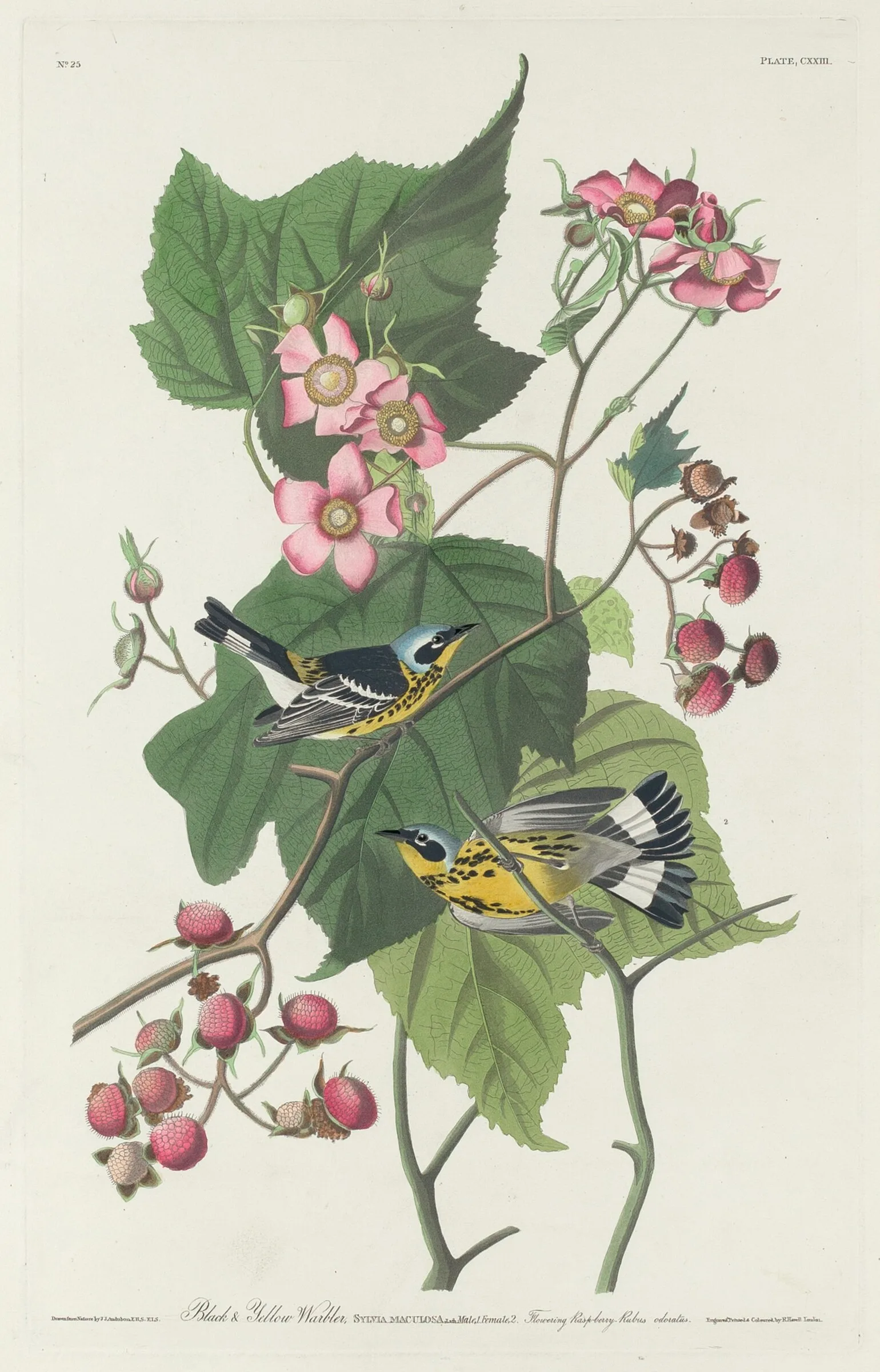
Audubon's “Black and Yellow Warbler”, The Birds of America, plate CXXIII
Click or press Enter to enlarge
Open the full-resolution image (2445 px, National Gallery of Art)
| Plate | 123 (CXXIII) |
|---|---|
| Audubon's name | Black and Yellow Warbler |
| Modern name | Magnolia Warbler |
| Scientific name | Setophaga magnolia |
| Status | Least Concern |
| Engraved by | Robert Havell, after Audubon's watercolor |
| Date | 1831 |
| Medium | Hand-colored engraving and aquatint on Whatman wove paper |
| Plants and setting | Flowering raspberry (Rubus odoratus) |
| Collections | Songbirds |
| This impression | National Gallery of Art, Washington, 1945.8.123; Gift of Mrs. Walter B. James |
About this plate
Plate 123 shows an adult male and female Magnolia Warbler on a stem of flowering raspberry, Rubus odoratus, with its large rose-pink flowers. Audubon noted that the plant grows in the undergrowth of woods and in old fields in the Middle and Eastern States. The young of the species had already appeared in his plate 50.
Audubon called it the Black and Yellow Warbler, Sylvia maculosa. It is now the Magnolia Warbler, Setophaga magnolia. The English name comes from Alexander Wilson, who collected one in a magnolia in Mississippi, though the bird nests in northern conifers rather than magnolias.
The Magnolia Warbler breeds in young spruce and fir forest across Canada and the northeastern United States and winters from southern Mexico to Panama and the Caribbean. It is common and listed as Least Concern. The white band across the middle of the tail is a good field mark at any age.
Audubon describes reaching Eastport, Maine, in May 1833 on his way to Labrador and finding the bird so abundant that it seemed an army had come to occupy the country. Icicles still hung on the shore. On cold mornings children caught the chilled birds by hand and brought them to him. He met it again in the Bay of Fundy, the Magdalen Islands and Labrador.
In Audubon's words
While in Maine, on my way to Labrador, in the month of May, I observed them to be very abundant by the roads, in the fields, the low woods, and even the orchards and gardens. In fact, so numerous were those interesting birds, that you might have fancied that an army of them had assembled to take possession of the country. Scarce a leaf was yet expanded, large icicles hung along the rocky shores, and I could not but feel surprised at the hardihood of the little adventurers. At night they roosted in numbers in the small evergreen trees, and by day they were to be seen flitting about wherever the sun shone. If the morning was cold, you might catch them with the hand, and several specimens, procured in that manner by children, were brought to me. This happened in the neighbourhood of Eastport.
John James Audubon, Ornithological Biography, vol. 2 (1834), “The Black and Yellow Warbler”. Read the full chapter.



