Wilson's Warbler (Plate 124)
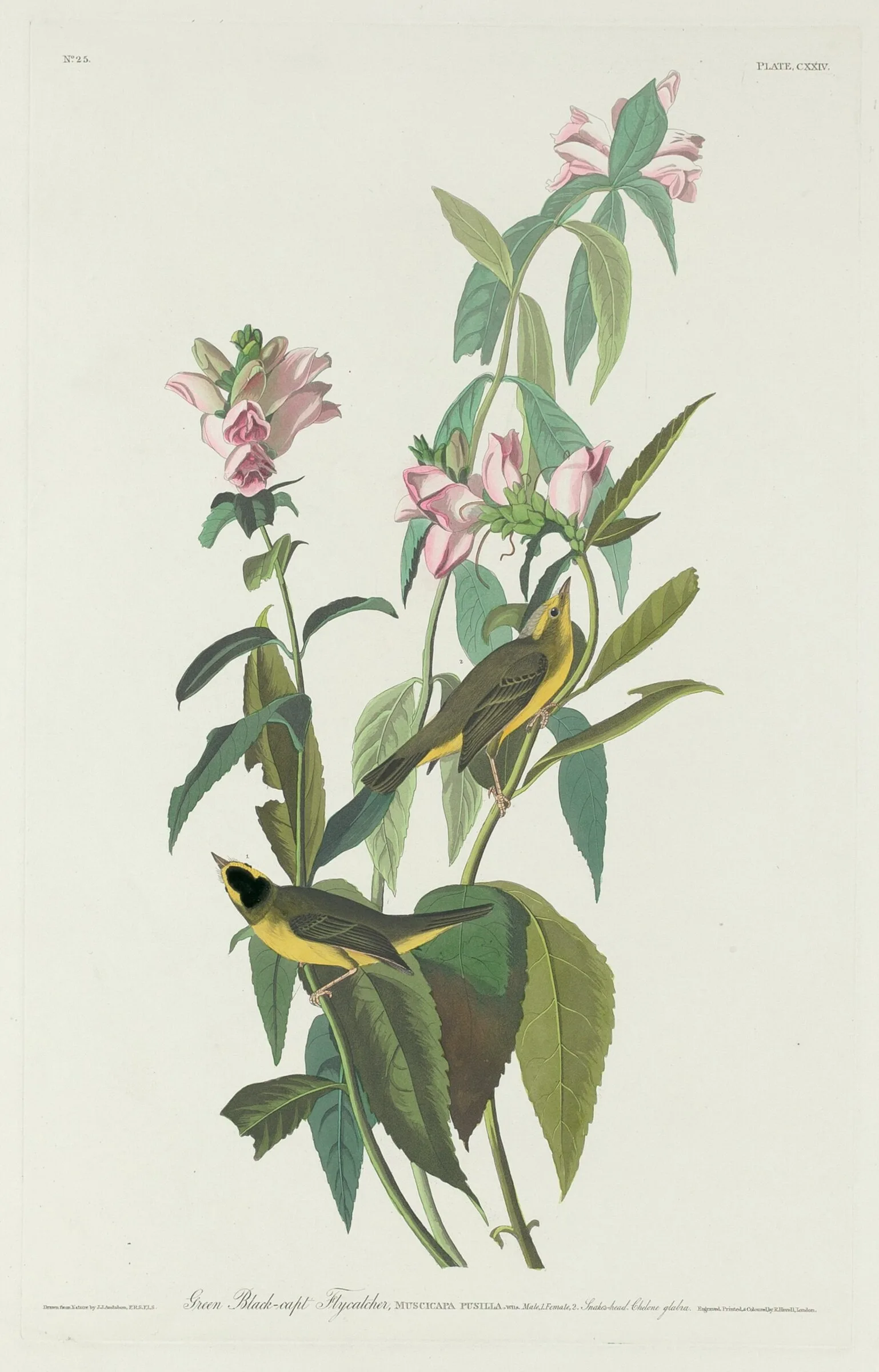
Audubon's “Green Black-Capt Flycatcher”, The Birds of America, plate CXXIV
Click or press Enter to enlarge
Open the full-resolution image (2473 px, National Gallery of Art)
| Plate | 124 (CXXIV) |
|---|---|
| Audubon's name | Green Black-Capt Flycatcher |
| Modern name | Wilson's Warbler |
| Scientific name | Cardellina pusilla |
| Status | Least Concern |
| Engraved by | Robert Havell, after Audubon's watercolor |
| Date | 1831 |
| Medium | Hand-colored engraving and aquatint on Whatman wove paper |
| Plants and setting | White turtlehead (Chelone glabra), which Audubon called the Snake's Head |
| Collections | Songbirds |
| This impression | National Gallery of Art, Washington, 1945.8.124; Gift of Mrs. Walter B. James |
About this plate
Plate 124 shows a male and a female Wilson's Warbler on a stem of white turtlehead, which Audubon called the Snake's Head, Chelone glabra. The male has a neat black cap. Audubon noted that the female lacks the cap and has a yellowish-grey crown instead. The plant grows along rivers and swamps.
Audubon called the bird the Green Black-capped Flycatcher and used the name Muscicapa wilsonii, honouring Alexander Wilson. He placed it with the flycatchers because it catches insects in the air with an audible snap of the bill. It is in fact a wood-warbler, now Cardellina pusilla, and the modern English name keeps the link to Wilson.
Wilson's Warbler breeds across Canada, Alaska and the western mountains in wet thickets of willow and alder and winters from Mexico to Panama. It is one of the most common migrant warblers in the West. It is listed as Least Concern, though surveys show declines.
Audubon wrote that Wilson had seen only a few specimens in Delaware and New Jersey and wrongly thought it a southern bird. Audubon found it in Maine and abundant in Labrador and Newfoundland in 1833. He described a small nest placed in dwarf firs a few feet above the ground; modern accounts say the species usually nests on or near the ground.
In Audubon's words
It has all the habits of a true Flycatcher, feeding on small insects, which it catches entirely on the wing, snapping its bill with a smart clicking sound. It frequents the borders of the lakes, and such streams as are fringed with low bushes, from which it is seen every moment sallying forth, pursuing its insect prey for many yards at a time, and again throwing itself into its favourite thickets. The nest is placed on the extremity of a small horizontal branch, amongst the thick foliage of dwarf firs, not more than from three to five feet from the ground, and in the centre of the thickets of these trees so common in Labrador.
John James Audubon, Ornithological Biography, vol. 2 (1834), “The Green Black-capped Flycatcher”. Read the full chapter.



