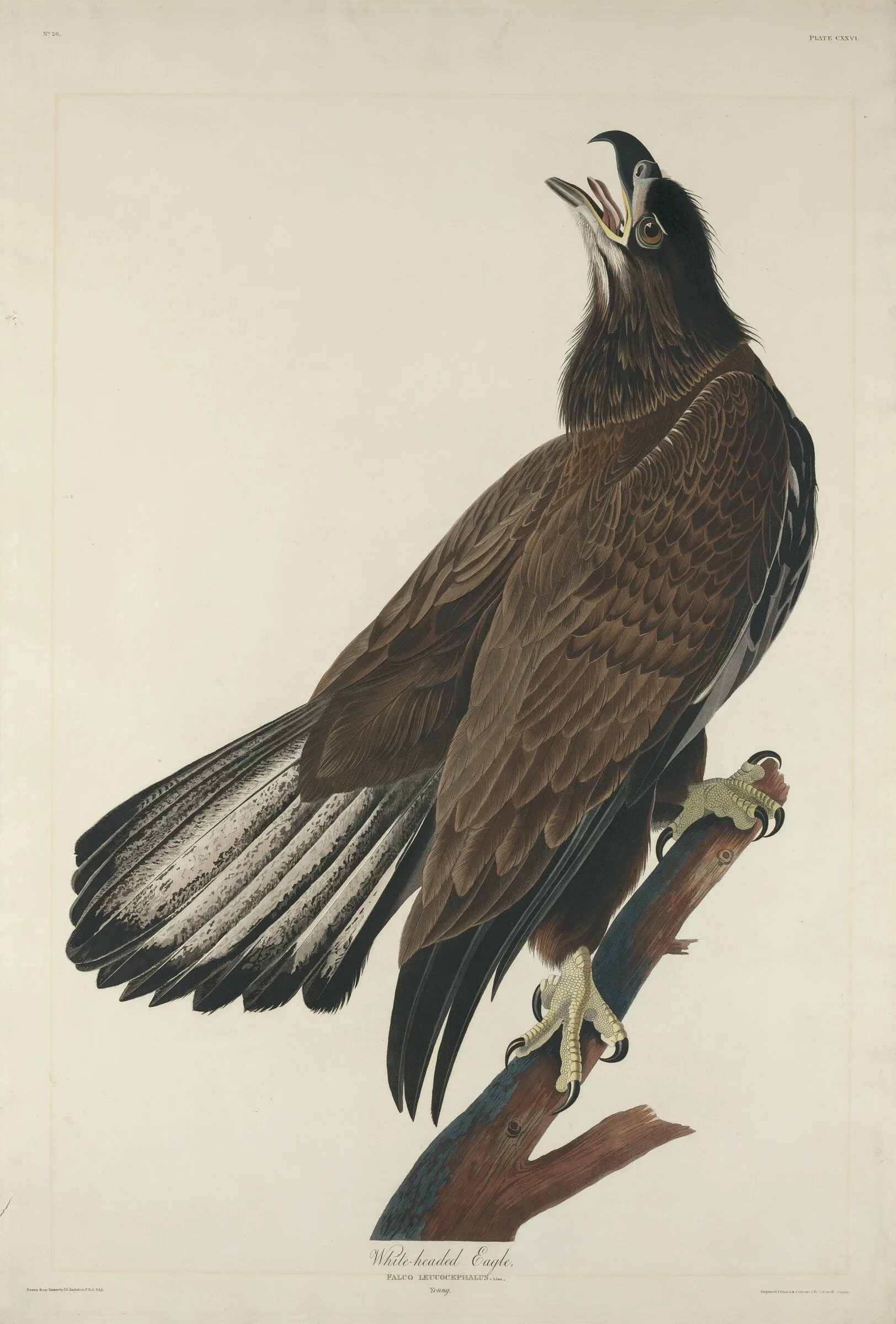
Bald Eagle (immature) (Plate 126)
Audubon's “White-Headed Eagle”, The Birds of America, plate CXXVI
Click or press Enter to enlarge
Open the full-resolution image (4619 px, National Gallery of Art)
| Plate | 126 (CXXVI) |
|---|---|
| Audubon's name | White-Headed Eagle |
| Modern name | Bald Eagle (immature) |
| Scientific name | Haliaeetus leucocephalus |
| Status | Least Concern |
| Engraved by | Robert Havell, after Audubon's watercolor |
| Date | 1832 |
| Medium | Hand-colored engraving and aquatint on Whatman wove paper |
| Collections | Hawks, Eagles and Falcons |
| This impression | National Gallery of Art, Washington, 1945.8.126; Gift of Mrs. Walter B. James |
About this plate
Plate 126 shows a young White-headed Eagle, that is, a Bald Eagle in its dark immature plumage before the white head and tail appear. Audubon had already shown the adult in plate 31 and explained that he figured the young separately so readers could recognise it.
Audubon used Linnaeus's name Falco leucocephalus. The bird is now Haliaeetus leucocephalus, a sea eagle. Young Bald Eagles take about five years to reach adult plumage, and their mottled brown stages caused confusion in Audubon's time. His Bird of Washington, plate 11, is widely thought to have been a large immature Bald Eagle.
The Bald Eagle lives across most of North America near coasts, rivers and lakes. It became rare in the lower 48 states in the mid-20th century because of shooting and DDT poisoning. After DDT was banned in 1972, numbers rose and the species was removed from the US endangered species list in 2007. It is listed as Least Concern.
The chapter is made up of journal entries. On 7 February 1832, on the St John's River in East Florida, Audubon saw four nests in tall pines while the United States schooner Spark lay at anchor. A shore party shot at two young eagles standing on a nest, and Audubon followed one that fluttered off on its first flight. He also recorded eagles feeding on mussels and sea urchins in the Bay of Fundy.
In Audubon's words
On approaching the nearest nest, we saw two young birds standing erect on its edge, while their parents were perched on the branches above them. As we went nearer, the old ones flew off silently, while the young did not seem to pay the least attention to us, this being a part of the woods where probably no white man had ever before put his foot, and the Eaglets having as yet had no experience of the barbarity of the race. The captain took the first shot: one of the birds was severely wounded, and tumbled half way from the nest towards the ground, when it recovered, flapped its wings, and suddenly sailed away until we lost sight of it as it flew into the woods.
John James Audubon, Ornithological Biography, vol. 2 (1834), “The White-headed Eagle”. Read the full chapter.