Rose-breasted Grosbeak (Plate 127)
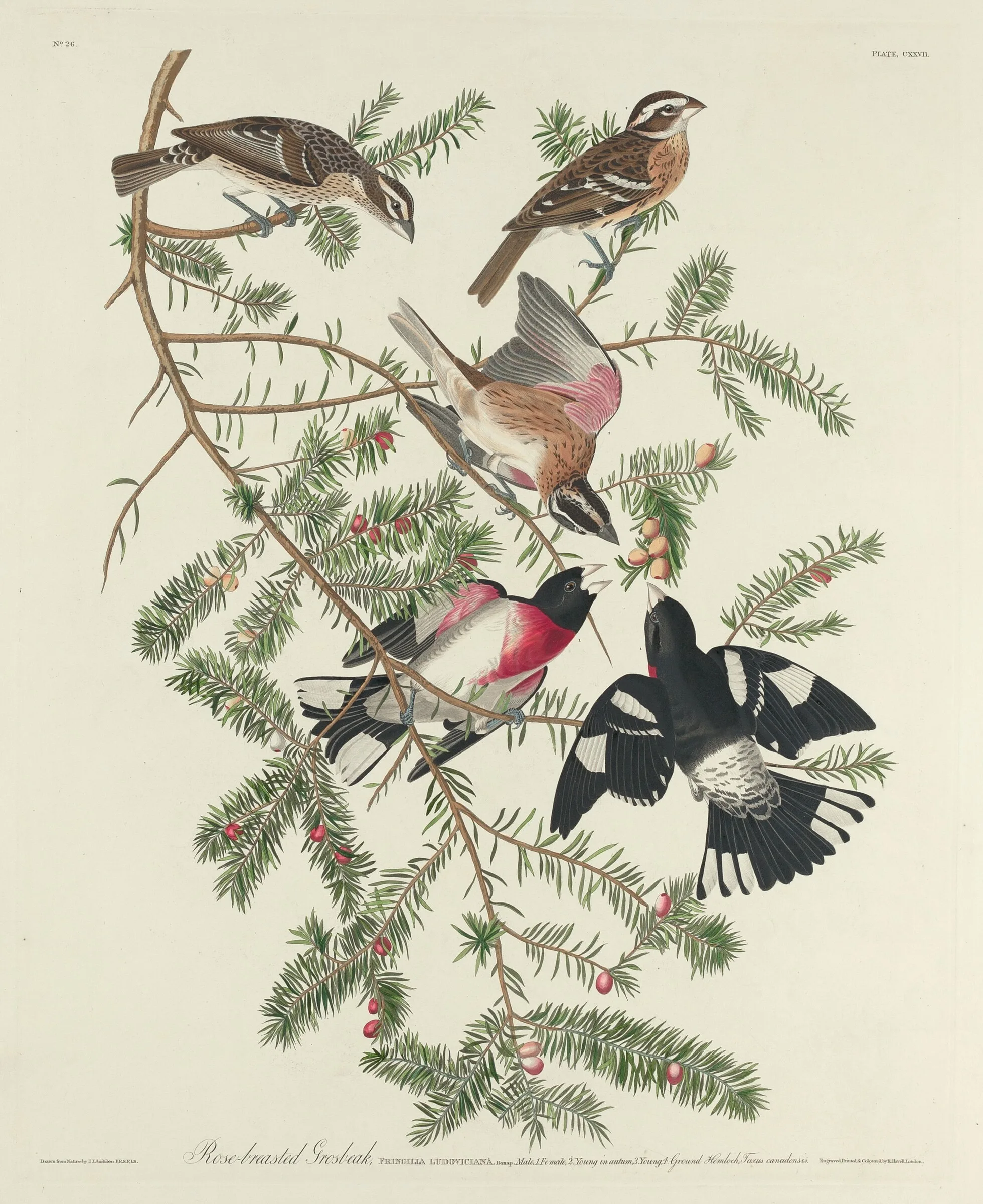
Audubon's “Rose-breasted Grosbeak”, The Birds of America, plate CXXVII
Click or press Enter to enlarge
Open the full-resolution image (3032 px, National Gallery of Art)
| Plate | 127 (CXXVII) |
|---|---|
| Audubon's name | Rose-breasted Grosbeak |
| Modern name | Rose-breasted Grosbeak |
| Scientific name | Pheucticus ludovicianus |
| Status | Least Concern |
| Engraved by | Robert Havell, after Audubon's watercolor |
| Date | 1832 |
| Medium | Hand-colored engraving and aquatint on Whatman wove paper |
| Collections | Songbirds |
| This impression | National Gallery of Art, Washington, 1945.8.127; Gift of Mrs. Walter B. James |
About this plate
Plate 127 shows a black and white male Rose-breasted Grosbeak with its rose-red breast patch, a streaked brown female and a young bird. The large pale bill that gives the bird its name is clear in all three figures.
Audubon used Bonaparte's name Fringilla ludoviciana, meaning 'of Louisiana', and the species is still Pheucticus ludovicianus. It is now placed in the cardinal family, not with the true finches. Males have rosy-red wing linings that show in flight.
The Rose-breasted Grosbeak breeds in deciduous and mixed woods across southern Canada and the northeastern and north-central United States and winters from Mexico to northern South America. Its song is like a sweeter, faster American Robin. It is listed as Least Concern.
The chapter opens with a night on the Mohawk River in New York in August. Audubon camped under a rock, and as he fell asleep a Rose-breasted Grosbeak began to sing in the dark so richly that sleep fled. He also recorded the species passing through Lower Louisiana in March and through Henderson, Kentucky, and Cincinnati, and kept a caged bird that sang on moonlit nights.
In Audubon's words
As I looked around on the fading features of the beautiful landscape, my heart turned towards my distant home, where my friends were doubtless wishing me, as I wished them, a happy night and peaceful slumbers. Then were heard the barkings of the watch-dog, and I tapped my faithful companion to prevent his answering them. The thoughts of my worldly mission then came over my mind, and having thanked the Creator of all for his never failing mercy, I closed my eyes, and was passing away into the world of dreaming existence, when suddenly there burst on my soul the serenade of the Rose-breasted bird, so rich, so mellow, so loud in the stillness of the night, that sleep fled from my eyelids. Never did I enjoy music more: it thrilled through my heart, and surrounded me with an atmosphere of bliss. One might easily have imagined that even the Owl, charmed by such delightful music, remained reverently silent.
John James Audubon, Ornithological Biography, vol. 2 (1834), “The Rose-breasted Grosbeak”. Read the full chapter.



