Gray Catbird (Plate 128)
Audubon's “Cat Bird”, The Birds of America, plate CXXVIII
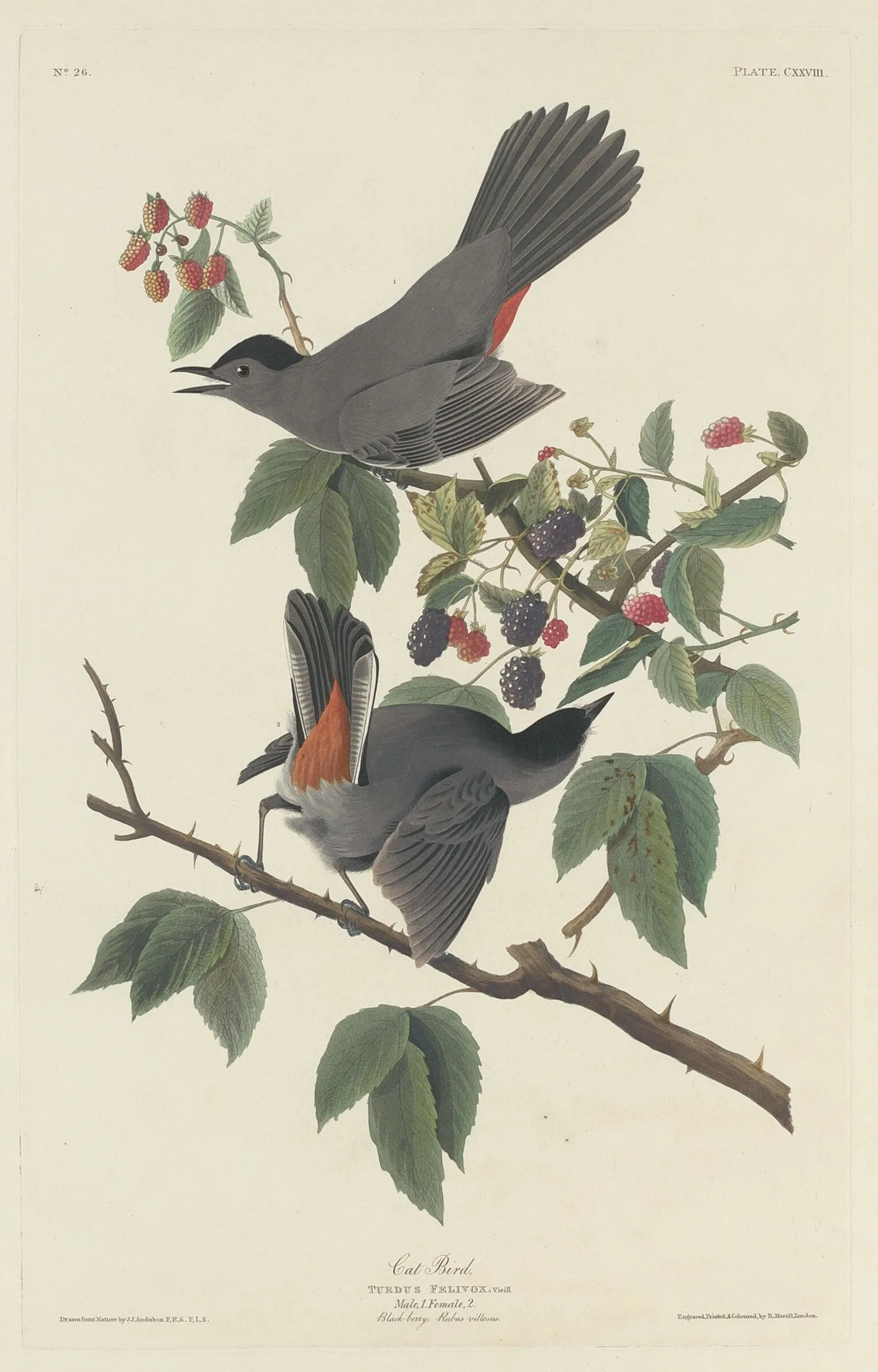
Click or press Enter to enlarge
Open the full-resolution image (2311 px, National Gallery of Art)
| Plate | 128 (CXXVIII) |
|---|---|
| Audubon's name | Cat Bird |
| Modern name | Gray Catbird |
| Scientific name | Dumetella carolinensis |
| Status | Least Concern |
| Engraved by | Robert Havell, after Audubon's watercolor |
| Date | 1832 |
| Medium | Hand-colored engraving and aquatint on Whatman wove paper |
| Collections | Songbirds |
| This impression | National Gallery of Art, Washington, 1945.8.128; Gift of Mrs. Walter B. James |
About this plate
Plate 128 shows a male and a female Gray Catbird, slate-grey birds with a black cap and a rusty patch under the tail. Audubon described them as familiar birds of gardens, orchards and hedges, building a large nest of twigs, briars, leaves and grass lined with black rootlets.
Audubon used Vieillot's name Turdus felivox, 'cat voice', and placed it among the thrushes. It is now Dumetella carolinensis, a member of the mockingbird and thrasher family. The common name comes from its mewing call. Like its relatives it is a fine mimic.
The Gray Catbird breeds across most of the United States and southern Canada east of the Rockies and winters along the Gulf and Atlantic coasts, in the Caribbean and in Central America. It is common in shrubby places and is listed as Least Concern.
Audubon wrote that a few spend the winter in southern East Florida, that the birds reach Charleston about 20 March and that they are abundant in Pennsylvania, where it was hard to walk through an orchard without hearing them. He said they migrate mostly at night, moving from bush to bush. He found none in Maine or the British provinces, but the species now breeds there.
In Audubon's words
Their migration is performed mostly during night, when they move slowly from bush to bush, scarcely ever extending their flight beyond the breadth of the rivers which they meet with. In a place where not an individual is to be seen in an afternoon, in the months of April or May, a considerable number may be found the following morning. They seem to give a preference to the Middle States during the summer season. Pennsylvania is particularly favoured by them; and it would be difficult to walk through an orchard or garden, along a field, or the borders of a wood, without being saluted by their plaintive notes.
John James Audubon, Ornithological Biography, vol. 2 (1834), “The Cat Bird”. Read the full chapter.



