Great Crested Flycatcher (Plate 129)
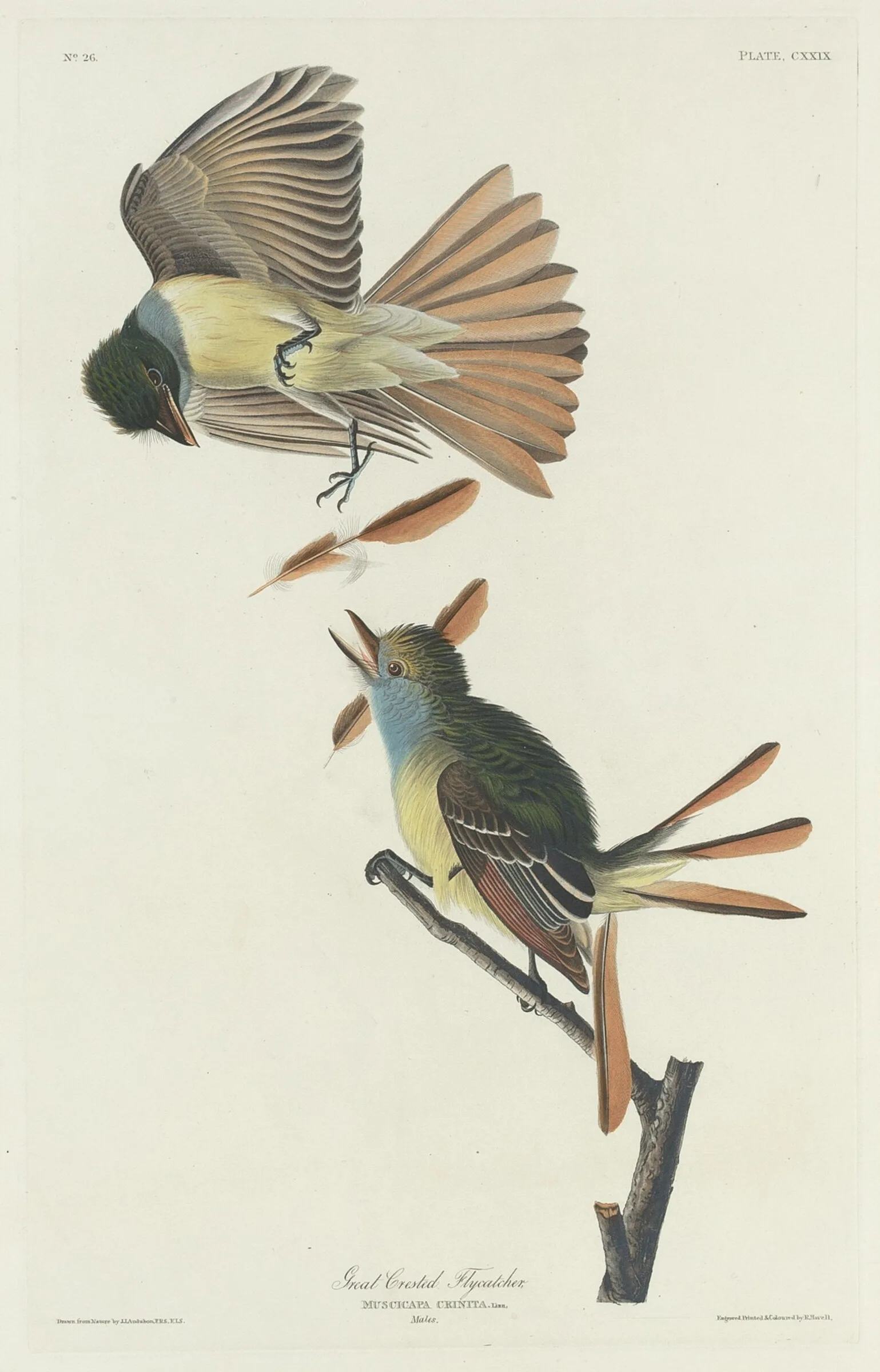
Audubon's “Great Crested Flycatcher”, The Birds of America, plate CXXIX
Click or press Enter to enlarge
Open the full-resolution image (2282 px, National Gallery of Art)
| Plate | 129 (CXXIX) |
|---|---|
| Audubon's name | Great Crested Flycatcher |
| Modern name | Great Crested Flycatcher |
| Scientific name | Myiarchus crinitus |
| Status | Least Concern |
| Engraved by | Robert Havell, after Audubon's watercolor |
| Date | 1832 |
| Medium | Hand-colored engraving and aquatint on Whatman wove paper |
| Collections | Songbirds |
| This impression | National Gallery of Art, Washington, 1945.8.129; Gift of Mrs. Walter B. James |
About this plate
Plate 129 shows a single male Great Crested Flycatcher, with its grey throat, lemon-yellow belly, rufous wings and tail and bushy crest. The chapter opens with Audubon wondering why some strong fliers migrate far north while others, like this bird, stop short.
Audubon used Linnaeus's name Muscicapa crinita. It is now Myiarchus crinitus, a tyrant flycatcher. It is the only eastern member of a genus of larger flycatchers that nest in cavities.
The Great Crested Flycatcher breeds in deciduous and mixed forest across the eastern and central United States and southern Canada, and winters from southern Mexico to northern South America and in South Florida. It nests in tree holes and nest boxes and is well known for adding shed snakeskins or plastic to its nest. It is listed as Least Concern.
Audubon wrote that unlike other flycatchers it builds no neat nest of its own but uses the decayed part of a tree, a fence rail or a rotting log, even a short stump at the bottom of a ravine trampled by raccoons. He said it seldom went farther east than Connecticut. Today it breeds north to Maine and the Maritime provinces.
In Audubon's words
There is nothing of the elegance of some, or of the curious texture of others, displayed in it. Unlike its kinsfolk, it is contented to seek a retreat in the decayed part of a tree, of a fence-rail, or even of a prostrate log mouldering on the ground. I have found it placed in a short stump at the bottom of a ravine, where the tracks of racoons were as close together as those of a flock of sheep in a fold, and again in the lowest fence-rail, where the black snake could have entered it, sucked the eggs or swallowed the young with more ease than by ascending to some large branches of a tree forty feet from the ground, where after all the reptile not unfrequently searches for such dainties.
John James Audubon, Ornithological Biography, vol. 2 (1834), “The Great Crested Flycatcher”. Read the full chapter.



