Grasshopper Sparrow (Plate 130)
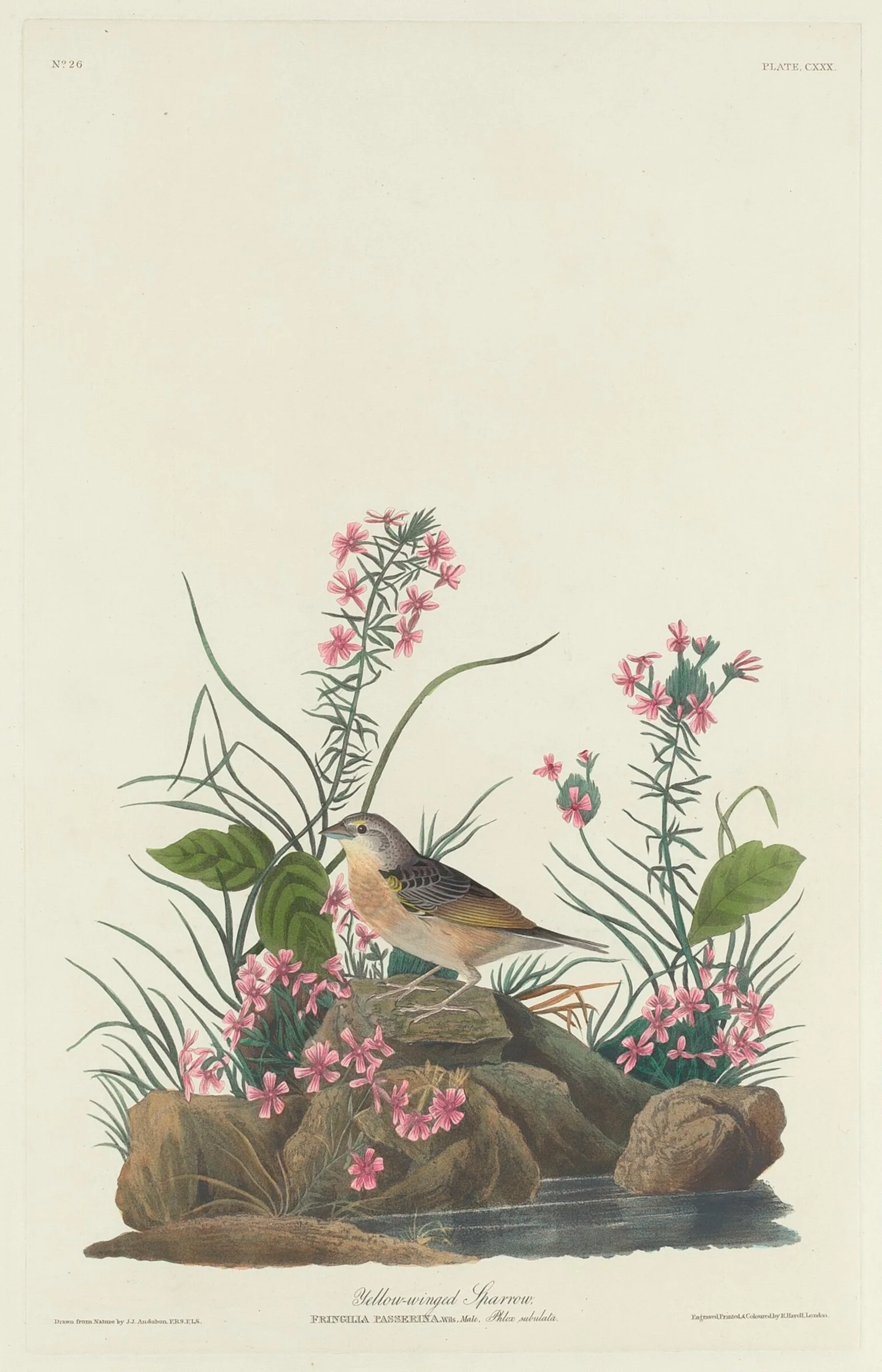
Audubon's “Yellow-winged Sparrow”, The Birds of America, plate CXXX
Click or press Enter to enlarge
Open the full-resolution image (2294 px, National Gallery of Art)
| Plate | 130 (CXXX) |
|---|---|
| Audubon's name | Yellow-winged Sparrow |
| Modern name | Grasshopper Sparrow |
| Scientific name | Ammodramus savannarum |
| Status | Least Concern |
| Engraved by | Robert Havell, after Audubon's watercolor |
| Date | 1832 |
| Medium | Hand-colored engraving and aquatint on Whatman wove paper |
| Collections | Songbirds |
| This impression | National Gallery of Art, Washington, 1945.8.130; Gift of Mrs. Walter B. James |
About this plate
Plate 130 shows a single male Yellow-winged Sparrow, the bird now called the Grasshopper Sparrow. It is a small, flat-headed, short-tailed sparrow with a buffy unstreaked breast and a touch of yellow at the bend of the wing and in front of the eye.
Audubon used Wilson's name Fringilla passerina. The species is now Ammodramus savannarum. The modern English name refers to its thin, insect-like buzzing song. Audubon took care to separate it from the Savannah Sparrow, which has a streaked breast.
The Grasshopper Sparrow breeds in open grasslands and hayfields across much of the United States and parts of southern Canada, Mexico and the Caribbean. Grassland birds have declined sharply as prairies were ploughed and hay is cut earlier, and the Florida subspecies is federally listed as endangered. The species as a whole is listed as Least Concern.
Audubon wrote that he never met the bird in Louisiana, the Floridas or west of the Alleghenies, but found it from Maryland to Maine, especially near the coast on light sandy soil and in fields of red clover. He described a simple nest on the ground of dry grass lined with roots and horse hair, with the first egg about 20 May.
In Audubon's words
Almost unregarded, it raises two broods in the season, perhaps three when it has chosen the warmer sandy soils in the vicinity of the sea, where it is evidently more abundant than in the interior of the country. The nest of the Yellow-winged Sparrow is as simple as its owner is innocent and gentle. It is placed on the ground, and is formed of light dry grasses, with a scanty lining of withered fibrous roots and horse hair. The female deposits her first egg about the 20th of May. The eggs are four or five, of a dingy white, sprinkled with brown spots. The young follow their parents on the ground for a short time, after which they separate and search for food singly.
John James Audubon, Ornithological Biography, vol. 2 (1834), “The Yellow-winged Sparrow”. Read the full chapter.



