Prairie Warbler (Plate 14)
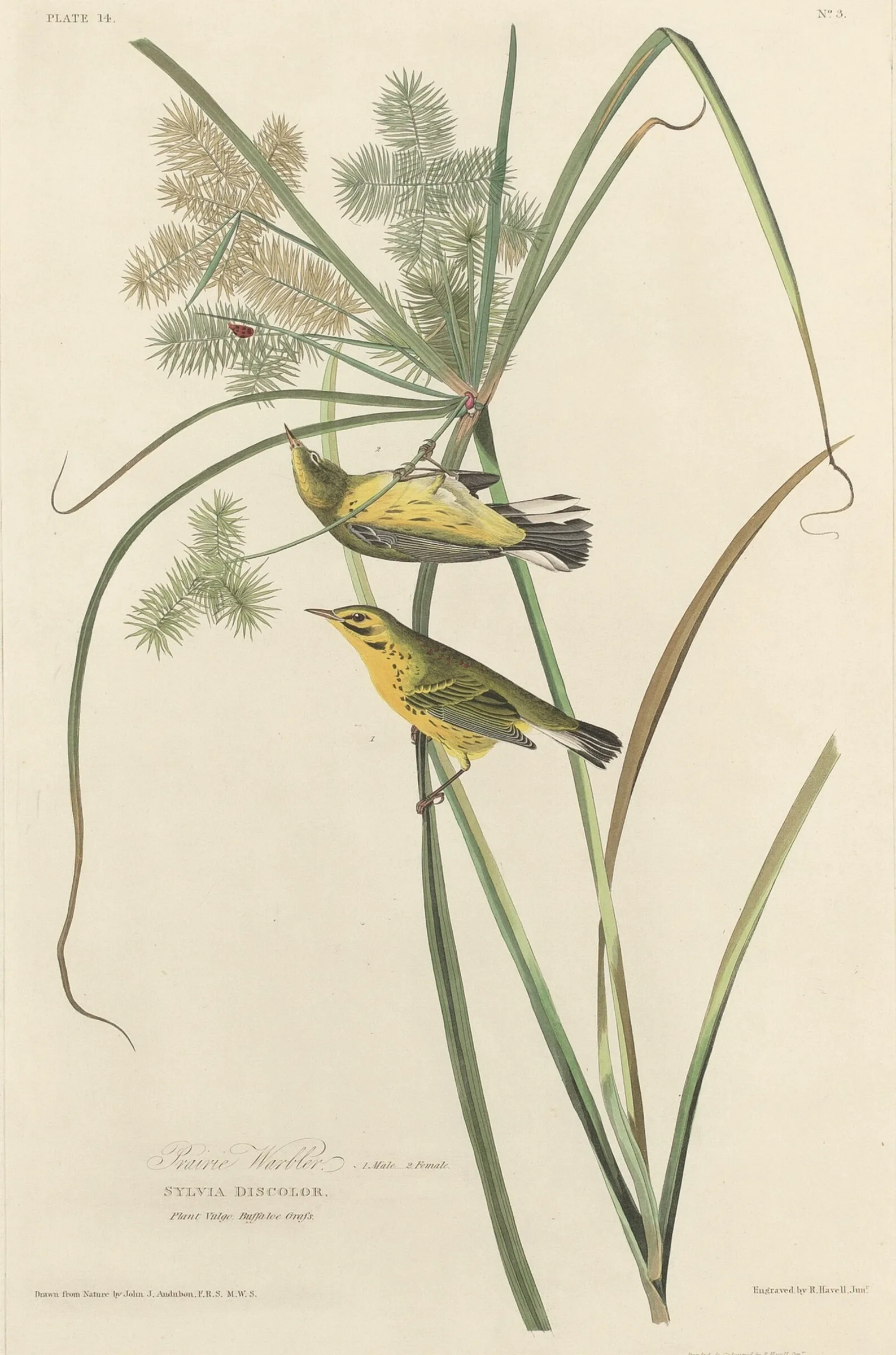
Audubon's “Prairie Warbler”, The Birds of America, plate XIV
Click or press Enter to enlarge
Open the full-resolution image (2301 px, National Gallery of Art)
| Plate | 14 (XIV) |
|---|---|
| Audubon's name | Prairie Warbler |
| Modern name | Prairie Warbler |
| Scientific name | Setophaga discolor |
| Status | Least Concern |
| Engraved by | Robert Havell, after Audubon's watercolor |
| Date | 1827 |
| Medium | Hand-colored engraving and aquatint on Whatman wove paper |
| Plants and setting | A plant Audubon called Buffalo Grass, from the prairie edges |
| Collections | Songbirds |
| This impression | National Gallery of Art, Washington, 1945.8.14; Gift of Mrs. Walter B. James |
About this plate
Plate 14 shows a male and female Prairie Warbler on a flowering plant that Audubon said was commonly called Buffalo Grass. He wrote that it grew along the edges of prairies, in the barrens of Kentucky and in Louisiana, preferring dry, stiff soil. The plate was engraved by Robert Havell in 1827.
Audubon found the bird in Louisiana cotton fields and along the edges of prairies. He also shot several near Philadelphia in New Jersey, in a clearing where young woods were growing back. He noted that it fed slowly on the ground among leaves, went singly and far apart, and arrived early in spring and left by early September. The farthest east he saw it was the Broad Mountain near Mauch Chunk, Pennsylvania.
The modern name is Prairie Warbler, Setophaga discolor. It was long placed in Dendroica, which was merged into Setophaga in 2011. Despite the name it is not a bird of open prairie. It prefers scrubby old fields, young pine stands, cut-over land and coastal mangroves. Audubon wrote that he never heard it sing beyond a soft whirr. In fact the male has a distinctive song of buzzy notes rising up the scale.
The species breeds across the eastern United States and winters in Florida and the Caribbean. It is listed as Least Concern, although it has declined as young forest and old fields have grown up or been cleared.
In Audubon's words
In Louisiana I found this bird amongst our cotton fields, where it easily procures the small insects and flies of which its food is entirely composed. It is also found in the prairies along the skirts of the woodlands. I have shot several within a few miles of Philadelphia, in the Jerseys, in a large opening where the woods had been cut down, and were beginning to spring up again. Its flight is light and short, it making an effort to rise to the height of eight or ten yards, and immediately sinking down to the grass or bushes. Whilst on the ground, where it remains a good deal, it searches amongst the leaves slowly and carefully, differing in this respect from all the true warblers with which I am acquainted. They go singly, and far apart, scarcely more than three or four being ever seen on an extent of twenty or thirty acres.
John James Audubon, Ornithological Biography, vol. 1 (1831), “The Prairie Warbler”. Read the full chapter.



