American Robin (Plate 131)
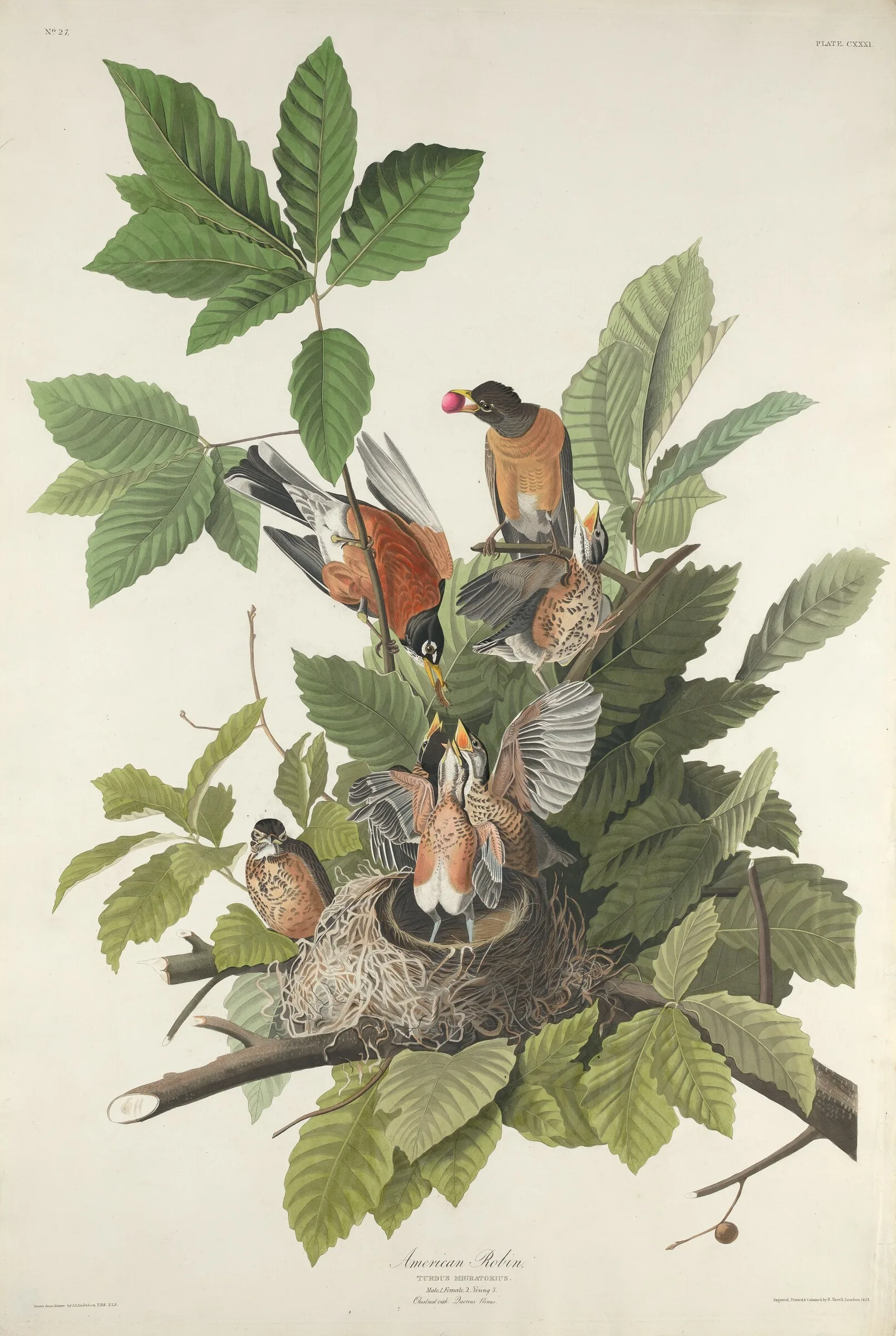
Audubon's “American Robin”, The Birds of America, plate CXXXI
Click or press Enter to enlarge
Open the full-resolution image (4392 px, National Gallery of Art)
| Plate | 131 (CXXXI) |
|---|---|
| Audubon's name | American Robin |
| Modern name | American Robin |
| Scientific name | Turdus migratorius |
| Status | Least Concern |
| Engraved by | Robert Havell, after Audubon's watercolor |
| Date | 1832 |
| Medium | Hand-colored engraving and aquatint on Whatman wove paper |
| Size | plate: 96 x 63.3 cm (37 13/16 x 24 15/16 in.) sheet: 99.6 x 66.5 cm (39 3/16 x 26 3/16 in.) |
| Collections | Songbirds |
| This impression | National Gallery of Art, Washington, 1945.8.131; Gift of Mrs. Walter B. James |
About this plate
Plate 131 shows an American Robin family: an adult male with a brick-red breast, a paler female, a spotted young bird and the mud-lined nest with eggs.
Audubon headed the chapter 'The American Robin or Migratory Thrush' and used Linnaeus's name Turdus migratorius, which is still current. The bird was named for its resemblance to the much smaller European Robin. It is a true thrush, and the spotted breast of the young shows the family likeness.
The American Robin breeds from Alaska and northern Canada to Mexico and is one of the most widespread birds in North America. Many birds move south in winter, but others stay as far north as they can find fruit. It is abundant and listed as Least Concern.
Audubon opens with his arrival in Labrador in June 1833, where the robin was the first land bird he saw and heard. Its song among snowbanks and barren hills nearly brought him to tears and gave him resolve to go on. He also described his disappointment at finding almost no native guides along three hundred miles of coast. Later in the chapter he cites Thomas Nuttall on robins nesting in a ship under construction and beside a blacksmith's anvil.
In Audubon's words
The first land-bird seen by me, when I stepped upon the rugged shores of Labrador, was the Robin; its joyful notes were the first that saluted my ear. Large patches of unmelted snow still dappled the surface of that wild country; and although vegetation was partially renewed, the chillness of the air was so peculiarly penetrating, that it brought to the mind a fearful anxiety for the future. The absence of trees, properly so called, the barren aspect of all around, the sombre mantle of the mountainous distance that hung along the horizon, excited the most melancholy feelings; and I could scarcely refrain from shedding tears when I heard the song of the Thrush, sent there as if to reconcile me to my situation. That song brought with it a thousand pleasing associations referring to the beloved land of my youth, and soon inspired me with resolution to persevere in my hazardous enterprise.
John James Audubon, Ornithological Biography, vol. 2 (1834), “The American Robin or Migratory Thrush”. Read the full chapter.



