Blackpoll Warbler (Plate 133)
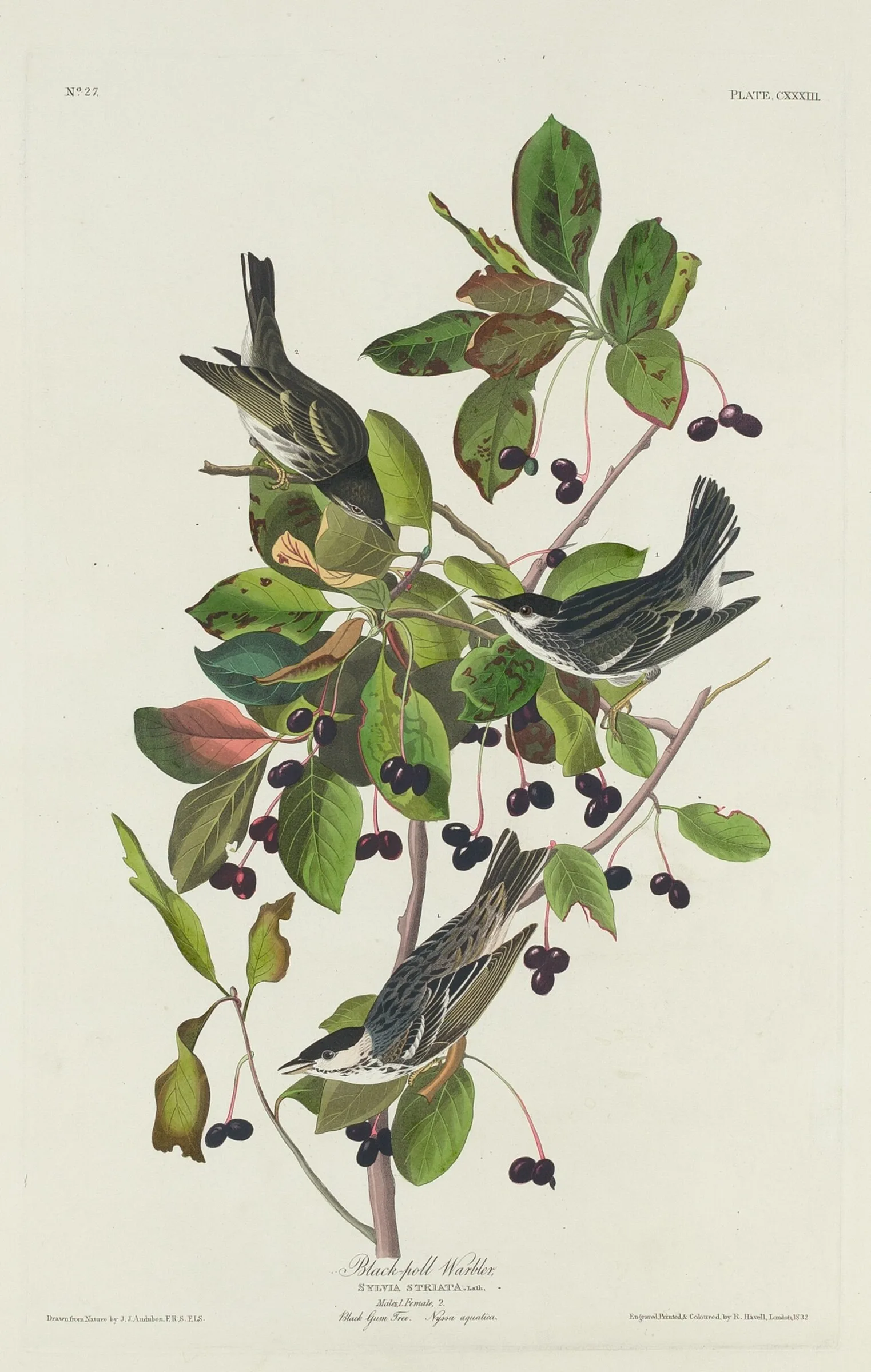
Audubon's “Black-Poll Warbler”, The Birds of America, plate CXXXIII
Click or press Enter to enlarge
Open the full-resolution image (2332 px, National Gallery of Art)
| Plate | 133 (CXXXIII) |
|---|---|
| Audubon's name | Black-Poll Warbler |
| Modern name | Blackpoll Warbler |
| Scientific name | Setophaga striata |
| Status | Near Threatened |
| Engraved by | Robert Havell, after Audubon's watercolor |
| Date | 1832 |
| Medium | Hand-colored engraving and aquatint on Whatman wove paper |
| Collections | Songbirds |
| This impression | National Gallery of Art, Washington, 1945.8.133; Gift of Mrs. Walter B. James |
About this plate
Plate 133 shows a male and a female Blackpoll Warbler. The male in spring has a black cap, white cheeks and black streaks on white; the female is greyer and greener and lacks the cap.
Audubon used Latham's name Sylvia striata, and the bird is now Setophaga striata. Blackpolls in autumn turn olive and yellowish and are among the hardest warblers to tell apart from the Bay-breasted Warbler at that season.
The Blackpoll breeds in spruce forest across Alaska and Canada and winters in northern South America. In autumn many fly nonstop from the northeastern coast over the Atlantic to the Caribbean and South America, a flight of several days that geolocator studies confirmed in 2015. Breeding Bird Survey data show a steep long-term decline.
The chapter is set at Little Macatina harbour in Labrador in July 1833, reached aboard the schooner Ripley under Captain Emery. While the party scrambled through waist-high fir thickets, Audubon's youngest son flushed a female from her nest. Audubon wrote that he felt the cost of the voyage had been repaid and told his companions they were the first white men to see such a nest. He described it as built in a small fir three feet up and lined with feathers of ducks and Willow Ptarmigan.
In Audubon's words
One fair morning, while several of us were scrambling through one of the thickets of trees, scarcely waist-high, my youngest son chanced to scare from her nest a female of the Black-poll Warbler. Reader, just fancy how this raised my spirits. I felt as if the enormous expense of our voyage had been refunded. "There," said I, "we are the first white men who have seen such a nest." I peeped into it, saw that it contained four eggs, and observed its little owner looking upon us with anxiety and astonishment.
John James Audubon, Ornithological Biography, vol. 2 (1834), “The Black-poll Warbler”. Read the full chapter.



