Blackburnian Warbler (Hemlock Warbler) (Plate 134)
Audubon's “Hemlock Warbler”, The Birds of America, plate CXXXIV
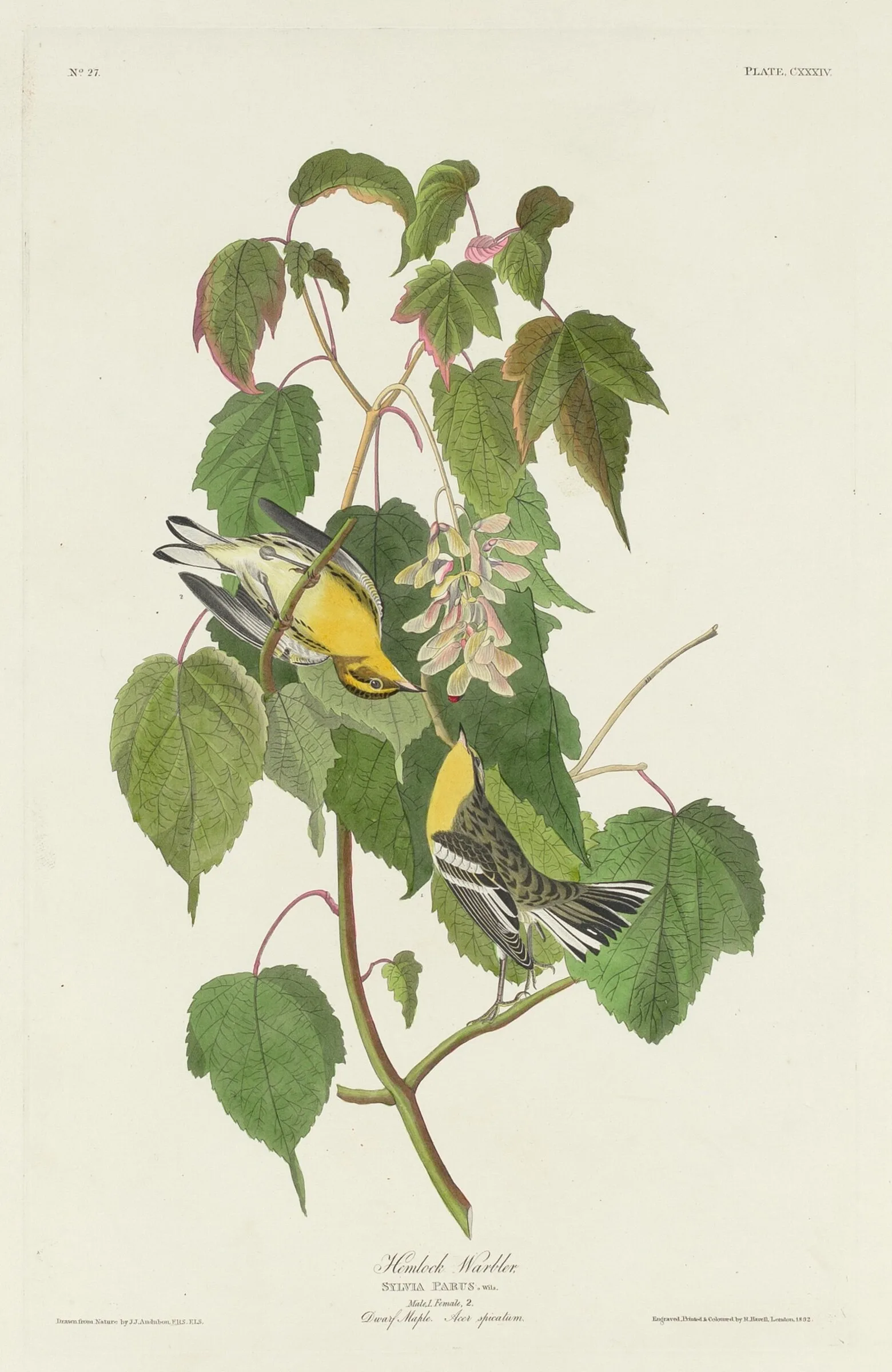
Click or press Enter to enlarge
Open the full-resolution image (2320 px, National Gallery of Art)
| Plate | 134 (CXXXIV) |
|---|---|
| Audubon's name | Hemlock Warbler |
| Modern name | Blackburnian Warbler (immature or female) |
| Scientific name | Setophaga fusca |
| Status | Least Concern |
| Engraved by | Robert Havell, after Audubon's watercolor |
| Date | 1832 |
| Medium | Hand-colored engraving and aquatint on Whatman wove paper |
| Plants and setting | Mountain maple (Acer spicatum), which Audubon called the Dwarf Maple |
| Collections | Songbirds |
| This impression | National Gallery of Art, Washington, 1945.8.134; Gift of Mrs. Walter B. James |
About this plate
Plate 134 shows a pair of yellowish, streaked warblers that Audubon called the Hemlock Warbler, perched on a twig of mountain maple. He called the plant the Dwarf Maple, Acer spicatum, a small tree of rocky stream banks at the foot of the Alleghenies.
Audubon used Wilson's name Sylvia parus. Wilson had described the bird from a single male shot in the Great Pine Forest of Pennsylvania. No such species is recognised today. The Hemlock Warbler is generally treated as a young or female Blackburnian Warbler, Setophaga fusca, whose duller plumages lack the flame orange of the adult male shown in plate 135.
The Blackburnian Warbler breeds in tall conifers, including hemlock and spruce, across southern Canada, the Great Lakes, the Northeast and the Appalachians, and winters in the Andes of northern South America. It feeds high in the canopy. It is listed as Least Concern.
Audubon wrote that he did not meet the bird until he visited the Great Pine Forest, following Wilson's track, and that within a week among the giant hemlocks he collected more than twenty specimens. He described birds feeding in the thickest foliage at the tops of the tallest hemlocks, arriving in early May and leaving in September. These habits fit the Blackburnian well.
In Audubon's words
The tallest of the hemlock pines are the favourite haunts of this species. It appears first among the highest branches early in May, breeds there, and departs in the beginning of September. Like the Blue Yellow-back Warbler, its station is ever amidst the thickest foliage of the trees, and with as much agility as its diminutive relative, it seeks its food by ascending from one branch to another, examining most carefully the under parts of each leaf as it proceeds. Every insect that escapes is followed on wing, and quickly secured. It now and then, as if for variety or sport, makes a downward flight, alights on a smaller tree, surveys it for a while, and again ascends to a higher station.
John James Audubon, Ornithological Biography, vol. 2 (1834), “The Hemlock Warbler”. Read the full chapter.



