Blackburnian Warbler (Plate 135)
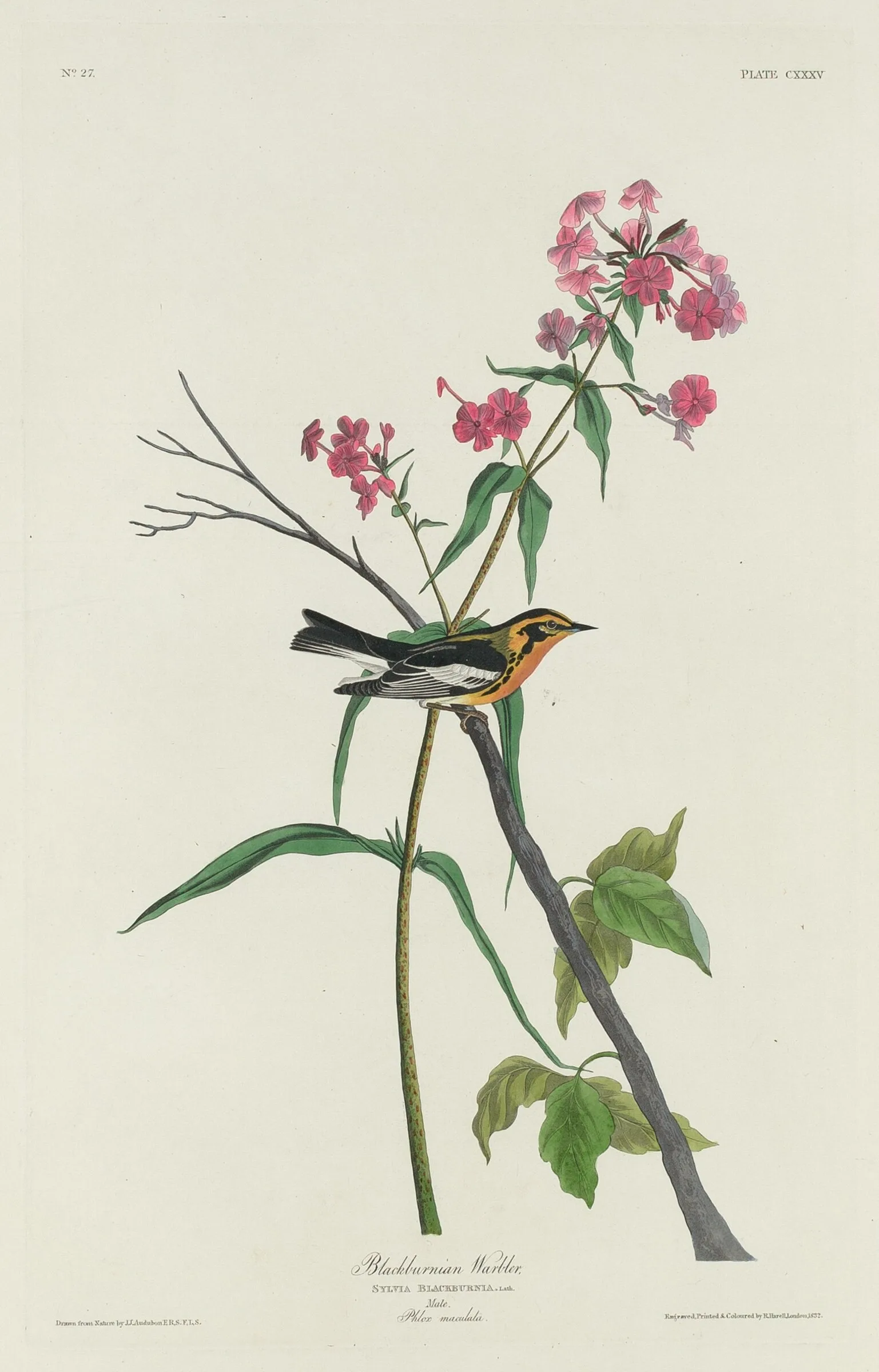
Audubon's “Blackburnian Warbler”, The Birds of America, plate CXXXV
Click or press Enter to enlarge
Open the full-resolution image (2325 px, National Gallery of Art)
| Plate | 135 (CXXXV) |
|---|---|
| Audubon's name | Blackburnian Warbler |
| Modern name | Blackburnian Warbler |
| Scientific name | Setophaga fusca |
| Status | Least Concern |
| Engraved by | Robert Havell, after Audubon's watercolor |
| Date | 1832 |
| Medium | Hand-colored engraving and aquatint on Whatman wove paper |
| Plants and setting | Spotted phlox (Phlox maculata) |
| Collections | Songbirds |
| This impression | National Gallery of Art, Washington, 1945.8.135; Gift of Mrs. Walter B. James |
About this plate
Plate 135 shows a male Blackburnian Warbler in breeding plumage, black and white with a flame-orange throat and face, on a stem of spotted phlox, Phlox maculata, with its purplish-red flower heads. Audubon noted that the female has yellow where the male is orange.
Audubon used Latham's name Sylvia blackburniae. The species is now Setophaga fusca. The English name honours Anna Blackburne, an English naturalist whose brother sent specimens from North America. The duller birds Audubon called Hemlock Warblers, in plate 134, are now thought to be young or female Blackburnians.
The Blackburnian Warbler breeds in tall conifer and mixed forest across southern Canada, the northeastern United States and the Appalachians and winters in the Andes from Venezuela to Peru. It forages high in the canopy, so it is heard more often than seen. It is listed as Least Concern.
Audubon wrote that the specimen in the plate was collected near Reading, Pennsylvania, on the Schuylkill River, about thirty years before he wrote. He later met the bird on the Saint John River in Maine with his sons and in the Magdalen Islands in June 1833, where he was surprised at how loud its song was. Professor McCulloch of Pictou gave him a nest and eggs. The book follows the chapter with an episode, A Ball in Newfoundland.
In Audubon's words
On the Magdalene Islands, in the Gulf of St Lawrence, which I visited in June 1833, I found the Blackburnian Warbler in all the brilliancy of its spring plumage, and had the pleasure of hearing its sweet song, while it was engaged in pursuing its insect prey among the branches of a fir tree, moving along somewhat in the manner of the American Redstart. Its song, which consisted of five or six notes, was so much louder than could have been expected from the size of the bird, that it was not until I had fairly caught it in the act, that I felt satisfied as to its proceeding from my old acquaintance.
John James Audubon, Ornithological Biography, vol. 2 (1834), “The Blackburnian Warbler”. Read the full chapter.



