Eastern Meadowlark (Plate 136)
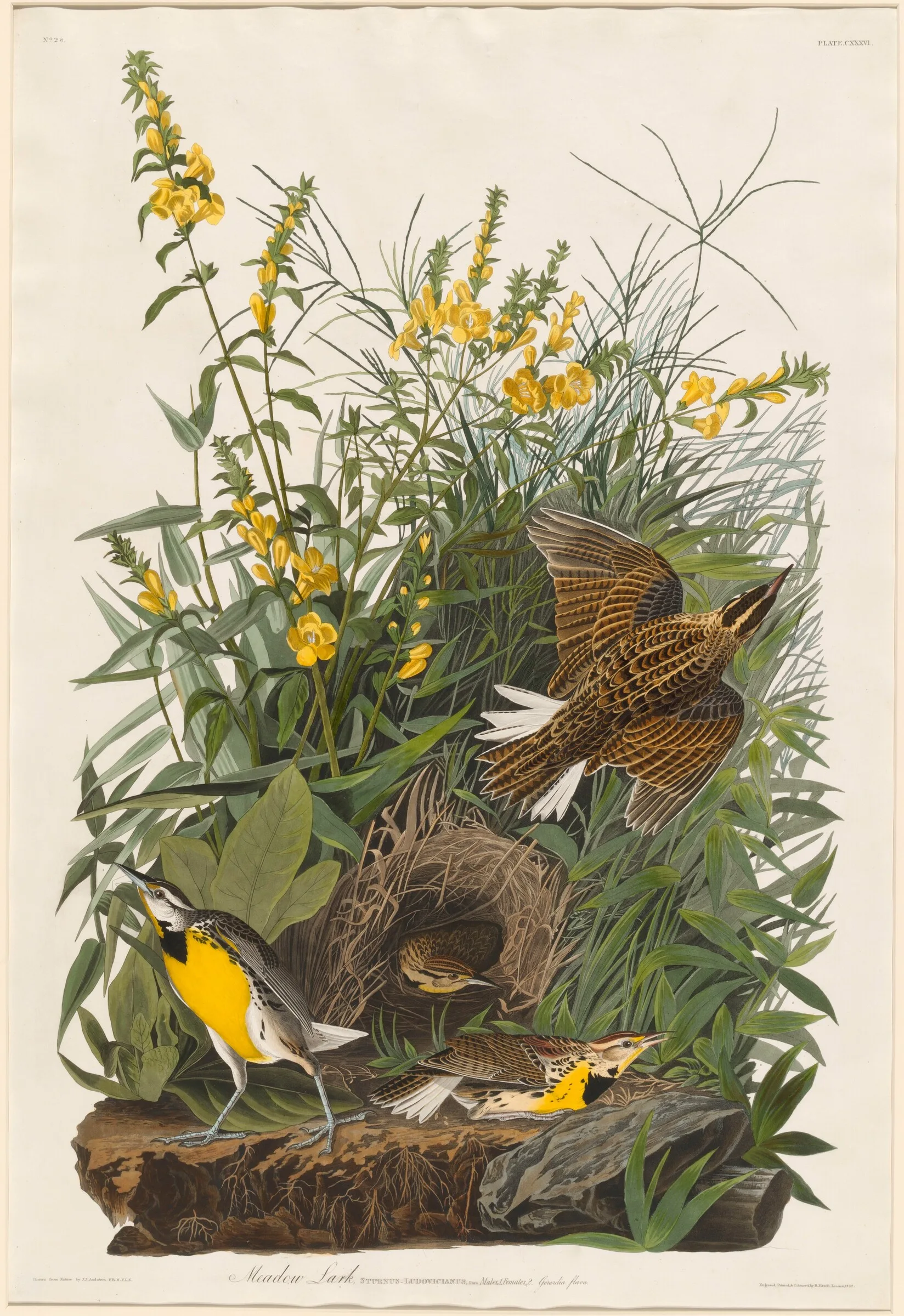
Audubon's “Meadow Lark”, The Birds of America, plate CXXXVI
Click or press Enter to enlarge
Open the full-resolution image (5219 px, National Gallery of Art)
| Plate | 136 (CXXXVI) |
|---|---|
| Audubon's name | Meadow Lark |
| Modern name | Eastern Meadowlark |
| Scientific name | Sturnella magna |
| Status | Near Threatened |
| Engraved by | Robert Havell, after Audubon's watercolor |
| Date | 1832 |
| Medium | Hand-colored engraving and aquatint on Whatman wove paper |
| Size | plate: 96 x 64.2 cm (37 13/16 x 25 1/4 in.) sheet: 100.5 x 67.5 cm (39 9/16 x 26 9/16 in.) |
| Collections | Songbirds |
| This impression | National Gallery of Art, Washington, 1945.8.136; Gift of Mrs. Walter B. James |
About this plate
Plate 136 shows a male and a female Eastern Meadowlark with their nest on the ground in grass. The birds show the bright yellow breast with a black V and the white outer tail feathers that flash in flight.
Audubon headed the chapter 'The Meadow Lark or American Starling' and used the name Sturnus ludovicianus. The bird is neither a lark nor a starling but a member of the New World blackbird family, now Sturnella magna. The Western Meadowlark, described by Audubon himself in 1844, looks almost the same and is best told by song.
The Eastern Meadowlark lives in grasslands, pastures and hayfields from southeastern Canada through the eastern United States to Central America and northern South America. It has declined steeply as farmland changed and grassland was lost, and the IUCN lists it as Near Threatened.
Most of the chapter is a long, romantic scene set in the grass fields near the sandy shore of New Jersey at dawn in early spring. Audubon follows a male that has arrived overnight as he sings over the meadow and waits for his mate, then describes their meeting. He also wrote that meadowlarks winter in flocks in the South and that the males move north first.
In Audubon's words
Her mate, her beloved, has felt the charm of her voice. His wings are spread, and buoyant with gladness, he flies to meet, to welcome her, anticipating all the bliss prepared for him. Would that I could interpret to you, reader, as I feel them, the many assurances of friendship, fidelity and love that at this precious moment pass from the one to the other, as they place their bills together and chatter their mutual loves!—the gentle chidings of the male for the sorrow her delay has caused him, and the sweet words she uses to calm his ardour.
John James Audubon, Ornithological Biography, vol. 2 (1834), “The Meadow Lark or American Starling”. Read the full chapter.



