Yellow-breasted Chat (Plate 137)
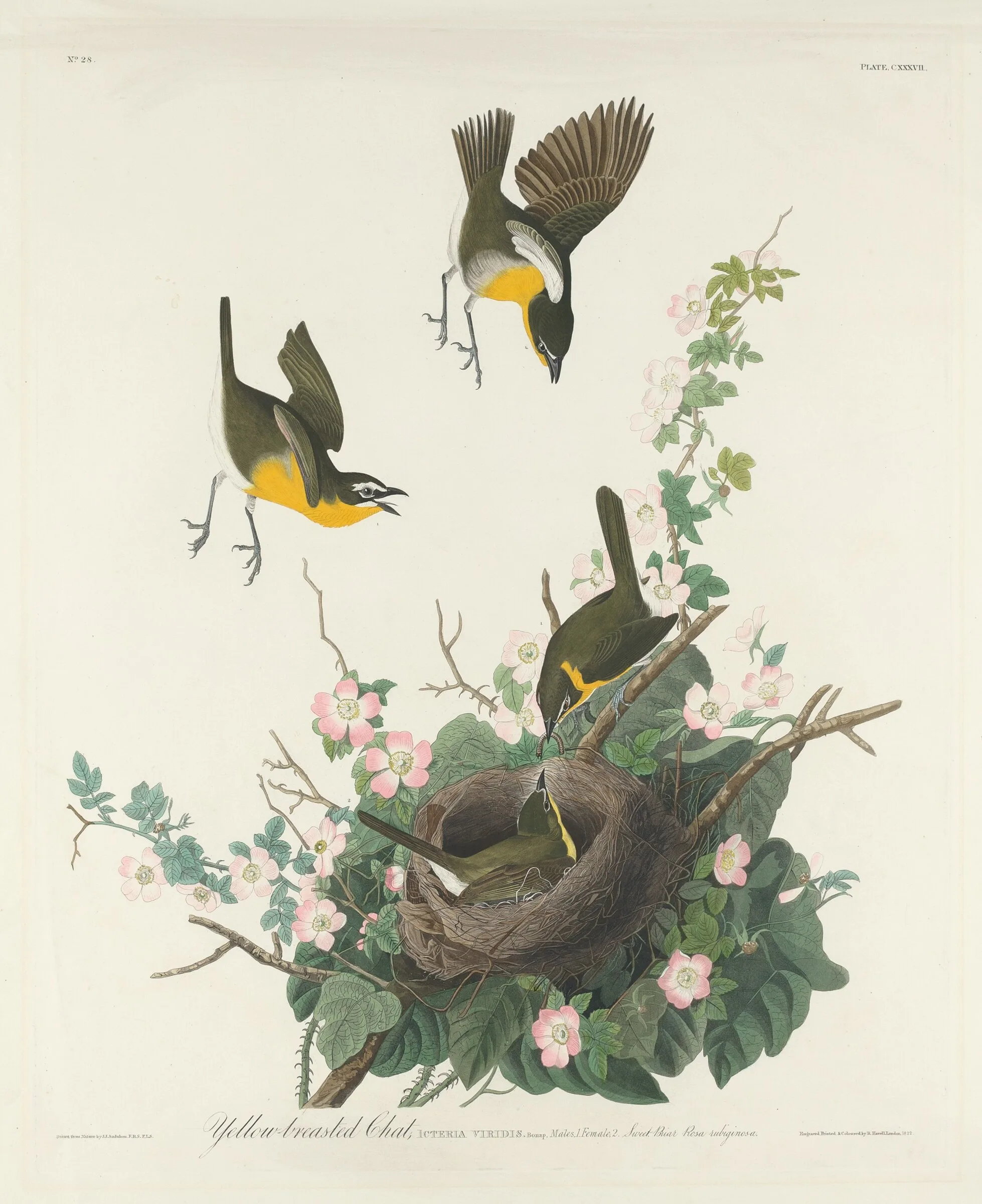
Audubon's “Yellow-breasted Chat”, The Birds of America, plate CXXXVII
Click or press Enter to enlarge
Open the full-resolution image (3142 px, National Gallery of Art)
| Plate | 137 (CXXXVII) |
|---|---|
| Audubon's name | Yellow-breasted Chat |
| Modern name | Yellow-breasted Chat |
| Scientific name | Icteria virens |
| Status | Least Concern |
| Engraved by | Robert Havell, after Audubon's watercolor |
| Date | 1832 |
| Medium | Hand-colored engraving and aquatint on Whatman wove paper |
| Size | plate: 65.5 x 52 cm (25 13/16 x 20 1/2 in.) sheet: 100.2 x 67.5 cm (39 7/16 x 26 9/16 in.) |
| Plants and setting | Sweet briar or eglantine (Rosa rubiginosa) |
| Collections | Songbirds |
| This impression | National Gallery of Art, Washington, 1945.8.137; Gift of Mrs. Walter B. James |
About this plate
Plate 137 shows a male and a female Yellow-breasted Chat with their nest in a sweet briar, Rosa rubiginosa, which Audubon called the eglantine. He closed the chapter by remarking on the fragrance of its leaves and the delicate colour of its flowers.
Audubon used Bonaparte's name Icteria viridis. The bird is now Icteria virens. It was long classed as an unusually large wood-warbler, but genetic studies led the AOS in 2017 to place it in its own family, Icteriidae.
The Yellow-breasted Chat breeds in dense thickets and overgrown fields across much of the United States and into southern Canada and Mexico, and winters in Mexico and Central America. It is listed as Least Concern.
Audubon wrote that the chat was plentiful in spring and summer in Louisiana, Georgia, the Carolinas and the barrens of Kentucky, arriving with the dogwood blossoms. He described its odd song of whistles, chuckles and harsh notes, sung by night as well as by day, and its display flight in which the male rises with legs dangling and jerks its body. He noted that if you imitate the song the bird will follow you through the thicket.
In Audubon's words
Now the bird mounts in the air in various attitudes, with its legs and feet hanging, while it continues its song and jerks its body with great vehemence, performing the strangest and most whimsical gesticulations; the next moment it returns to the bush. If you imitate its song, it follows your steps with caution, and responds to each of your calls, now and then peeping at you for a moment, the next quite out of sight. Should you have a dog, which will enter its briary retreat, it will skip about him, scold him, and frequently perch, or rise on wing above the thicket, so that you may easily shoot it.
John James Audubon, Ornithological Biography, vol. 2 (1834), “The Yellow-breasted Chat”. Read the full chapter.



