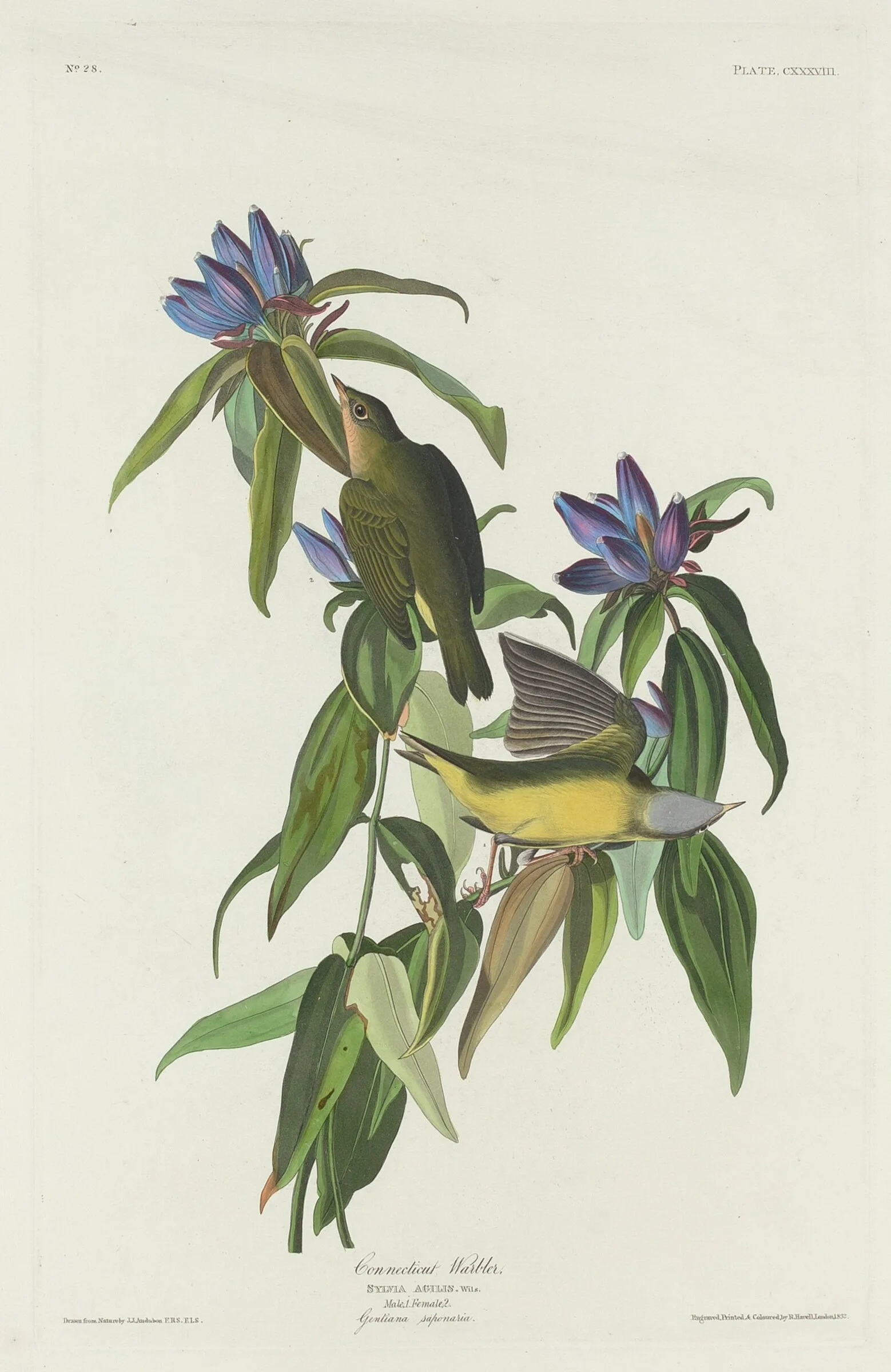
Connecticut Warbler (Plate 138)
Audubon's “Connecticut Warbler”, The Birds of America, plate CXXXVIII
Click or press Enter to enlarge
Open the full-resolution image (2323 px, National Gallery of Art)
| Plate | 138 (CXXXVIII) |
|---|---|
| Audubon's name | Connecticut Warbler |
| Modern name | Connecticut Warbler |
| Scientific name | Oporornis agilis |
| Status | Least Concern |
| Engraved by | Robert Havell, after Audubon's watercolor |
| Date | 1832 |
| Medium | Hand-colored engraving and aquatint on Whatman wove paper |
| Plants and setting | Soapwort gentian (Gentiana saponaria) |
| Collections | Songbirds |
| This impression | National Gallery of Art, Washington, 1945.8.138; Gift of Mrs. Walter B. James |
About this plate
Plate 138 shows a male and a female warbler on a stem of soapwort gentian, Gentiana saponaria, with its closed blue flowers. Audubon explained that the plant grew where he shot the birds and that they had just landed on it, so he drew them on it.
Audubon used Wilson's name Sylvia agilis. The Connecticut Warbler is now Oporornis agilis, the only member of its genus. Wilson named it after the state where he collected his first specimen, though it is only a rare autumn migrant there. Audubon's account is odd: the species is a shy ground-walker of boreal bogs, not a bird that skims water for spiders, and some writers have questioned whether his pair were Connecticut Warblers at all.
The Connecticut Warbler breeds in spruce and tamarack bogs and poplar woods in central Canada and the northern Great Lakes states and winters in South America. It is one of the least-known North American warblers. It is listed as Least Concern.
Audubon wrote that he shot the pair at sunset at the end of August on the Delaware River in New Jersey, a few miles below Camden, where they were chasing spiders over the water. He outlined both by candlelight and finished the drawing by breakfast the next morning, but in the heat the bodies spoiled before he could skin them. He said they were the only individuals he ever met.
In Audubon's words
When I first observed them, they were hopping and skipping from one low bush to another, and among the tall reeds of the marsh, emitting an often-repeated tweet at every move. They were chasing a species of spider which runs nimbly over the water, and which they caught by gliding over it, as a Swallow does when drinking. I followed them for about a hundred yards, when, watching a fair opportunity, I shot both at once. The weather was exceedingly sultry; and although I outlined both by candle-light that evening, and finished the drawing of them next morning by breakfast time, they had at that early hour become putrid, so that their skins could not be preserved.
John James Audubon, Ornithological Biography, vol. 2 (1834), “The Connecticut Warbler”. Read the full chapter.



