Field Sparrow (Plate 139)
Audubon's “Field Sparrow”, The Birds of America, plate CXXXIX
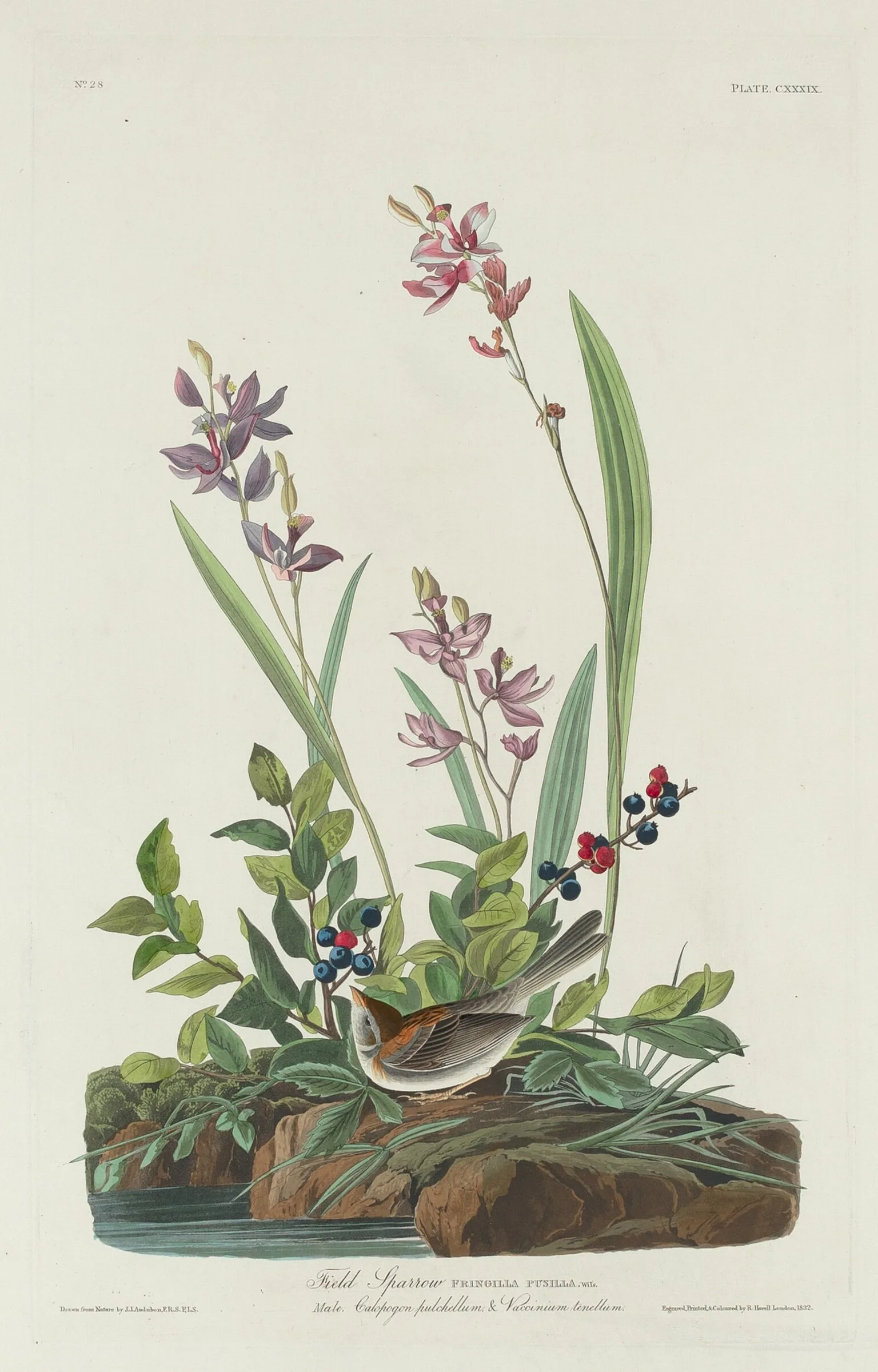
Click or press Enter to enlarge
Open the full-resolution image (2357 px, National Gallery of Art)
| Plate | 139 (CXXXIX) |
|---|---|
| Audubon's name | Field Sparrow |
| Modern name | Field Sparrow |
| Scientific name | Spizella pusilla |
| Status | Least Concern |
| Engraved by | Robert Havell, after Audubon's watercolor |
| Date | 1832 |
| Medium | Hand-colored engraving and aquatint on Whatman wove paper |
| Plants and setting | Grass-pink orchid (Calopogon pulchellus) and dwarf huckleberry (Vaccinium tenellum) |
| Collections | Songbirds |
| This impression | National Gallery of Art, Washington, 1945.8.139; Gift of Mrs. Walter B. James |
About this plate
Plate 139 shows a single adult Field Sparrow with two plants that Audubon described in his notes: grass-pink, Calopogon pulchellus, a pink orchid of sandy bogs, and dwarf huckleberry, Vaccinium tenellum, whose berries he said are eaten by birds and by children.
Audubon used Wilson's name Fringilla pusilla. The bird is now Spizella pusilla, in the same genus as the Chipping and American Tree sparrows. Its pink bill, plain face and white eye-ring set it apart from other small sparrows.
The Field Sparrow lives in old fields, brushy pastures and woodland edges across the eastern and central United States. Northern birds move south in winter. Its song is a series of sweet whistles that speed up like a bouncing ball. It has declined as old fields grow into forest or are developed, but it is listed as Least Concern.
Audubon wrote that the bird stays all winter in the South, where loose flocks of forty or fifty feed on grass seeds along hedgerows and sandy roads, and that it reaches New York and Pennsylvania in mid-April. He described the song as trilled like a young canary and admitted he could not put it into words.
In Audubon's words
The song of the Field Sparrow is remarkable, although not fine. It trills its notes like a young Canary Bird, and now and then emits emphatical, though not very distinct sounds of some length. One accustomed to distinguish the notes of different birds can easily recognise the song of this species; but the description of it, I confess, I am unable to accomplish, so at least as to afford you any tolerable idea of it. It is a social and peaceable bird. When the breeding season is at hand they disperse, move off in pairs, and throw themselves into old pasture grounds, overgrown with low bushes, on the tops of which the males may be heard practising their vocal powers.
John James Audubon, Ornithological Biography, vol. 2 (1834), “The Field Sparrow”. Read the full chapter.



