Pine Warbler (Plate 140)
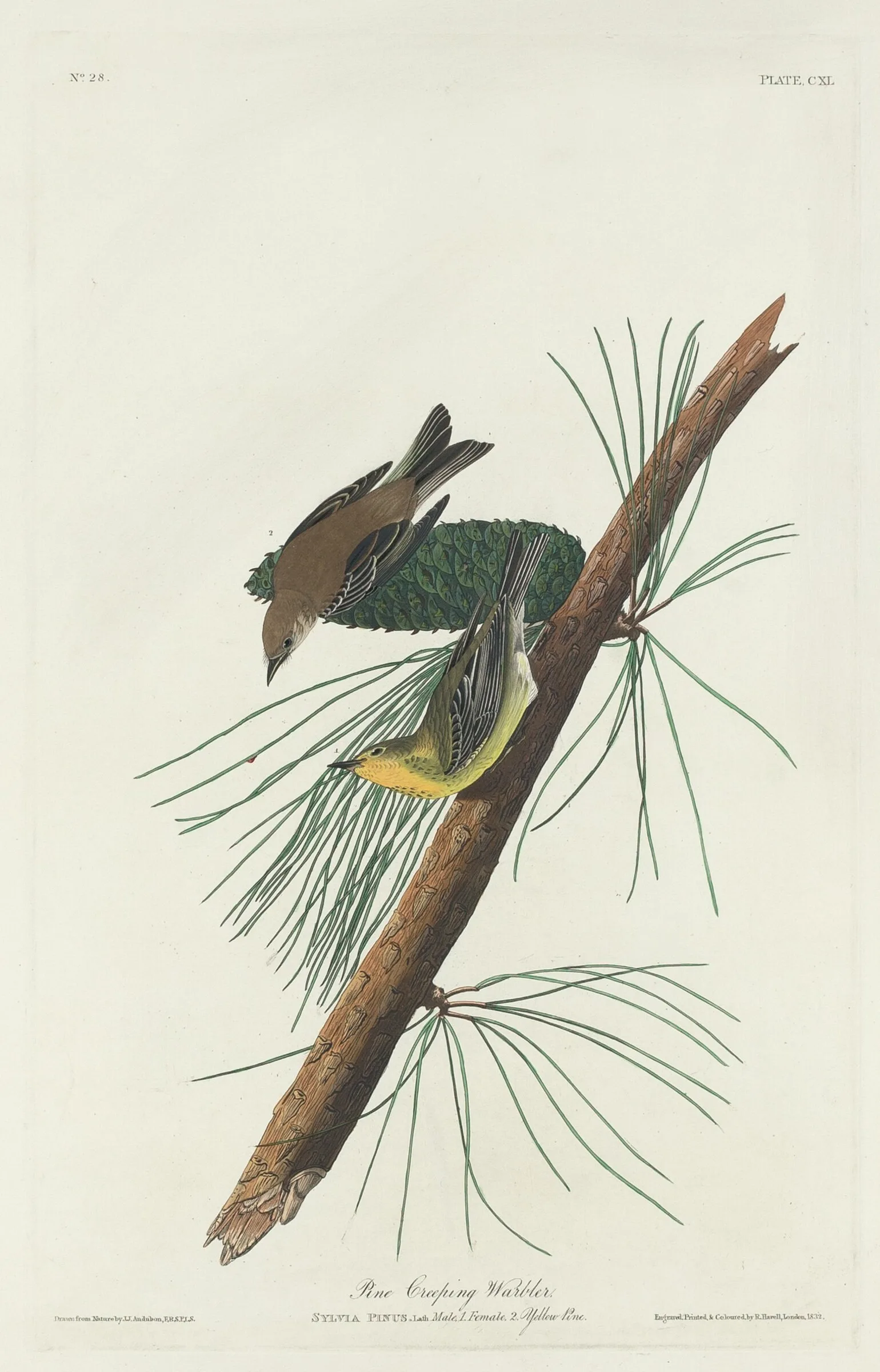
Audubon's “Pine Creeping Warbler”, The Birds of America, plate CXL
Click or press Enter to enlarge
Open the full-resolution image (2337 px, National Gallery of Art)
| Plate | 140 (CXL) |
|---|---|
| Audubon's name | Pine Creeping Warbler |
| Modern name | Pine Warbler |
| Scientific name | Setophaga pinus |
| Status | Least Concern |
| Engraved by | Robert Havell, after Audubon's watercolor |
| Date | 1832 |
| Medium | Hand-colored engraving and aquatint on Whatman wove paper |
| Plants and setting | Yellow or longleaf pine, which Audubon called the Yellow Pine |
| Collections | Songbirds |
| This impression | National Gallery of Art, Washington, 1945.8.140; Gift of Mrs. Walter B. James |
About this plate
Plate 140 shows a male and a female Pine Warbler on a branch of long-needled southern pine. Audubon called the tree the Yellow Pine and noted its other names: Long-leaved Pine, Red Pine and Pitch Pine. He wrote that the male's colours are duller than in spring because the bird was drawn in Louisiana in winter.
Audubon used Latham's name Sylvia pinus. The bird is now Setophaga pinus. The old name 'creeping warbler' refers to its habit, which Audubon compared to that of the creepers, of climbing trunks and branches in search of insects.
The Pine Warbler is the only warbler that lives almost entirely in pines. It breeds across the eastern United States and southeastern Canada and winters in the Southeast, where it is one of the few warblers to eat seeds and visit feeders. It is common and listed as Least Concern.
Audubon wrote that it was the most abundant warbler from Louisiana to Maine and bred wherever pines grew. He found it singing on the sandy barrens of the St John's River in East Florida early in February and suspected it was already nesting there. He described its song as a tremulous trill that he wrote as trr-rr-rr-rr.
In Audubon's words
In some degree allied to the Certhiæ in its habits, it is often seen ascending the trunks and larger branches of trees, hopping against the bark, in search of the larvæ that lurk there. At times it moves sidewise along a branch three or four steps, and turning about, goes on in the same manner, until it has reached a twig, which it immediately examines. Its restless activity is quite surprising: now it gives chase to an insect on wing; now, it is observed spying out those more diminutive species concealed among the blossoms and leaves of the pines; again, it leaves the topmost branches of a tree, flies downwards, and alights sidewise on the trunk of another, which it ascends, changing its position, from right to left, at every remove. It also visits the ground in quest of food, and occasionally betakes itself to the water, to drink or bathe.
John James Audubon, Ornithological Biography, vol. 2 (1834), “The Pine Creeping Warbler”. Read the full chapter.



