Northern Parula (Plate 15)
Audubon's “Blue Yellow-backed Warbler”, The Birds of America, plate XV
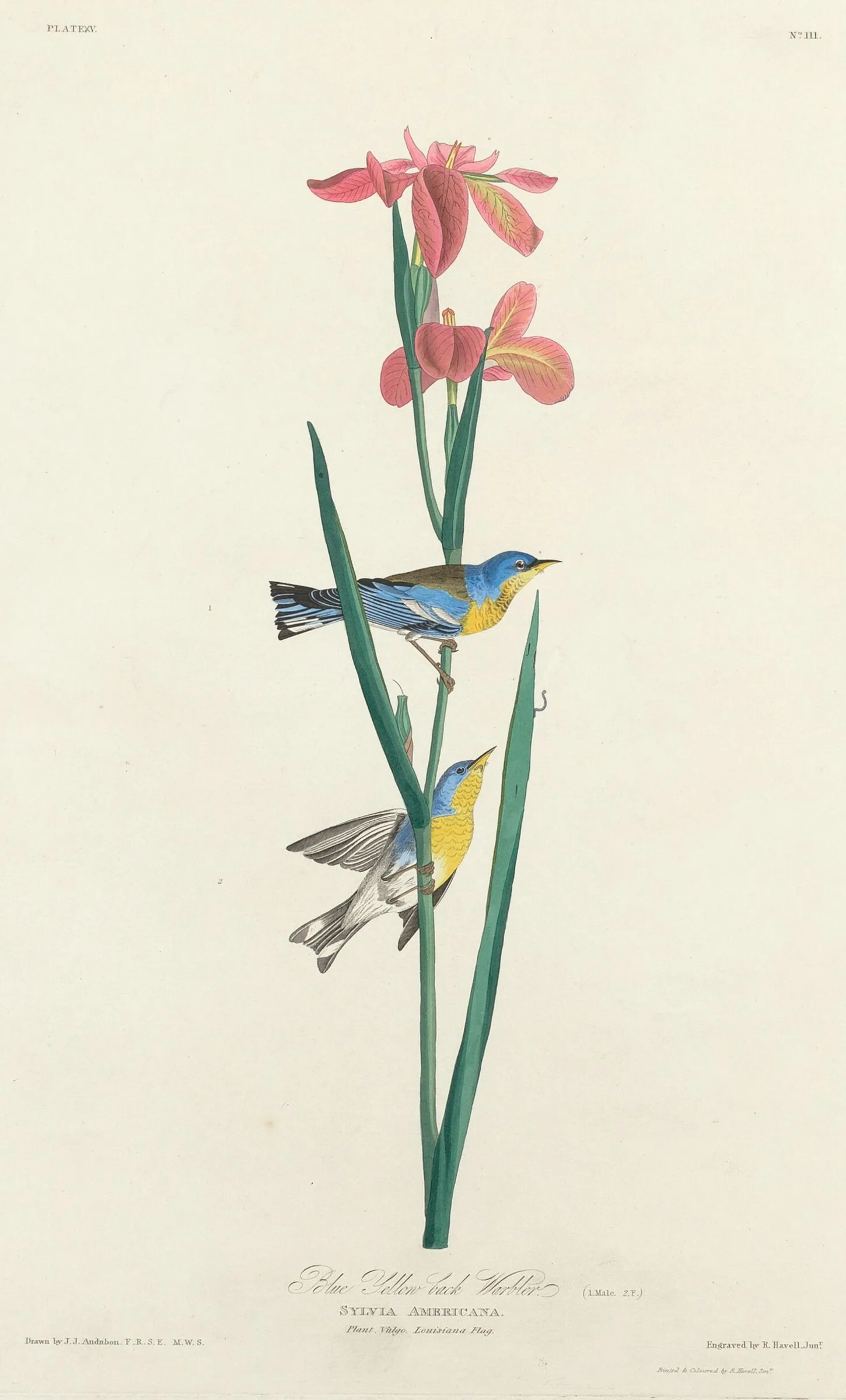
Click or press Enter to enlarge
Open the full-resolution image (2391 px, National Gallery of Art)
| Plate | 15 (XV) |
|---|---|
| Audubon's name | Blue Yellow-backed Warbler |
| Modern name | Northern Parula |
| Scientific name | Setophaga americana |
| Status | Least Concern |
| Engraved by | Robert Havell, after Audubon's watercolor |
| Date | 1827 |
| Medium | Hand-colored engraving and aquatint on Whatman wove paper |
| Plants and setting | Louisiana Flag iris |
| Collections | Songbirds |
| This impression | National Gallery of Art, Washington, 1945.8.15; Gift of Mrs. Walter B. James |
About this plate
Plate 15 shows a male and female Northern Parula on a red-flowered iris. Audubon wrote that he found the iris growing in water a few miles below New Orleans, abundant and in bloom in early April, and that it was commonly called the Louisiana Flag. He said he had met with it nowhere else. The plate was engraved by Robert Havell in 1827.
Audubon wrote that the bird entered Louisiana from the south at the very start of spring and fed low over the edges of ponds and rivers before moving to the treetops when the leaves came out. He described the small nest of lichens, set so far out on a branch that he had to cut the branch ten or fifteen feet back to reach it. The pair flew at him in rage. He thought it raised two broods a year.
The modern name is Northern Parula, Setophaga americana. It was long known as the Parula Warbler, in the genus Parula, and moved to Setophaga in 2011. In the South it usually builds its nest inside hanging clumps of Spanish moss, and in the North inside Usnea lichen. Audubon described the nest as lichen fixed in the fork of a twig.
The species breeds in moist forest across the eastern United States and southeastern Canada and winters in Mexico, Central America and the Caribbean. It is listed as Least Concern. The Louisiana irises, including Iris fulva and Iris hexagona, are native to the swamps of the Gulf coast.
In Audubon's words
This pretty species enters Louisiana from the south as early as spring appears, at the period when most insects are found closer to the ground, and more about water-courses, than shortly after, when a warmer sun has invited every leaf and blossom to hail the approach of that season when they all become as brilliant as nature intended them to be. The little fellow under your eye is then seen flitting over damp places, such as the edges of ponds, lakes, and rivers, chasing its prey with as much activity and liveliness as any other of the delicate and interesting tribe to which it belongs. It alights on every plant in its way, runs up and down it, picks here and there a small winged insect, and should one, aware of its approach, fly off, pursues it and snatches it in an instant.
John James Audubon, Ornithological Biography, vol. 1 (1831), “The Blue Yellow-backed Warbler”. Read the full chapter.



