American Goshawk and Cooper's Hawk (Plate 141)
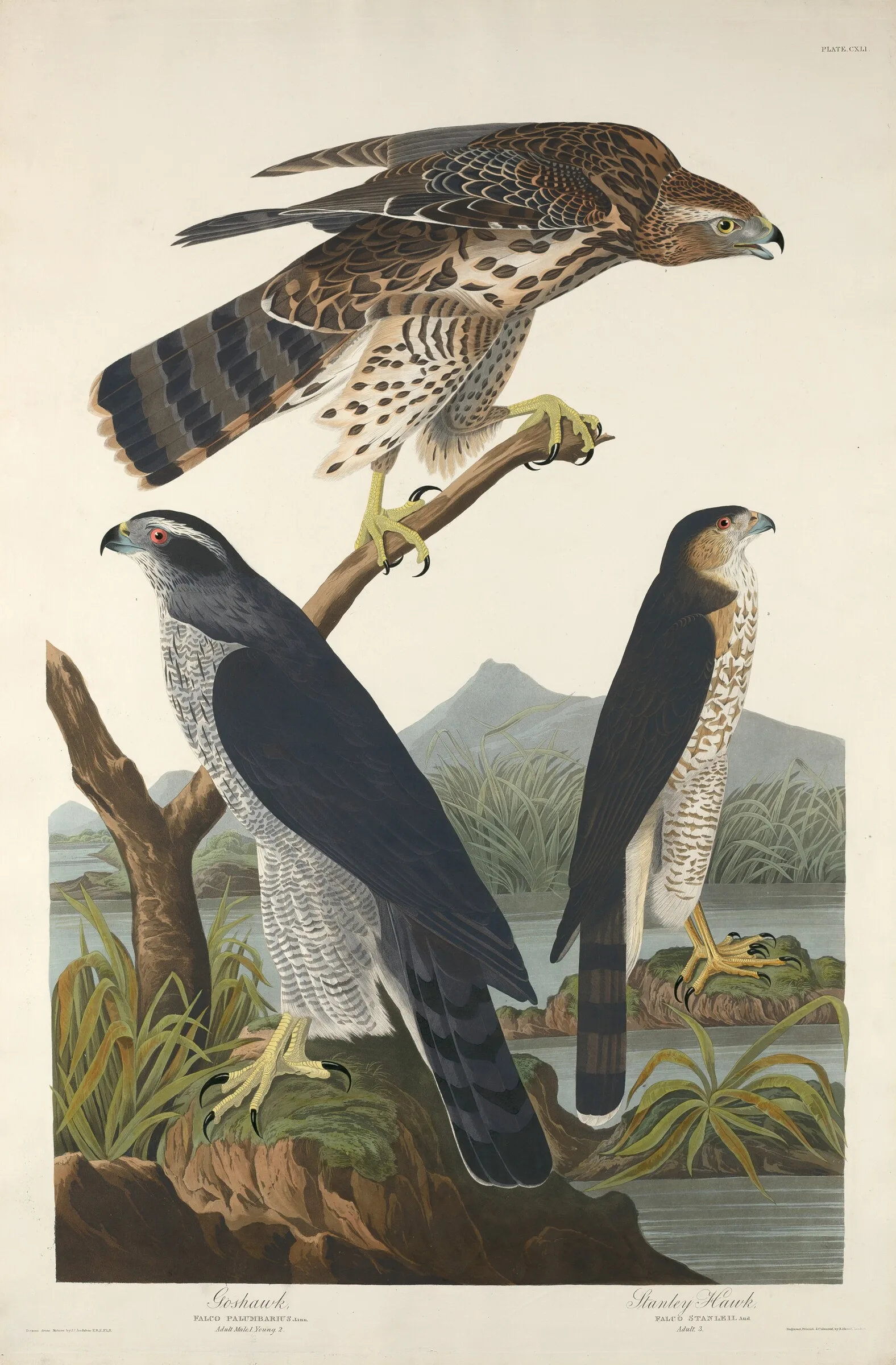
Audubon's “Goshawk and Stanley Hawk”, The Birds of America, plate CXLI
Click or press Enter to enlarge
Open the full-resolution image (4701 px, National Gallery of Art)
| Plate | 141 (CXLI) |
|---|---|
| Audubon's name | Goshawk and Stanley Hawk |
| Modern names | American Goshawk, Cooper's Hawk |
| Scientific names | Astur atricapillus, Astur cooperii |
| Status | Least Concern |
| Engraved by | Robert Havell, after Audubon's watercolor |
| Date | 1832 |
| Medium | Hand-colored engraving and aquatint on Whatman wove paper |
| Size | plate: 96.5 x 64.1 cm (38 x 25 1/4 in.) sheet: 99.7 x 67.3 cm (39 1/4 x 26 1/2 in.) |
| Collections | Hawks, Eagles and Falcons |
| This impression | National Gallery of Art, Washington, 1945.8.141; Gift of Mrs. Walter B. James |
About this plate
Plate 141 shows three hawks on one sheet: an adult male goshawk, grey above with fine barring below; a young male goshawk, brown and streaked; and an adult of what Audubon called the Stanley Hawk.
Audubon called the goshawk Falco palumbarius, treating it as the same bird as the European goshawk. In 2023 the American Ornithological Society split the American birds as the American Goshawk, now placed in the genus Astur. Audubon believed his Stanley Hawk was a new species and named it after Lord Stanley, but it was an adult Cooper's Hawk, a species Charles Bonaparte had already named in 1828.
The American Goshawk lives in mature forest across Canada, Alaska, the western mountains and the northern United States, hunting grouse, hares and squirrels. Cooper's Hawk is a smaller relative found over most of the United States and southern Canada, and it now nests commonly in towns and hunts birds at feeders. Both are listed as Least Concern.
Audubon wrote that the goshawk was rare in most of the United States, but he found it breeding in the Great Pine Forest of Pennsylvania and at Niagara Falls. Near Henderson, Kentucky, one cold winter, he shot a dozen or more on the ice of Canoe Creek, where they caught Mallards and ate only the breast. He also described a goshawk dashing into a flock of Passenger Pigeons and coming out with a bird in its talons.
Birds on this plate
- American Goshawk Astur atricapillus: Audubon's Goshawk (adult male and young male). Least Concern
- Cooper's Hawk Astur cooperii: Audubon's Stanley Hawk (adult). Least Concern
In Audubon's words
The flight of the Goshawk is extremely rapid and protracted. He sweeps along the margins of the fields, through the woods, and by the edges of ponds and rivers, with such speed as to enable him to seize his prey by merely deviating a few yards from his course, assisting himself on such occasions by his long tail, which, like a rudder, he throws to the right or left, upwards or downwards, to check his progress, or enable him suddenly to alter his course. At times he passes like a meteor through the underwood, where he secures squirrels and hares with ease. Should a flock of Wild Pigeons pass him when on these predatory excursions, he immediately gives chase, soon overtakes them, and forcing his way into the very centre of the flock, scatters them in confusion, when you may see him emerging with a bird in his talons, and diving towards the depth of the forest to feed upon his victim.
John James Audubon, Ornithological Biography, vol. 2 (1834), “The Goshawk”. Read the full chapter.