American Kestrel (Plate 142)
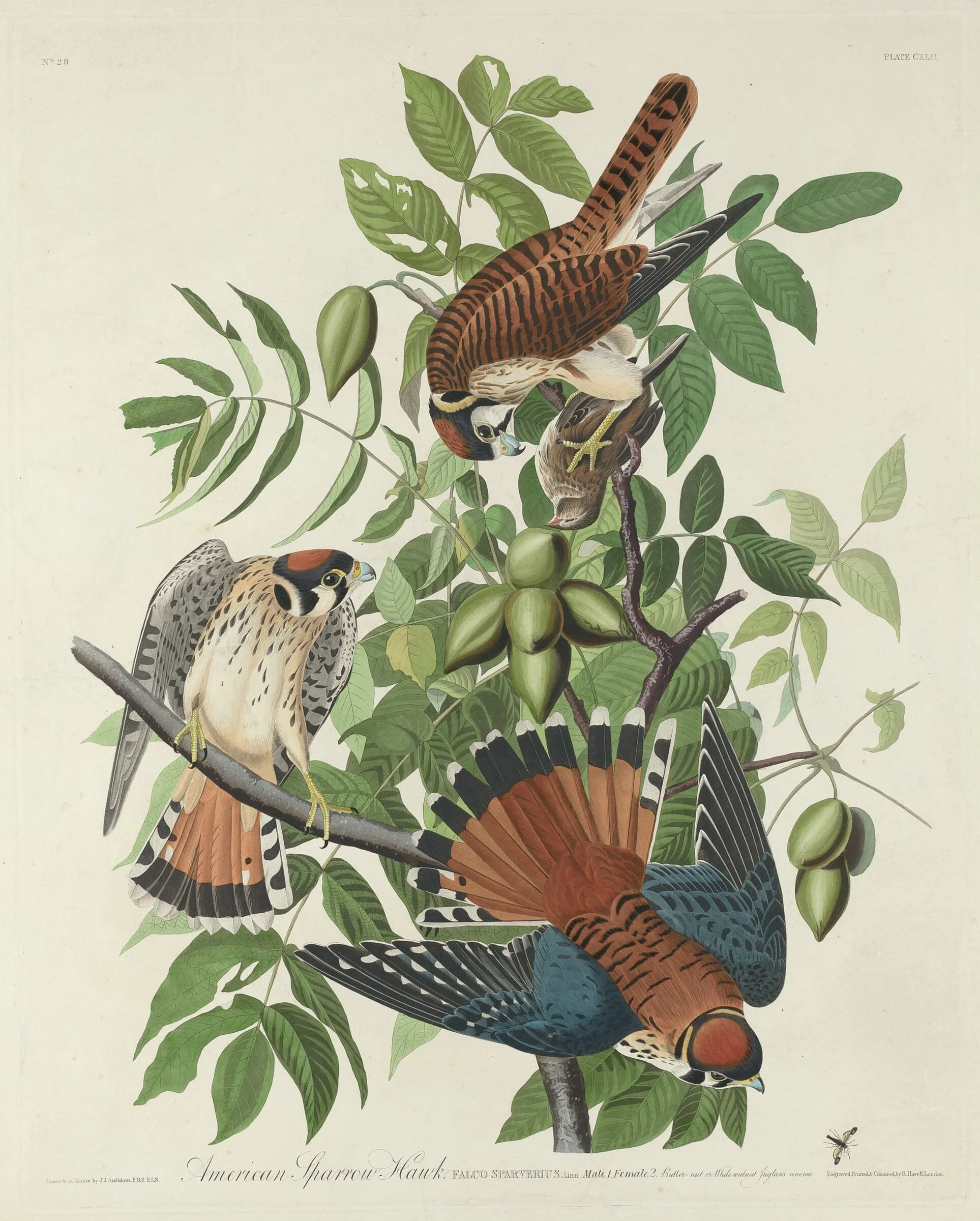
Audubon's “American Sparrow Hawk”, The Birds of America, plate CXLII
Click or press Enter to enlarge
Open the full-resolution image (3227 px, National Gallery of Art)
| Plate | 142 (CXLII) |
|---|---|
| Audubon's name | American Sparrow Hawk |
| Modern name | American Kestrel |
| Scientific name | Falco sparverius |
| Status | Least Concern |
| Engraved by | Robert Havell, after Audubon's watercolor |
| Date | 1832 |
| Medium | Hand-colored engraving and aquatint on Whatman wove paper |
| Collections | Hawks, Eagles and Falcons |
| This impression | National Gallery of Art, Washington, 1945.8.142; Gift of Mrs. Walter B. James |
About this plate
Plate 142 shows a male and a female American Kestrel, the bird Audubon knew as the American Sparrow-Hawk. The male has blue-grey wings and a rufous back and tail; the female is rufous with dark barring throughout. Both have the two black face stripes typical of the species.
Audubon used Linnaeus's name Falco sparverius, which is still in use. The old name Sparrow Hawk was dropped by the AOU in 1973 in favour of American Kestrel, because the bird is a falcon and the Eurasian Sparrowhawk is an accipiter. It is the smallest falcon in North America.
The American Kestrel lives in open country from Alaska and Canada to the tip of South America. It hunts insects, small rodents and small birds from wires and posts, and nests in tree holes and nest boxes. Numbers have fallen in parts of the Northeast and the West Coast, but it is listed as Least Concern.
Audubon wrote that it was the most abundant hawk in the United States and was found from Louisiana to Maine. He described it standing erect on fence stakes, broken tree tops and corners of barns, waiting for mice, crickets and grasshoppers, then dropping on them and carrying them back to its perch. He added that because it did not take poultry, few farmers troubled it.
In Audubon's words
Beautifully erect, it stands on the highest fence-stake, the broken top of a tree, the summit of a grain stack, or the corner of the barn, patiently and silently waiting until it spy a mole, a field-mouse, a cricket, or a grasshopper, on which to pounce. If disappointed in its expectation, it leaves its stand and removes to another, flying low and swiftly until within a few yards of the spot on which it wishes to alight, when all of a sudden, and in the most graceful manner, it rises towards it and settles with incomparable firmness of manner, merely suffering its beautiful tail to vibrate gently for a while, its wings being closed with the swiftness of thought. Its keen eye perceives something beneath, when down it darts, secures the object in its talons, returns to its stand, and devours its prey piece by piece.
John James Audubon, Ornithological Biography, vol. 2 (1834), “The American Sparrow-hawk”. Read the full chapter.