Ovenbird (Plate 143)
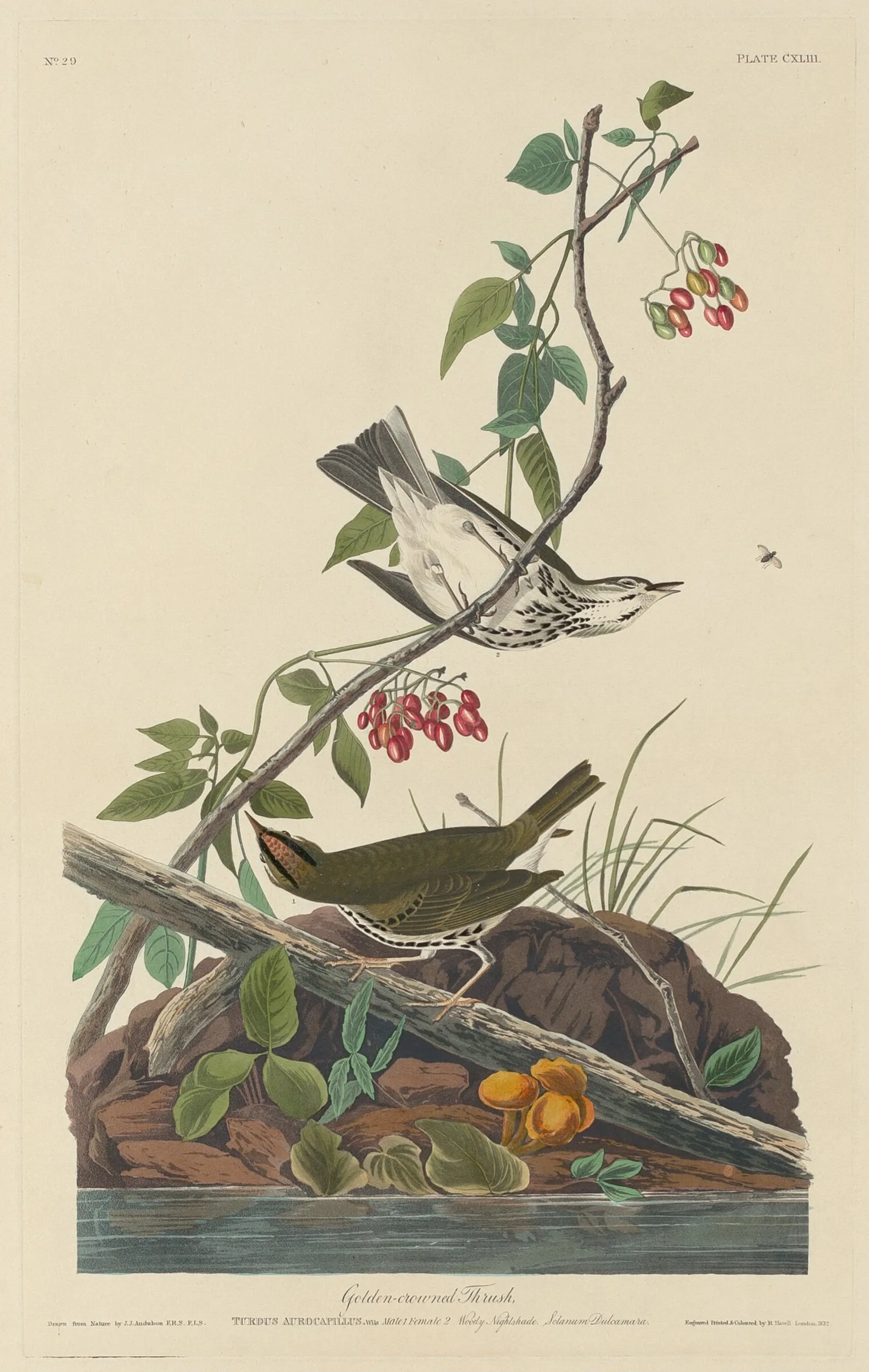
Audubon's “Golden-Crowned Thrush”, The Birds of America, plate CXLIII
Click or press Enter to enlarge
Open the full-resolution image (2431 px, National Gallery of Art)
| Plate | 143 (CXLIII) |
|---|---|
| Audubon's name | Golden-Crowned Thrush |
| Modern name | Ovenbird |
| Scientific name | Seiurus aurocapilla |
| Status | Least Concern |
| Engraved by | Robert Havell, after Audubon's watercolor |
| Date | 1832 |
| Medium | Hand-colored engraving and aquatint on Whatman wove paper |
| Plants and setting | Woody nightshade (Solanum dulcamara) |
| Collections | Songbirds |
| This impression | National Gallery of Art, Washington, 1945.8.143; Gift of Mrs. Walter B. James |
About this plate
Plate 143 shows a male and a female Ovenbird, an olive, thrush-like warbler with a spotted breast and an orange crown stripe edged in black. They stand on a stem of woody nightshade, Solanum dulcamara. Audubon wrote that the plant grew near where he shot the birds in a dark wood not far from Philadelphia.
Audubon called it the Golden-crowned Thrush, Turdus aurocapillus. He argued against naturalists who had moved it to the warbler genus Sylvia, because it nests on the ground and walks like a thrush. Here the naturalists were right. It is a wood-warbler, now Seiurus aurocapilla.
The Ovenbird breeds in mature deciduous and mixed forest across southern Canada and the eastern United States and winters from Mexico and Florida to northern South America and the Caribbean. Its loud teacher-teacher song is one of the commonest sounds of eastern woods in June. It is listed as Least Concern.
Audubon described the nest well: sunk in the leaf litter, built of grass, arched over and covered with leaves, with a small opening at one side. He noted that children called the bird the Oven Bird because the nest looks like an oven, and that a disturbed female glides off and pretends injury to lead an intruder away.
In Audubon's words
The nest is so like an oven, that the children in many places call this species the "Oven Bird." I have found it always on the ground, sometimes among the roots of a tall tree, sometimes by the side of a fallen trunk, and again at the foot of some slender sapling. It is sunk in the ground among dry leaves or decayed moss, and is neatly formed of grasses, both inside and out, arched over with a thick mass of the same material, covered by leaves, twigs, and such grasses as are found in the neighbourhood. A small aperture is left on one side, just sufficient to admit the owner. In this snug tenement the female deposits from four to six eggs, which are white, irregularly spotted with reddish-brown near the larger end. When accidentally disturbed at the period of incubation, it glides over the ground before you, and uses all sorts of artifices to decoy you from its nest.
John James Audubon, Ornithological Biography, vol. 2 (1834), “The Golden-crowned Thrush”. Read the full chapter.



