Acadian Flycatcher (Plate 144)
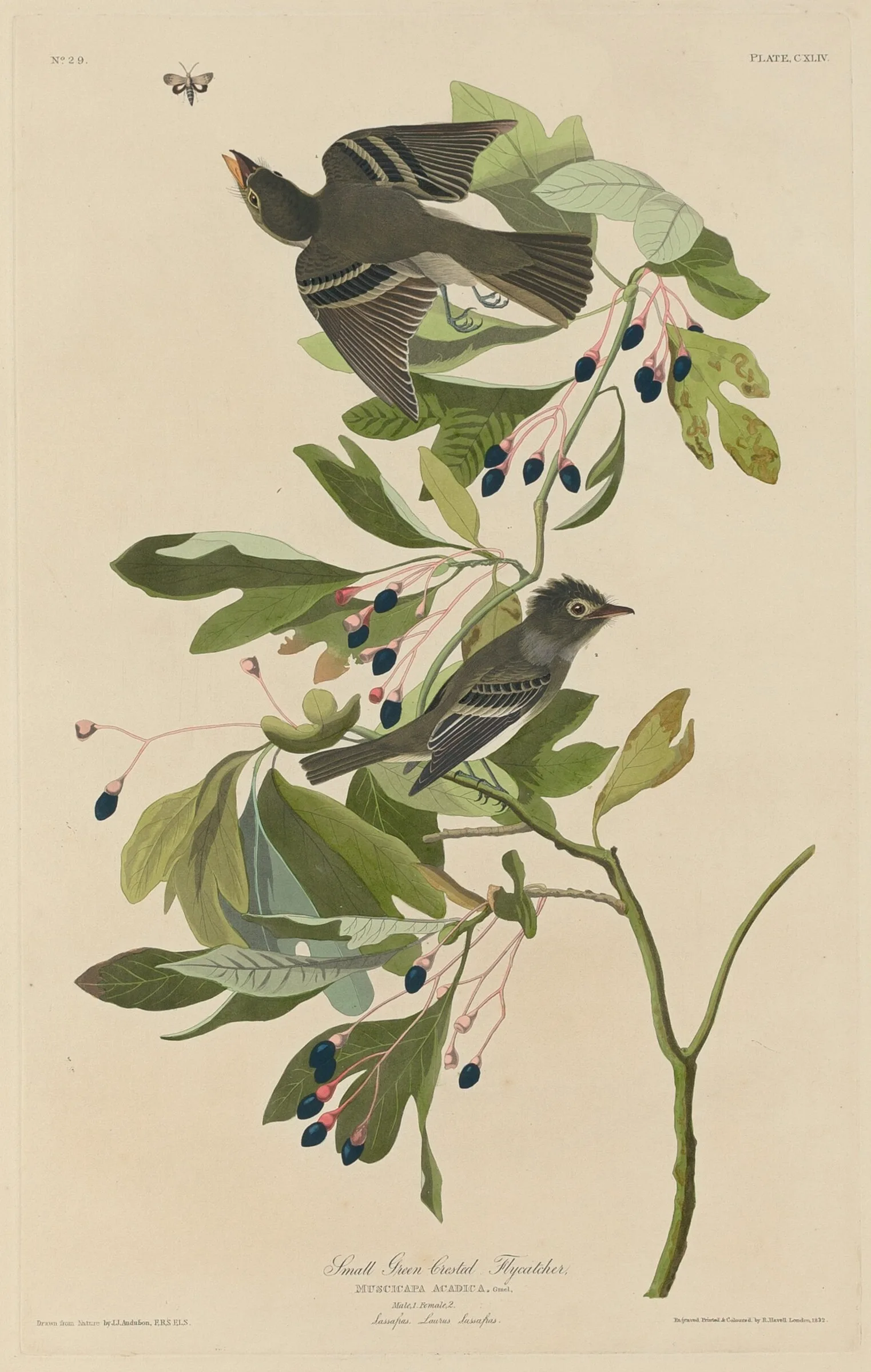
Audubon's “Small Green-Crested Flycatcher”, The Birds of America, plate CXLIV
Click or press Enter to enlarge
Open the full-resolution image (2428 px, National Gallery of Art)
| Plate | 144 (CXLIV) |
|---|---|
| Audubon's name | Small Green-Crested Flycatcher |
| Modern name | Acadian Flycatcher |
| Scientific name | Empidonax virescens |
| Status | Least Concern |
| Engraved by | Robert Havell, after Audubon's watercolor |
| Date | 1832 |
| Medium | Hand-colored engraving and aquatint on Whatman wove paper |
| Plants and setting | Sassafras (Sassafras albidum) |
| Collections | Songbirds |
| This impression | National Gallery of Art, Washington, 1945.8.144; Gift of Mrs. Walter B. James |
About this plate
Plate 144 shows a male and a female Acadian Flycatcher on a branch of sassafras. Audubon's plant note describes the tree's leaves, which may be oval or three-lobed, and its blue-black berries held on bright red stalks.
Audubon used Gmelin's name Muscicapa acadica. The species is now Empidonax virescens. It is one of the Empidonax flycatchers, a group of small olive birds so alike that they are best told by voice. Audubon discussed the same problem in his Wood Pewee chapter.
The Acadian Flycatcher breeds in mature, shady deciduous forest, often along streams and in ravines, across the eastern United States, and winters from Nicaragua to Ecuador. Its song is an explosive peet-sa. It is listed as Least Concern.
Audubon wrote that the bird was not abundant even in South Carolina, passed through Louisiana only in spring and autumn, and was found from Maryland to Nova Scotia. He described it as a bird of gloomy, secluded woods, almost as quarrelsome as the Eastern Kingbird, snapping up insects with an audible click and quivering its wings and jerking its tail on landing.
In Audubon's words
Perched on some small spray or dry twig, it stands erect, patiently eyeing the objects around. When it perceives an insect, it sweeps after it with much elegance, snaps its bill audibly as it seizes the prey, and on realighting, utters a disagreeable squeak. While perched it is heard at intervals repeating its simple, guttural, gloomy notes, resembling the syllables queae, queae, tchooe, tchewee. These notes are often followed, as the bird passes from one tree to another, by a low murmuring chirr or twitter, which it keeps up until it alights, when it instantly quivers its wings, and jerks its tail a few times.
John James Audubon, Ornithological Biography, vol. 2 (1834), “The Small Green Crested Flycatcher”. Read the full chapter.



