Palm Warbler (Plate 145)
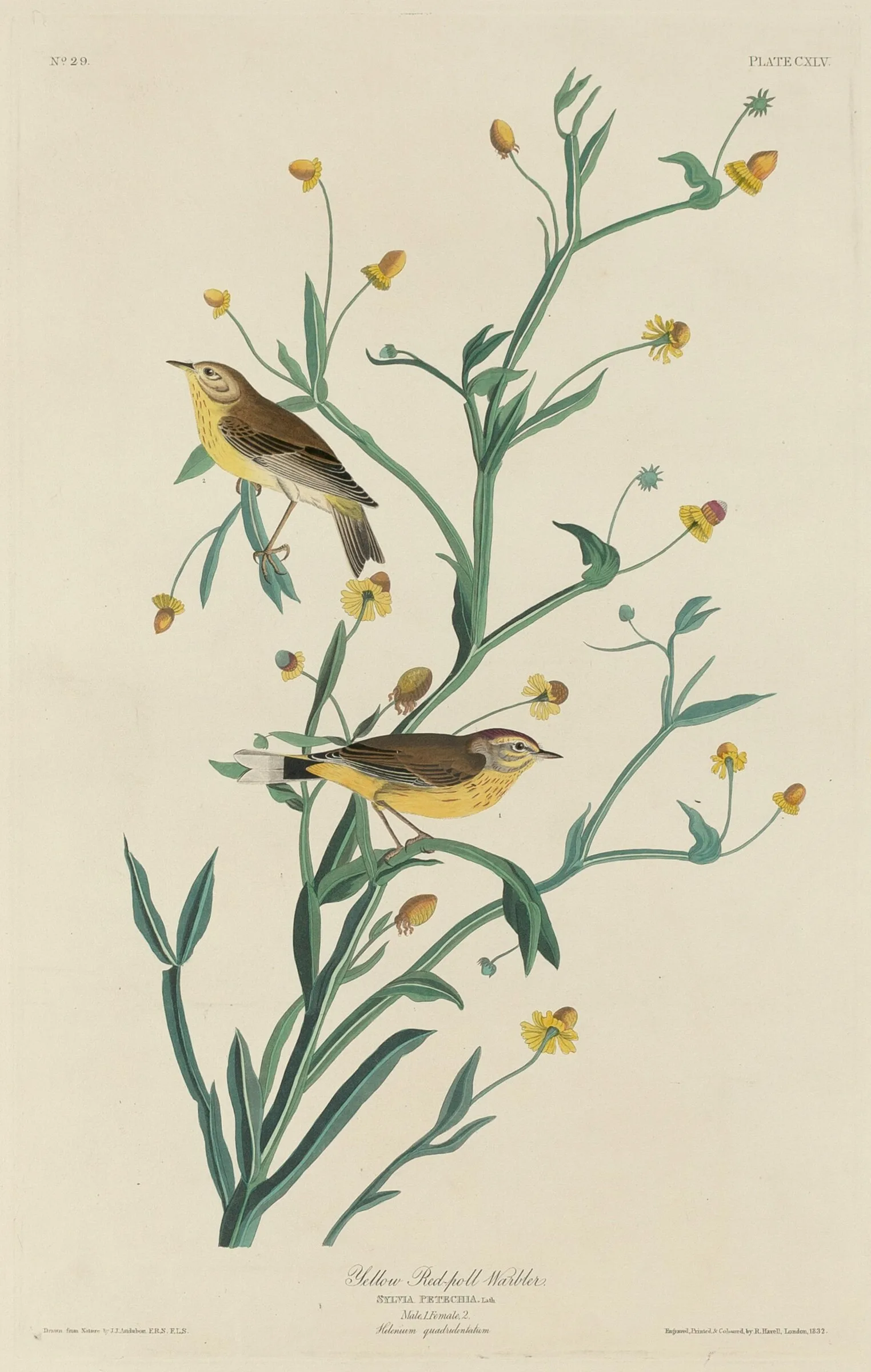
Audubon's “Yellow Red-Poll Warbler”, The Birds of America, plate CXLV
Click or press Enter to enlarge
Open the full-resolution image (2418 px, National Gallery of Art)
| Plate | 145 (CXLV) |
|---|---|
| Audubon's name | Yellow Red-Poll Warbler |
| Modern name | Palm Warbler |
| Scientific name | Setophaga palmarum |
| Status | Least Concern |
| Engraved by | Robert Havell, after Audubon's watercolor |
| Date | 1832 |
| Medium | Hand-colored engraving and aquatint on Whatman wove paper |
| Plants and setting | Sneezeweed (Helenium), named by Audubon as Helenium quadridentatum |
| Collections | Songbirds |
| This impression | National Gallery of Art, Washington, 1945.8.145; Gift of Mrs. Walter B. James |
About this plate
Plate 145 shows a male and a female Palm Warbler in what Audubon called their first autumnal dress. They were drawn on the banks of the Mississippi with a plant that was in flower there, a sneezeweed that Audubon named Helenium quadridentatum.
Audubon called the bird the Yellow Red-poll Warbler and used Latham's name Sylvia petechia. He had also drawn the same species in spring plumage as the Palm Warbler, Sylvia palmarum, in plate 163. In this chapter he admits his error and credits John Bachman with showing him at Charleston in the winter of 1833 to 1834 that the two were one bird at different ages and seasons. The name that survived is palmarum: the bird is now Setophaga palmarum, while the name petechia now belongs to the Yellow Warbler.
The Palm Warbler breeds in bogs across Canada and winters in the southeastern United States and the Caribbean. It feeds on the ground and constantly pumps its tail. The eastern, yellower form is the one Audubon knew best. It is listed as Least Concern.
Audubon wrote that it was among the commonest birds in Florida in winter, especially along the coast and in wild orange groves, and found it abundant in Newfoundland and Labrador, where he searched for its nest without success.
In Audubon's words
It never removes from one spot to another, without uttering a sharp twit, and vibrating its tail in the manner of the Wagtails of Europe, though less frequently. I never saw this species in Pennsylvania in summer, although occasionally in the month of May it is to be seen for a few days. It is very rare in Maine; but I found it abundant in Newfoundland and Labrador, where I seldom passed a day without searching for its nest, although I am sorry to say, in vain. In the month of August the old birds were feeding their young all around us, and preparing to return to milder winter quarters.
John James Audubon, Ornithological Biography, vol. 2 (1834), “The Yellow Red-poll Warbler”. Read the full chapter.



