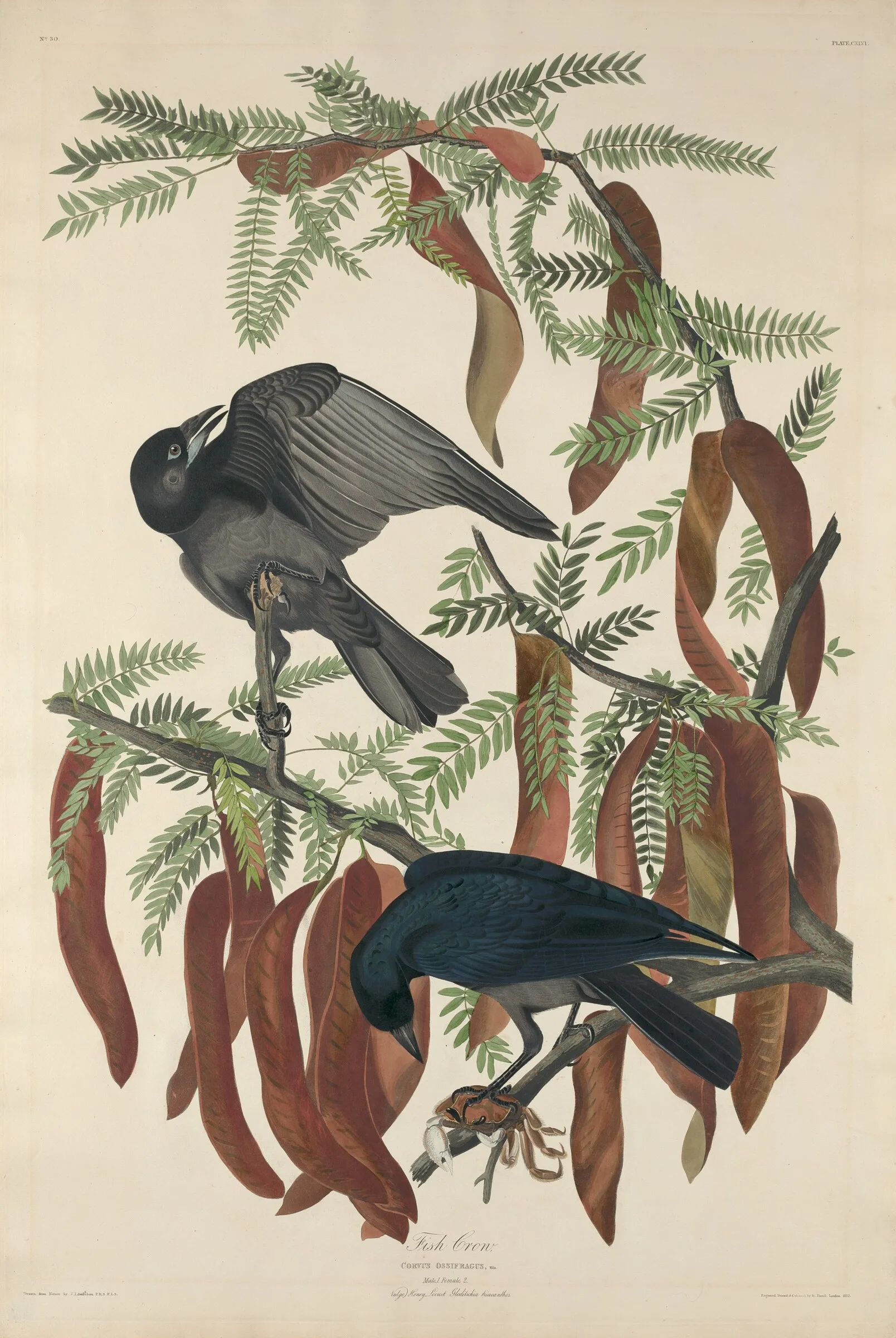
Fish Crow (Plate 146)
Audubon's “Fish Crow”, The Birds of America, plate CXLVI
Click or press Enter to enlarge
Open the full-resolution image (4709 px, National Gallery of Art)
| Plate | 146 (CXLVI) |
|---|---|
| Audubon's name | Fish Crow |
| Modern name | Fish Crow |
| Scientific name | Corvus ossifragus |
| Status | Least Concern |
| Engraved by | Robert Havell, after Audubon's watercolor |
| Date | 1832 |
| Medium | Hand-colored engraving and aquatint on Whatman wove paper |
| Collections | Songbirds |
| This impression | National Gallery of Art, Washington, 1945.8.146; Gift of Mrs. Walter B. James |
About this plate
Plate 146 shows a male and a female Fish Crow. The species looks almost exactly like the American Crow but is slightly smaller, and Audubon's text stresses behaviour and habitat rather than plumage.
Audubon used Wilson's name Corvus ossifragus, which is still current. Wilson described the species in 1812. In the field it is best separated from the American Crow by its call, a nasal, short uh-uh or car.
The Fish Crow lives along the Atlantic and Gulf coasts and up major rivers of the eastern United States. Over the last century it has spread inland and north, and it now winters and breeds well away from the coast in many states. It eats fish, crabs, eggs, fruit and scraps. It is listed as Least Concern, though West Nile virus caused local declines.
Audubon wrote that it was the one blackbird in the United States that people did not persecute, because they thought it harmless. He described flocks living around towns and cities on the southern coast, walking along pools and rivers and entering gardens for fruit. He noted that some went up the Delaware and the Mississippi and that a few bred in New Jersey each year.
In Audubon's words
You would suppose it fully aware of its privileges, were you to witness the liveliness of its motions, and to listen to its continued chatter. While the Raven and the Common Crow are ever on the watch to escape the effects of the enmity which man harbours towards them, the Fish-Crow pays little attention to him as he approaches, and even enters his garden to feed on his best fruits. Hundreds are seen to alight on the trees near the towns and cities placed along our southern shores; many fly over or walk about the pools and rivers, and all pursue their avocations without apprehension of danger from the lords of the land.
John James Audubon, Ornithological Biography, vol. 2 (1834), “The Fish-Crow”. Read the full chapter.



