Common Nighthawk (Plate 147)
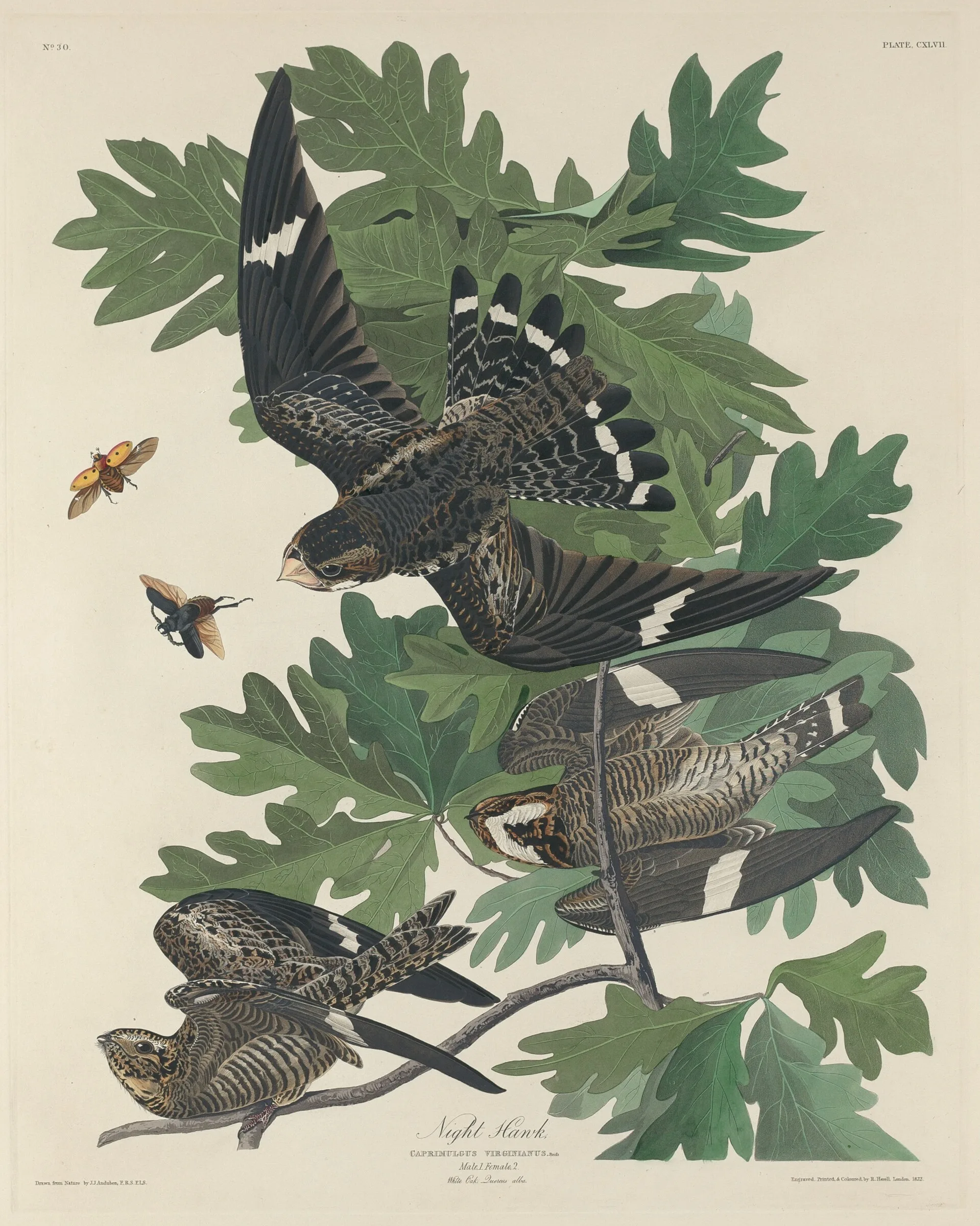
Audubon's “Night Hawk”, The Birds of America, plate CXLVII
Click or press Enter to enlarge
Open the full-resolution image (3197 px, National Gallery of Art)
| Plate | 147 (CXLVII) |
|---|---|
| Audubon's name | Night Hawk |
| Modern name | Common Nighthawk |
| Scientific name | Chordeiles minor |
| Status | Least Concern |
| Engraved by | Robert Havell, after Audubon's watercolor |
| Date | 1832 |
| Medium | Hand-colored engraving and aquatint on Whatman wove paper |
| Collections | Songbirds |
| This impression | National Gallery of Art, Washington, 1945.8.147; Gift of Mrs. Walter B. James |
About this plate
Plate 147 shows a male and a female Common Nighthawk. The birds show the long pointed wings with a white bar across the primaries, and the male's white throat and tail band. Audubon noted that nighthawks perch lengthwise along branches.
Audubon used Brisson's name Caprimulgus virginianus, placing it with the whip-poor-wills. It is now Chordeiles minor. Despite its name it is not a hawk but a nightjar. Audubon himself pointed out that the name is misleading, since the bird is often active by day and goes to rest soon after dark.
The Common Nighthawk breeds across most of North America and winters in South America, making one of the longest migrations of any North American bird. It nests on bare ground, rock and gravel roofs, and males make a booming sound with their wings at the bottom of a display dive. Numbers have fallen, but it is listed as Least Concern.
Audubon wrote that nighthawks pass through Lower Louisiana in early April, that none breed there, and that the autumn return lasts from mid-August to late October as they feed over cotton fields, prairies and rivers. He described them alighting on city trees and chimney tops and squeaking, to the surprise of people below. He saw them in New Brunswick and Nova Scotia but not in Newfoundland or Labrador.
In Audubon's words
The Night-Hawk has a firm, light, and greatly prolonged flight. In dull cloudy weather, it may be seen on the wing during the whole day, and is more clamorous than at any other time. The motions of its wings while flying are peculiarly graceful, and the playfulness which it evinces renders its flight quite interesting. The bird appears to glide through the air with all imaginable ease, assisting its ascent, or supporting itself on high, by irregular hurried flappings performed at intervals, as if it had unexpectedly fallen in with its prey, pursued, and seized it. Its onward motion is then continued.
John James Audubon, Ornithological Biography, vol. 2 (1834), “The Night-hawk”. Read the full chapter.



